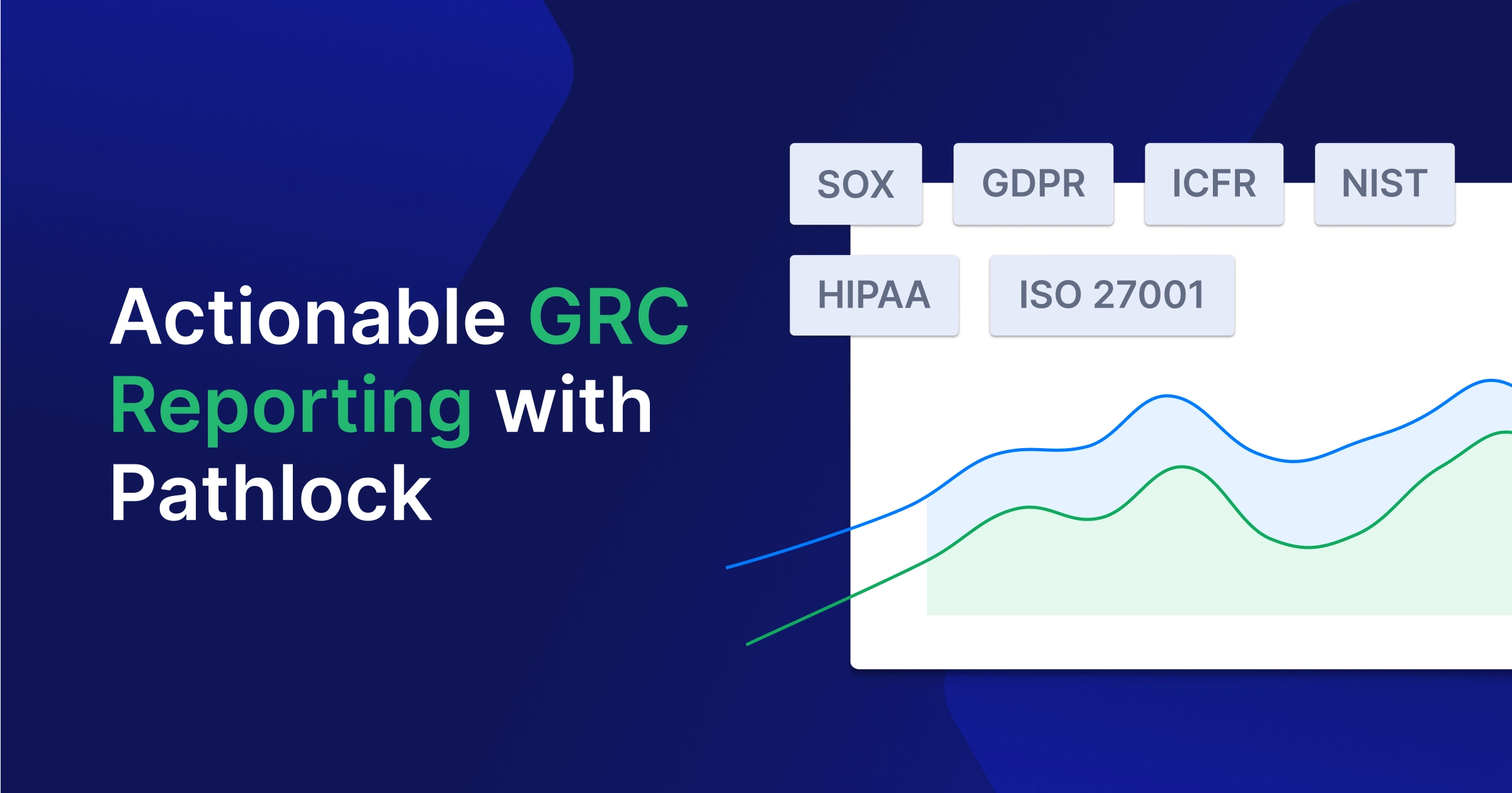

Governance, Risk & Compliance has evolved far beyond a business function. In 2025, it stands as a strategic advantage and an essential requirement for fulfilling complex regulatory requirements and combating cybersecurity threats.
Today’s GRC platforms are no longer static systems. They have transformed into intelligent SaaS ecosystems with embedded automation, continuous monitoring, and direct integration across the enterprise tech stack, including HR, IT systems, and cybersecurity platforms.
Modern GRC solutions break down silos through APIs, connecting with digital infrastructure and automating manual repetitive tasks like evidence collection, control testing, and audit documentation, freeing up teams to focus on strategy rather than paperwork.
Data privacy, operational resilience, third-party accountability, and cybersecurity threats are rapidly changing. Businesses need to manage regulatory compliance requirements using multiple frameworks, oversee global operations, and undergo dozens of annual audits. GRC solutions shine in these demanding scenarios, enabling businesses to streamline processes, reduce audit fatigue, automate evidence collection, and create a culture of transparency and accountability within organizations. GRC tools offer a solution for cross-mapping security controls to manage multiple frameworks and simplify complexity.
The next generation of GRC software is already leveraging advanced technology to offer proactive prediction and strategic capabilities.
- Continuous control monitoring assesses control effectiveness in real-time.
- Predictive risk analytics, with the help of artificial intelligence, assesses existing risks and forecasts emerging ones based on historical data analysis and natural language processing features.
- Regulatory change management scans and interprets new or updated regulations, identifies their impact on existing controls, and suggests policy changes.
The Increasing Need for GRC Tools
The demand for GRC management systems emerged as a reaction to business crises, where a lack of oversight, fragmented risk management, and poor corporate governance led to financial scandals. High-profile failures like Enron in the early 2000s revealed the devastating impact of fraudulent accounting, lack of transparency, and failure of internal controls. With the rise of the digital age, massive data breaches exposed millions of customers’ personal data and proprietary information. Government regulatory agencies faced criticism for inadequate oversight during these financial scandals and data leaks. These events shifted the role of GRC from a compliance checkbox into a strategic discipline for accountability and trust.
Historical debacles and emerging risks forced US regulators to introduce strict regulations, making compliance more complex and non-negotiable.
- One of the most significant regulatory responses was the Sarbanes-Oxley Act (SOX), which strengthened internal controls, requiring documented processes and independent audits for the accuracy of financial statements.
- The Health Insurance Portability and Accountability Act (HIPAA) enforced strict standards protecting sensitive patient data, making IT GRC software necessary for the entire health sector.
Multiple factors are driving these regulatory changes:
- Technological Advancement: The rapid adoption of cloud computing platforms, the impact of artificial intelligence, a distributed remote workforce, and the proliferation of IoT devices are creating new attack surfaces.
- Economic shifts: Globalization and third-party supply chains amplified complexity, regulatory jurisdiction, and third-party risks.
- Societal Demands: Stakeholders focusing on environmental, social, and governance (ESG) factors require companies to expand GRC beyond traditional compliance to include sustainability, human rights, and ethical corporate culture.
The 2008 Recession revealed that:
- Financial institutions underestimated systemic risk.
- Regulators failed to enforce adequate controls.
- Executive compensation structures favored short-term gains.
- Institutions lacked robust models for assessing liquidity risk.
Post-crisis, organizations invested heavily in enterprise risk management (ERM), stress testing, and risk analytics. Regulators introduced strict compliance requirements, including risk reporting, board accountability, and capital adequacy. Industries moved away from fragmented “check the box” compliance towards an integrated GRC framework to consolidate risks, enforce controls, and automate reporting to provide auditable transparency.
What Is a GRC Tool?
A GRC tool is designed to help organizations effectively manage their governance structures, risk management practices, and compliance obligations. It acts as a centralized hub for establishing policies and procedures, identifying and prioritizing risk mitigation plans across the enterprise, and ensuring adherence to laws, regulations, and internal policies.
Core functionalities include:
- Risk assessment: Systematically identify and evaluate potential risks that may impact business objectives.
- Policies analysis: Review and manage organizational policies so that they remain up-to-date, effective, and aligned with both internal goals and regulations.
- Regulatory monitoring: Track and adapt to changes in laws, regulations, and industry mandates.
- Operations streamlining: Automate repetitive processes, integrate compliance activities, and reduce manual workloads to save time and resources.
Modern GRC tools leverage automation and AI to transform how organizations manage compliance and risk. Workflow automation routes tasks, reviews, and approvals for risk assessments, control testing, and incident response. Centralized databases assist in automatic evidence and data collection, further streamlining real-time alert generation and comprehensive reporting.
Pivotal Role of GRC Tools in Business Operations
Top GRC products provide a systematic way to identify potential threats, continuously track key risk indicators (KRIs), and help implement effective strategies to reduce the impact and likelihood of adverse events. They manage the design, documentation, testing, and effectiveness of internal controls to prevent fraud, ensure data integrity, and ensure non-compliance. Maintain a central library of policies and regulatory requirements, track compliance status across business units, and provide an auditable trail.
GRC tools break down organizational silos by unifying risk, compliance, policy management, and audit functions in one centralized system to ensure consistency and accountability. Intuitive dashboards and data-driven analytics offer decision makers complete visibility into enterprise-wide risk, enabling them to manage remediation plans proactively rather than reactively to loss events. By improving accountability, transparency, and clarity in roles and responsibilities, GRC tools ensure that organizations operate ethically and in alignment with strategic objectives.
Top 18 GRC Tools in 2025
The list of the top 18 GRC tools in 2025 is as follows:
- Pathlock
- MetricStream
- AuditBoard
- LogicGate
- ServiceNow
- Archer
- Vanta
- Risk Cognizance
- Workiva
- Corporater
- DigitalXForce
- StandardFusion
- Ascent AutoResilience
- Diligent One Platform
- IBM OpenPages
- Onspring
- Protecht ERM
- ZenGRC
Pathlock
Pathlock is a unified platform for identity security, access governance, and continuous compliance, designed to help enterprises eliminate complexity and risk across their application landscape. It provides a holistic approach to GRC to protect data, streamline compliance, and improve operational resilience.
In 2025, Pathlock continues to redefine how companies approach GRC. The platform goes far beyond traditional GRC silos by unifying identity security and application controls into one system. Pathlock integrates with SAP, Oracle, Workday, and other critical enterprise systems. It enables companies to manage compliance in real time by automating evidence collection, role design, compliance provisioning, and risk analysis. It reduces manual workloads while improving visibility and trust across the enterprise.
Application Access Governance
Pathlock Application Access Governance (AAG) solution is a core component of its GRC platform, specifically designed to automate and enforce policy-driven access controls across business-critical applications. It ensures that the right users have the right access at the right time.
Key highlights:
- Automated policy-based access enforcement
- Temporary privileged access with automatic revocation.
- Real-time monitoring and reporting for audit readiness
- Unified view of access across SAP, Oracle, and other systems.
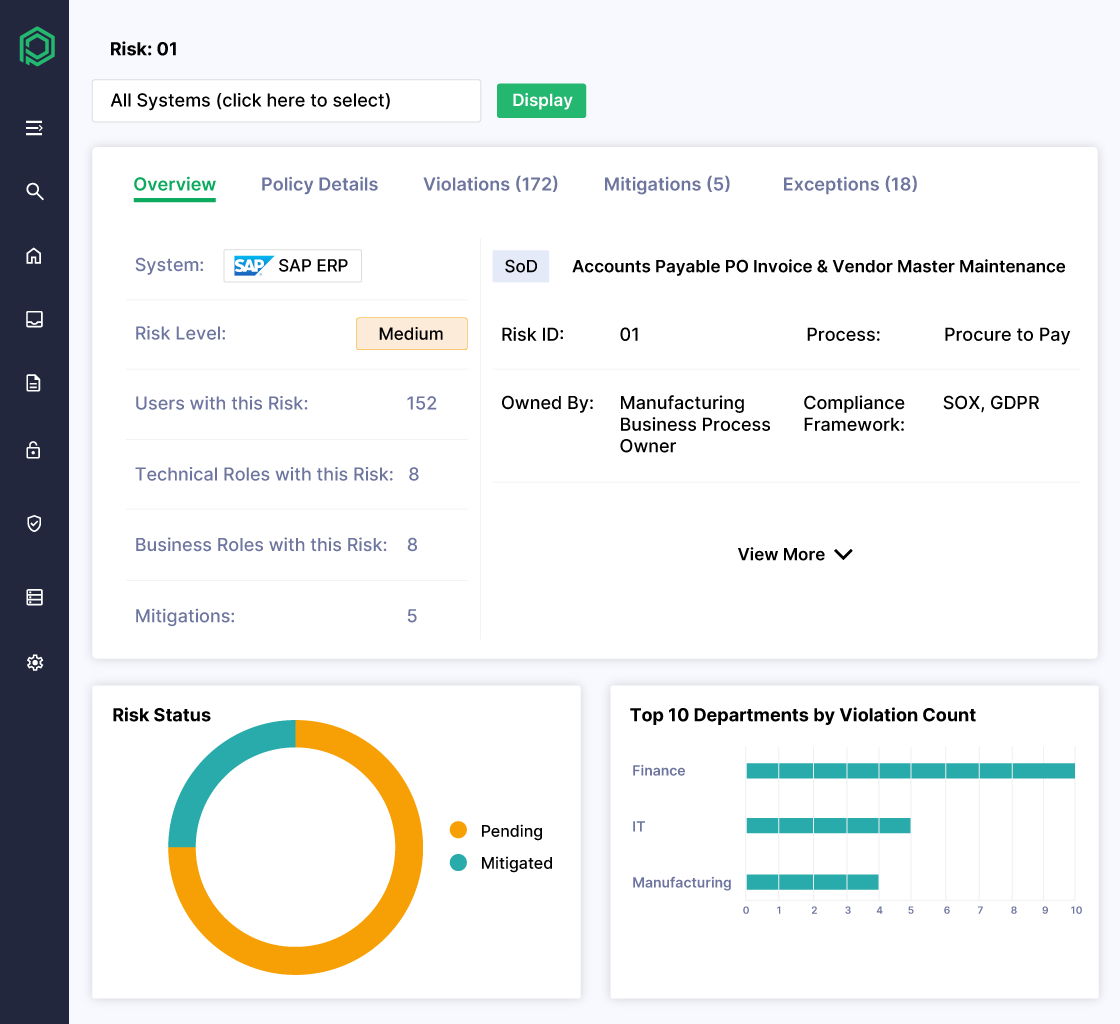
Access Risk Analysis
- Identify and assess risk associated with user permissions & roles
- Manage segregation of duties (SoD) for all critical business applications.
- Get end-to-end visibility and control by uncovering risks across the entire application ecosystem, rather than focusing solely on a single application.
- Analyze risks at the permission level to reveal actual risk exposure and include comprehensive, out-of-the-box rules tailored to common use cases in leading business applications.
- Simplify tracking remediation progress, risk scores, and audit preparation with customizable dashboards and reports.

Demo
Compliant Provisioning
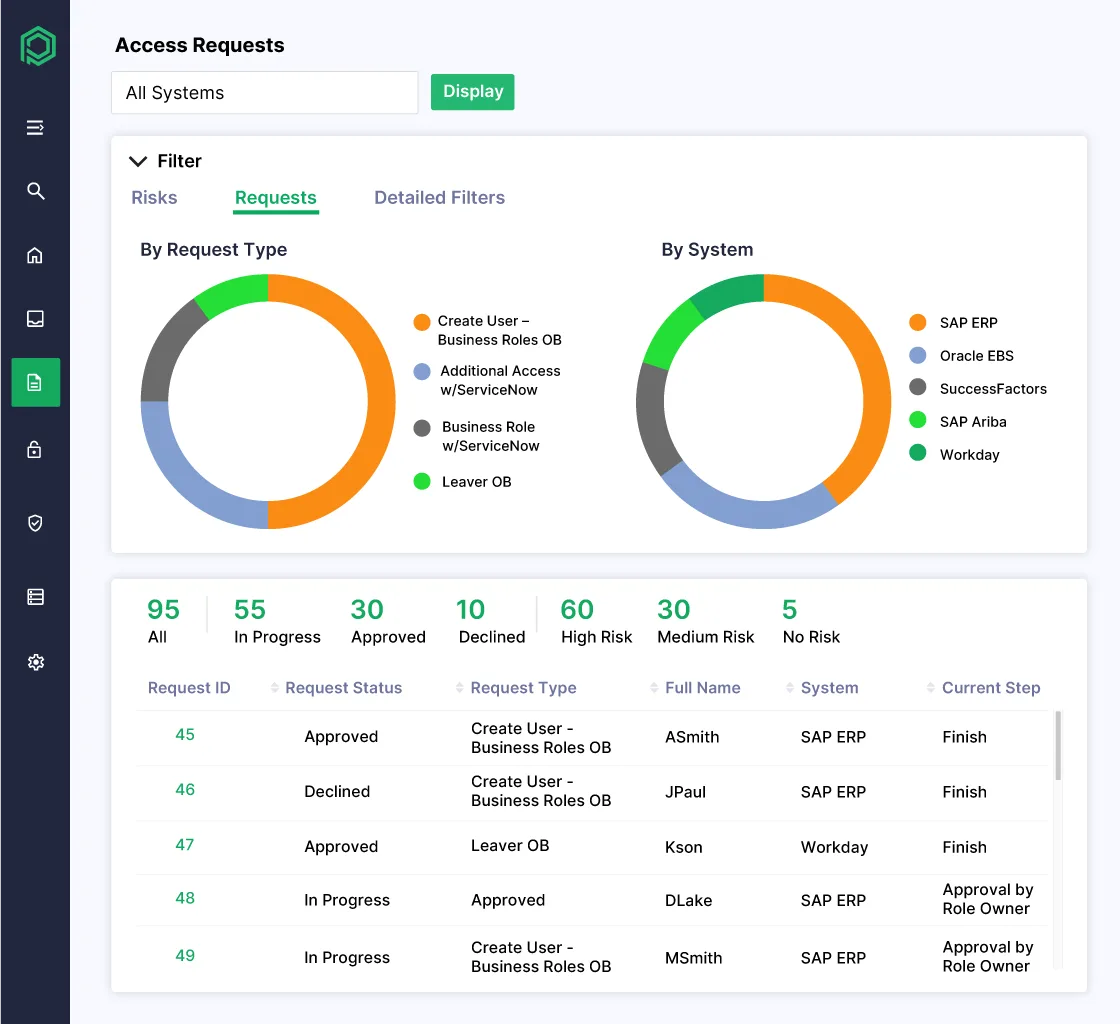
- Automate user lifecycle from onboarding, management, and offboarding to ensure that user access is efficiently maintained in accordance with regulatory compliance.
- Simplify and standardize access granting across all applications with consistent rules and workflows for all types of users, including employees, contractors, and third parties.
- Maintain a complete audit trail for every provisioning action to support regulatory compliance.
- Configure provisioning workflows to fulfill unique processes, policies, and organization structure with customizable approval paths based on user types, application, or risk level.
Demo
User Access Review
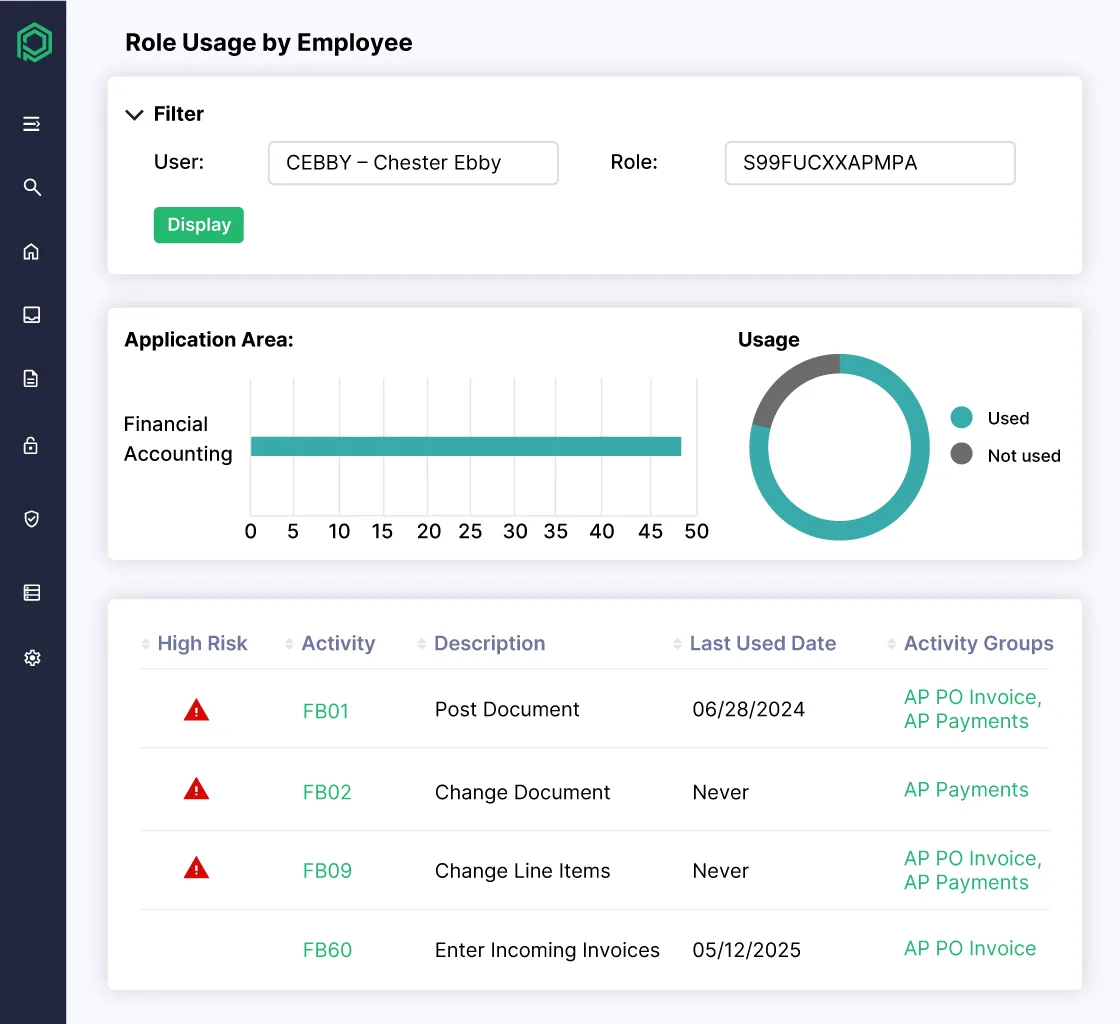
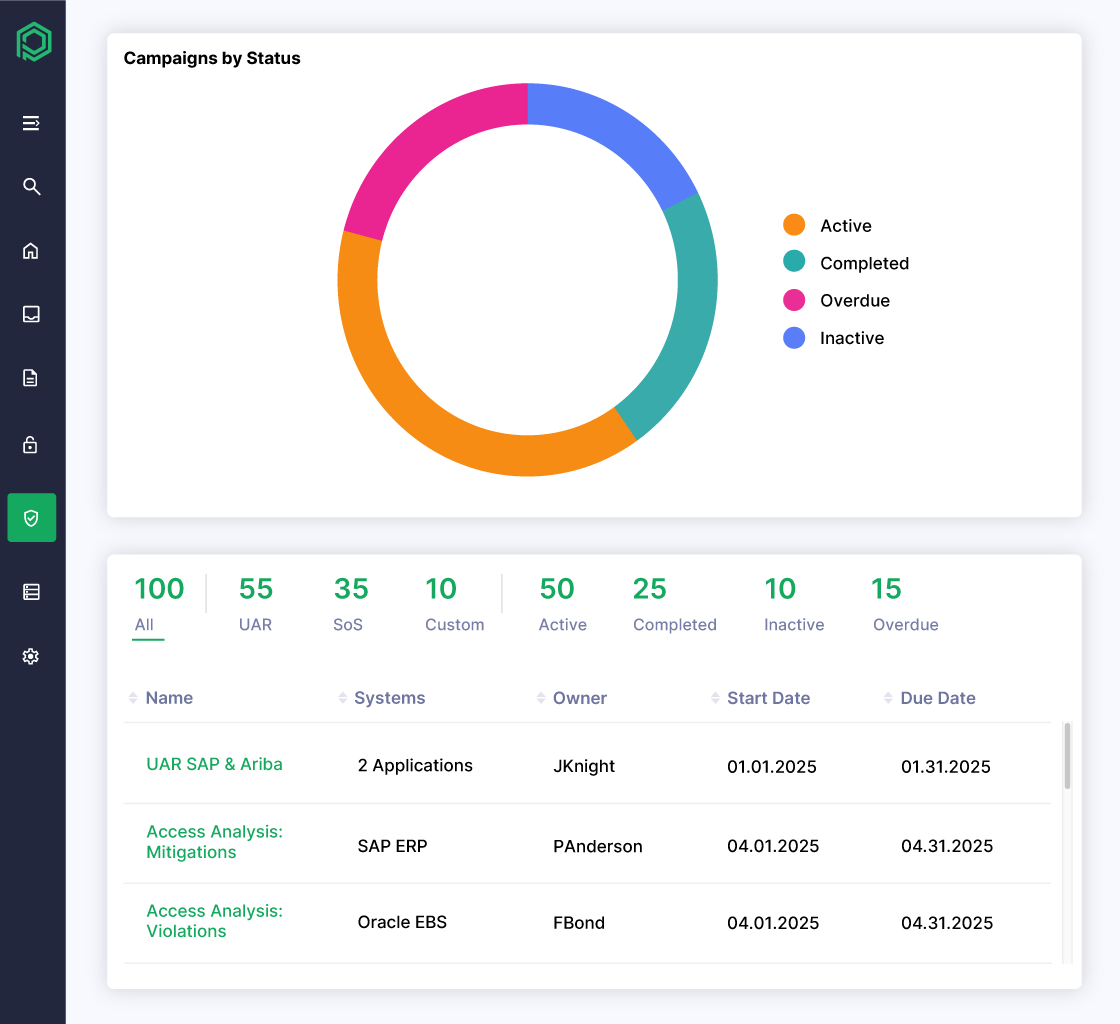
- Detect SoD conflicts, prioritize high-risk users, and leverage HR data for faster reviews.
- See what users actually did, eliminate unused access, and enforce least-privilege policies.
- Manage all access certifications across enterprise systems with automated workflows and dashboards.
- Empower reviewers with a clear context and audit-ready visibility.
Demo
Elevated Access Management
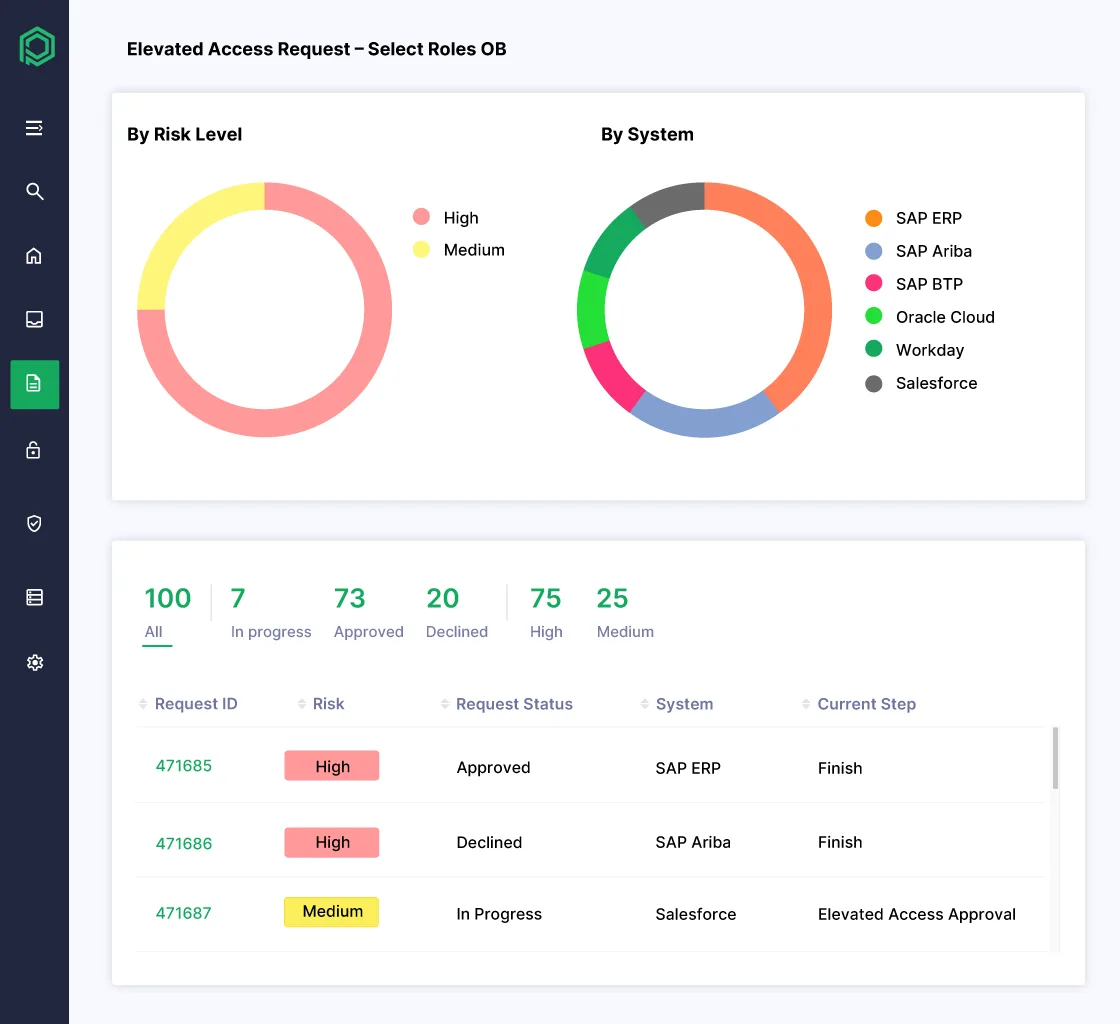
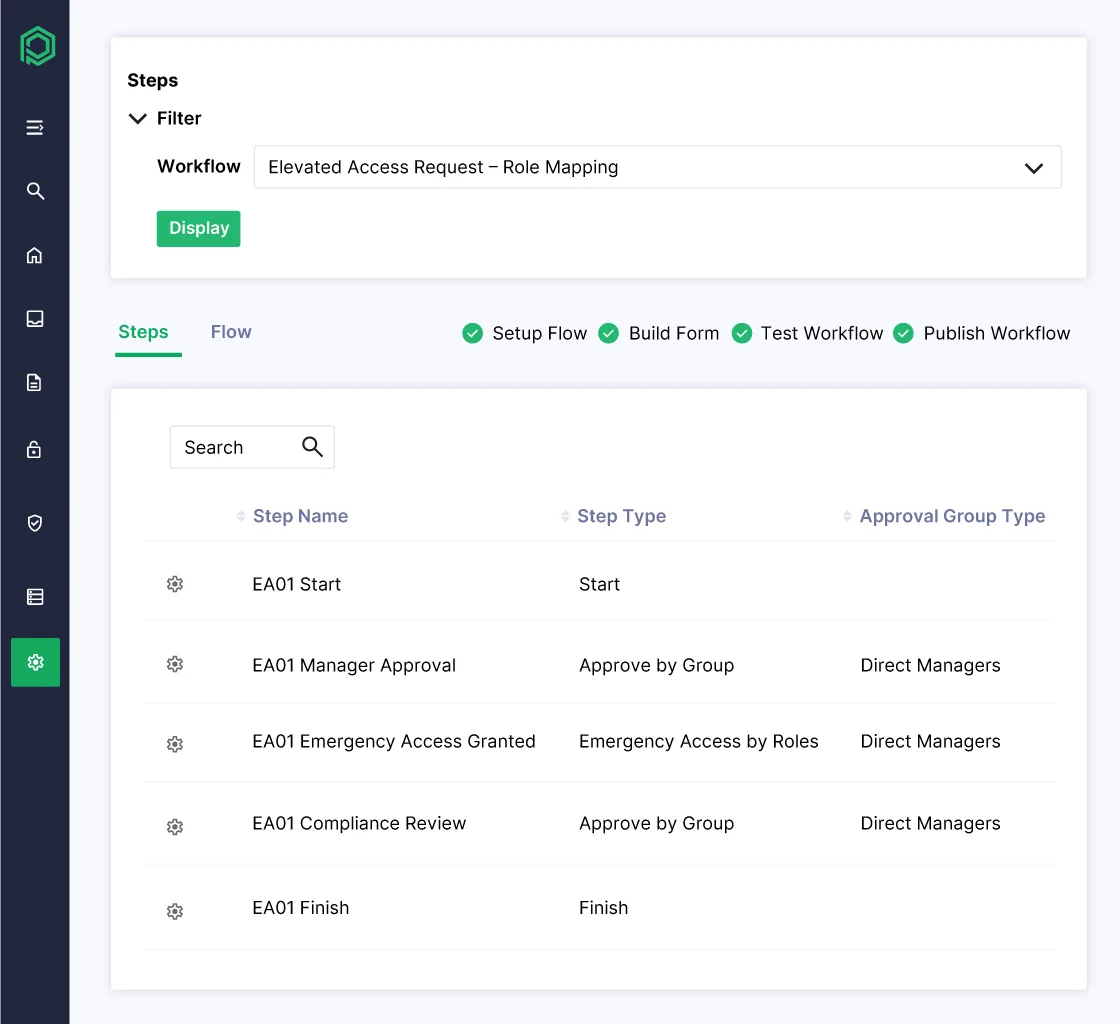
- Grant elevated permissions only when needed and automatically revoke them, reducing standing privileges and meeting audit requirements.
- Capture who requested and who approved access, see all actions taken during privileged sessions with full traceability for SAP, Oracle, Workday, and more.
- Route requests through configurable processes (role-based, ID-based, multi-step) while detecting SoD conflicts and sensitive-access risks before approval.
- Manage all elevated-access activity in one platform with an intuitive interface for requesters, approvers, and compliance teams, supported by unified dashboards and reporting.
Demo
Role Management
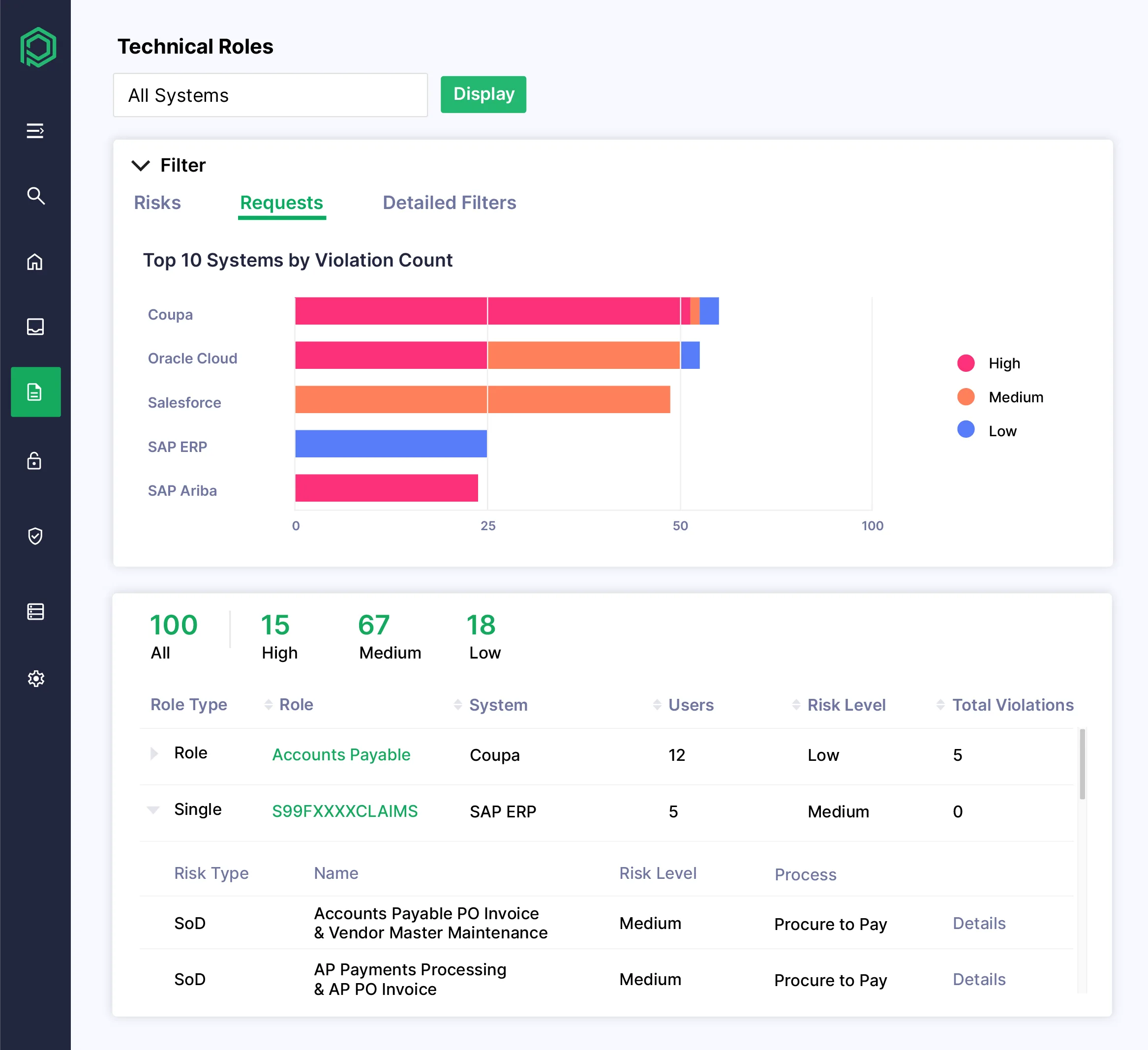
- Automated, policy-aware role management to help organizations create and maintain business or technical roles that are compliant, efficient, and aligned with business needs.
- Fine-grained SoD and sensitive access analysis are directly embedded into the role design process to identify and eliminate risks before roles are deployed.
- Consolidates role management in one centralized platform, where roles can be designed and reused across SAP, Oracle, and Workday.
- Automatically generates documentation, standardizes workflows, and approval mechanisms across all systems. Detailed reporting throughout the role lifecycle helps the team monitor role quality, usage, and compliance over time to ensure that every access decision-making is backed by data.
Demo
Continuous Controls Monitoring
The Pathlock Continuous Controls Monitoring (CCM) module is designed to transition organizations from periodic, manual audits to automation and continuous monitoring of business processes and financial controls, reducing risks and enforcing compliance. CCM focuses on automating the detection of control failures, quantifying the economic impact of risks, and continuously tracking changes within core business applications. This approach maintains data integrity and operational effectiveness while simplifying audit preparation through evidence collection.
Demo
Control Management
- Define, document, and maintain key controls from various frameworks within a centralized repository.
- Business process controls, derived from various regulatory and compliance frameworks, get aligned across diverse operations to ensure consistency, reduce duplication, and improve visibility into control performance.
- Automation increases the efficiency of execution and monitoring while also reducing the risk of errors, continuous testing, and evidence collection required for compliance.
Risk Quantification
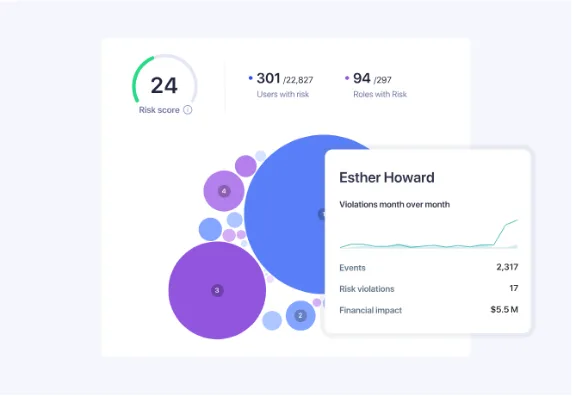
- Analyzes the transaction data within business applications to quantify the financial exposure of SoD conflicts and identify the monetary risk and impact on the business.
- Real-time risk quantification enables security and audit teams to focus on the few risks that have a material financial impact on the organization, rather than an overwhelming list of violations. For any flagged violation, the system provides transaction details, including the username, time, application, and associated financial value, to facilitate prompt investigation and remediation.
Change Monitoring
- Continuously tracks and logs all modifications to application configurations and master data that could affect control effectiveness. It captures detailed information about each change, including who made it, where it originated, and the precise before and after data values.
- Monitoring covers every type of change, whether records were added, updated, or deleted, providing a comprehensive audit trail.
Cybersecurity Application Controls
The Pathlock Cybersecurity Application Controls (CAC) suite is designed to reduce operational security burdens by combining preventive and detective controls to safeguard SAP systems and sensitive data without unnecessary complexity.
Vulnerability Management
- Automates vulnerability scanning and audit campaigns to reduce manual effort in detecting known vulnerabilities, misconfigurations, and missing security patches.
Code Scanning
- Analyzes custom ABAP and UI5 code to detect insecure code patterns and vulnerabilities.
- Leverages over 150 out-of-the-box, customizable checks to keep code secure, eliminating manual code scanning and providing actionable guidance to fix the identified issues quickly.
Transport Control
- Enables continuous monitoring and blocks transports containing critical change packages that carry sensitive configurations, code, or critical objects.
Threat Detection
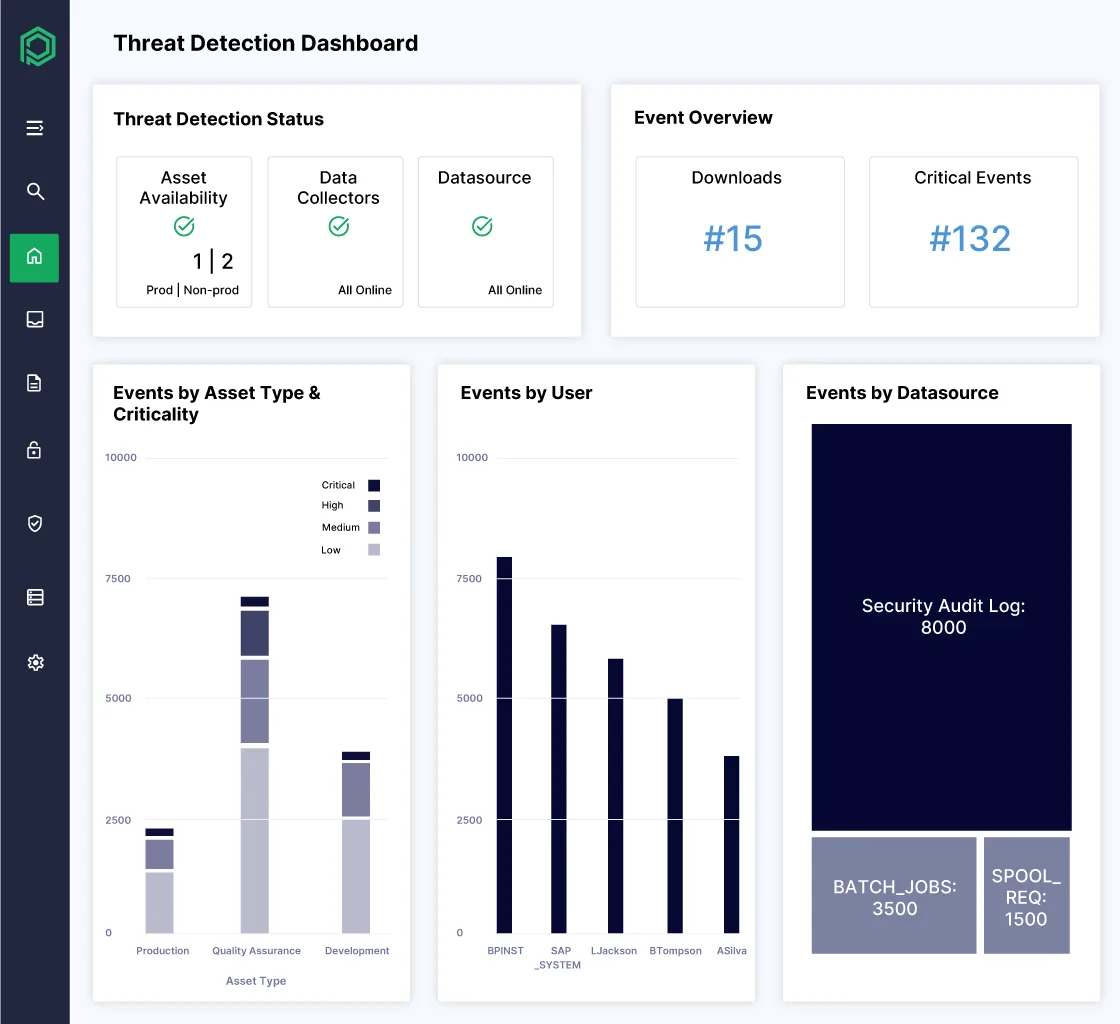
- Provides continuous monitoring through logs, events, and system behavior analysis with more than 1500 threat detection signatures. When a threat is detected, it gives context and severity, suggesting responses to help the security team handle threats at scale
- Integrates with existing SIEM systems for enterprise-level correlation.
Application Profiler
- Provides a technical flow of customer transactions in custom applications and identifies compliance issues. How data flows through custom applications, captures the sequence of operations and dependencies, tracks code changes, and notifies approvers in security and compliance teams.
MetricStream
Overview
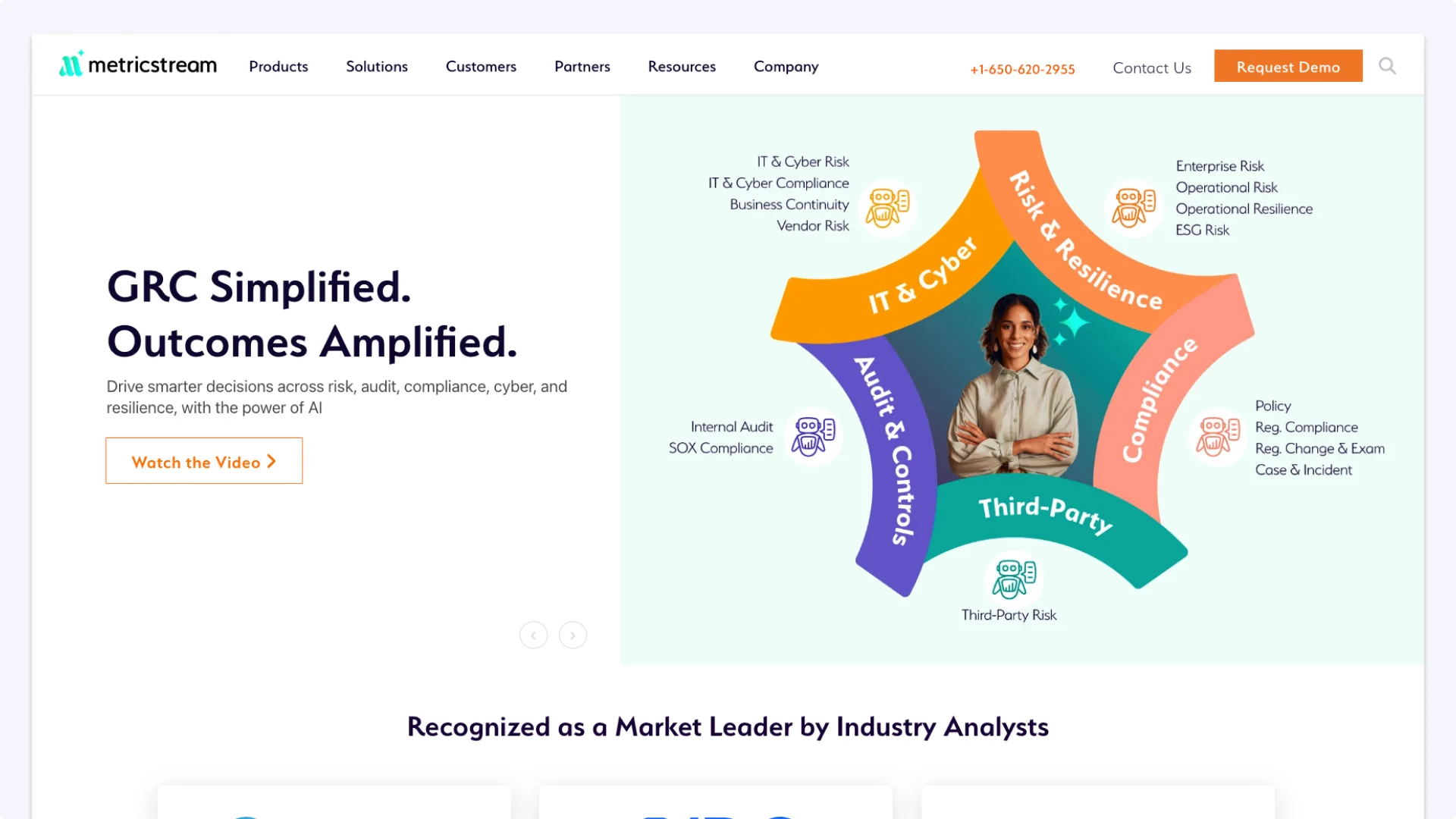
MetricStream provides integrated solutions for governance, risk, and compliance (GRC) through its connected GRC approach, which includes three main product lines: business GRC, CyberGRC, and ESGRC.
- Supports enterprise-wide risk and compliance functions such as enterprise risk management (ERM), operational risk management (ORM), cyber & IT risk management, and environmental, social & governance (ESG) risk management.
- Features include AI-powered capabilities, advanced risk analytics, and simplified regulatory automation.
Key Features
Risk Management
- Centralized risk repository for enterprise and operational risks.
- Supports capturing and tracking loss events and incidents, conducting risk control self-assessments, and evaluating control effectiveness.
- Provides risk assessments with risk scores, weights, quantitative and qualitative models, heat maps, risk trends, and analytics to monitor risk exposure over time.
Compliance Management
- Unified framework for managing compliance requirements
- Enables continuous monitoring, real-time compliance reporting, and regulatory change management integration with policy management.
Policy Management
- Integrates policies and documentation into a centralized policy portal.
- Streamlines policy collaboration with version control, review, attestation, and approval workflows, publication, and archiving capabilities.
Case Management
- Facilitates organizations in establishing consistent procedures for case and incident planning, tracking, and administration.
- Captures and classifies incidents based on pre-defined criteria.
- Triage teams can determine the threat level, assign them to relevant owners with remediation tasks, and track the status of action items, due dates, and trigger reminders or escalations.
Audit Management
- Supports an agile internal audit program to define auditable entities such as business units, functions, processes, and shared risk libraries.
- Enables dynamic audit plans with defined objectives, workpapers management, and collaborative findings review.
- Provides real-time dashboards with audit data, history, and analysis of audit results.
IT & Cybersecurity risk management
- Centralized repository automates assets, threats, and vulnerability management with the ability to map IT assets to threats and vulnerabilities along with associated details such as description, category, hierarchy, and ownership using industry-standard frameworks such as ISO 27001 and NIST.
- Delivers visibility into risks, threats, and vulnerabilities with built-in dashboards and customizable risk reports.
ESG Management
- Enables ESG data collection, disclosure requirements from various ESG frameworks, including SASB, TCFD, and optimizes the process with automated reporting.
- Automatically capturing data for environmental, social, and governance metrics allows organizations to define custom calculation logic, aggregate metrics, and analyze data from dashboards and comprehensive reports.
AuditBoard
Overview
AuditBoard is a cloud-native “connected risk” platform that unifies audit, risk, compliance, IT risk, ESG, and third-party processes with multiple interconnected solutions. The platform provides a connected, AI-powered approach to streamline governance, risk, and compliance processes across the enterprise.
Key Features
SOXHUB
This module focuses on managing SOX compliance with ease and precision, all within a single connected risk platform. Automates control test execution, evidence collection by linking evidence to control steps, role-based dashboards, and permissions ensure that control owners, reviewers, and auditors see what’s relevant to them.
OpsAudit
Provides an all-in-one audit solution to identify and prioritize key risks on one platform, optimize testing and field work, and offers no-code audit analytics for the advanced control and efficiency the team needs. Auditboard automates evidence requests, follow-up, and request tracking, making it easy to create, send, and monitor the status of document requests.
TPRM
A third-party risk management solution that provides a central repository that automates vendor onboarding, assessment with profile data, and risk categorization.
ITRM
This module brings together information security, compliance, and IT risk management to assess cybersecurity risk, quantify threats, and align IT controls with business objectives and regulatory compliance.
Riskoversight
A centralized Enterprise Risk Management (ERM) tool that allows organizations to capture, assess, aggregate, and monitor risk across multiple domains such as operations, finance, and IT. The system simplifies collaboration with an intuitive interface, allowing both stakeholders and frontline employees to easily add risks and associated ratings, manage action plans, and efficiently use built-in workflows.
CrossComply
AuditBoard’s compliance framework and policy management module provides a unified compliance control environment, cross-framework mapping, evidence collection, and real-time reporting.
LogicGate
Overview
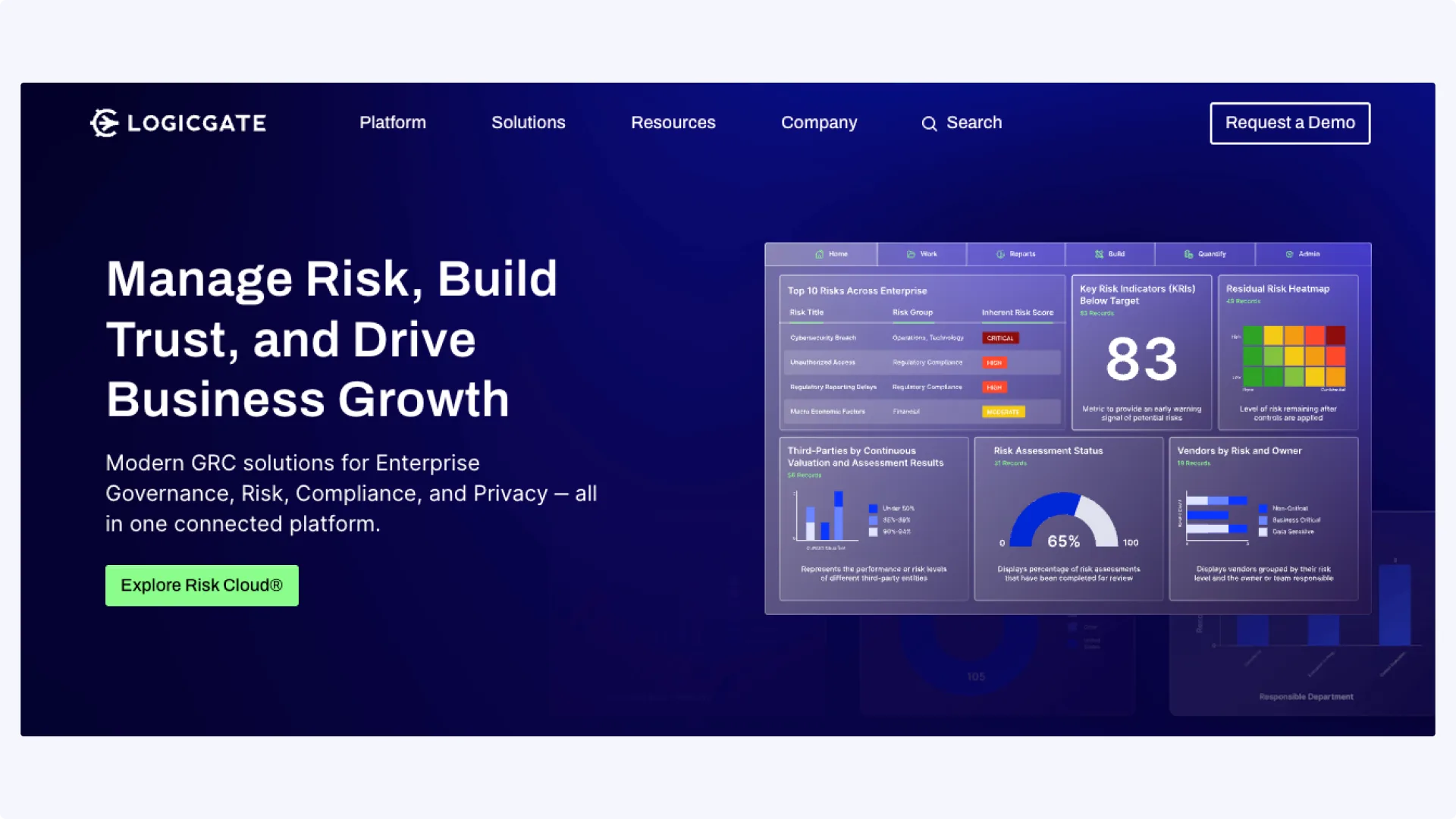
LogicGate is a global software-as-a-service (SaaS) company that offers a comprehensive governance, risk, and compliance (GRC) platform with its cloud-based services, Risk Cloud. It combines a suite of modular applications designed to address specific challenges, streamlining governance, mitigating risks, and ensuring regulatory compliance with real-time reporting and automation features.
Key Features
Enterprise Risk Management (ERM)
It provides a centralized risk register to manage enterprise risks, automates workflows for risk assessments, and tracks mitigation efforts. Continuous monitoring and alerts for significant risk changes allow organizations to respond quickly to emerging threats.
Cyber Risk Management
This system offers a unified view of all cybersecurity threats with integrated data that enables real-time insights and helps data security teams stay ahead of emerging risks. A centralized view of assets and cyber risks allows administrators to identify risk assets quickly, prioritize responses using integrated tools, and tailor reports and dashboards to enhance stakeholders’ engagement.
Regulatory compliance
Specially designed module reduces regulatory risk by linking tasks to controls, policies, and procedures while automating change management, assessments, and remediation workflows. Ensures ongoing compliance through continuous auditing and monitoring, while identifying potential risks related to non-compliance.
Control compliance
This product manages the lifecycles of compliance controls from definition, testing, monitoring, to enforcement and enhancements. The system offers pre-built dashboards and reports to track control, audit status, and effectiveness, sharing key metrics with stakeholders.
ServiceNow
Overview
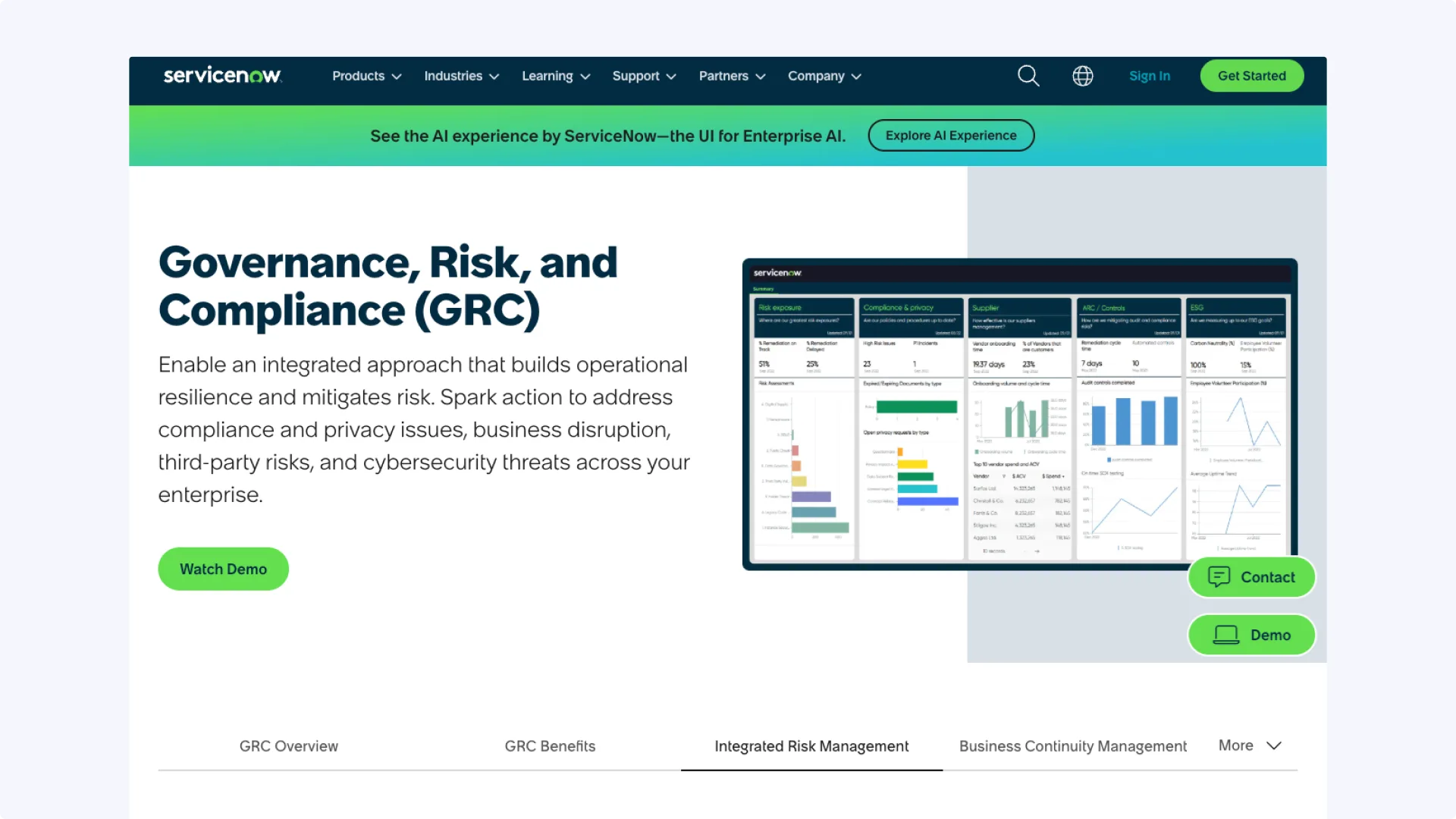
ServiceNow Integrated Risk Management Tools transforms manual and inefficient processes across the enterprise into an integrated, resilient risk program built into a single platform. ServiceNow IRM suite connects risk management to daily business operations; instead of reacting to issues, organizations can continuously monitor data, identify emerging risks, and automate remediation tasks. GRC tools can leverage ServiceNow AI platform capabilities like workflow orchestration, role-based workspaces, mobile access, reporting, and analytics to enforce risk mitigation and compliance.
Key Features
Policy and Compliance Management
Enable organizations to automate the creation and management of policies and procedures through collaborative workflows with a review and approval process. Automate control testing with compliance indicators, thresholds, or recurring assessments to continuously test controls and flag failures in real-time. When control failures or violations are detected, issues are automatically generated, assigned to respective teams, and tracked using AI.
Risk Management
A centralized risk register with real-time tracking captures all enterprise risks across business units and assets. Monitors critical risks and controls continuously to quickly identify risk posture changes, and comprehensive risk reporting identifies and presents vital information in a single place.
Virtual Agent
An AI-powered conversational chatbot helps employees identify steps in complex procedures, make requests through a virtual agent to trigger automated workflows, and report risk assessments.
Audit Management
The audit engagement lifecycle streamlines the process of creating audit plans, selecting auditable entities, defining scope, and scheduling audits with resource allocation. Automates evidence collection requests, uses AI to prioritize and assign issues to the right people for efficient resolution.
Archer
Overview
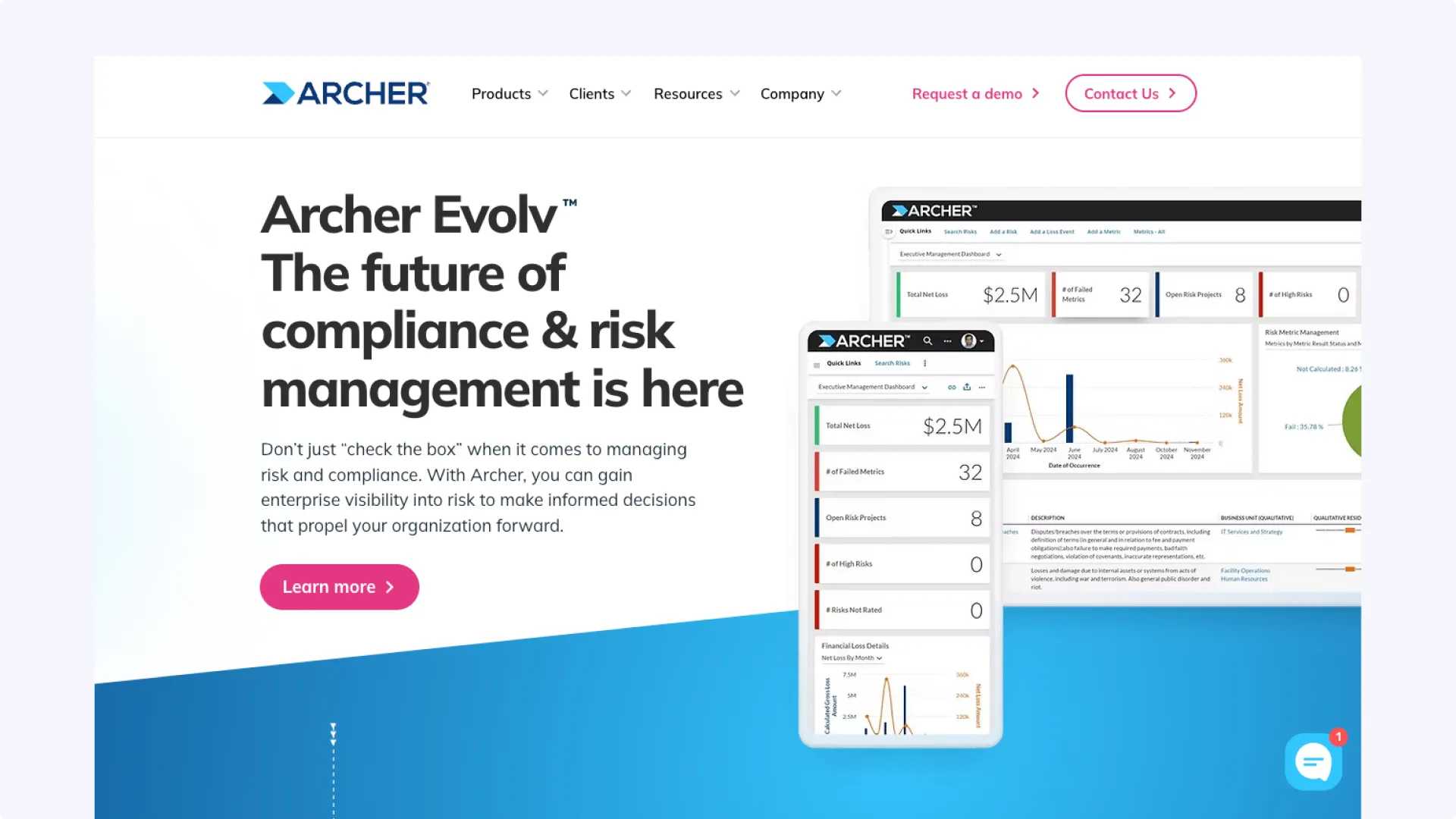
Archer offers a suite of GRC tools designed to help enterprises manage risk, meet compliance obligations, and improve business performance by providing integrated visibility into risk and automated workflows. Archer delivers a centralized foundation for managing policies, controls, and risks by combining data analysis across the organization and its third-party ecosystem, providing a holistic view of risk management.
Key Features
Evolve Compliance
- Brings together the scattered information throughout the organization into a centralized platform,
- Provides AI-powered horizon scanning to monitor 2000+ regulatory sources to categorize, version control, and create a unified obligation catalog as a single source of truth for all regulatory and non-regulatory requirements.
Evolve Risk
- Provides a unified risk management solution covering enterprise risk, operational risk, IT, and third-party risk to simplify assessments with quantitative insights and analytics.
AI Governance
- Archer AI Governance is designed to help organizations adopt AI in a responsible and compliant way, adhering to the EU AI Act to manage risk, policies, and compliance reporting.
ESG Management
- Collect and report ESG data, reduce ESG-related risks, predict ESG performance, and integrate with over 100 standards across ESG frameworks.
Vanta
Overview
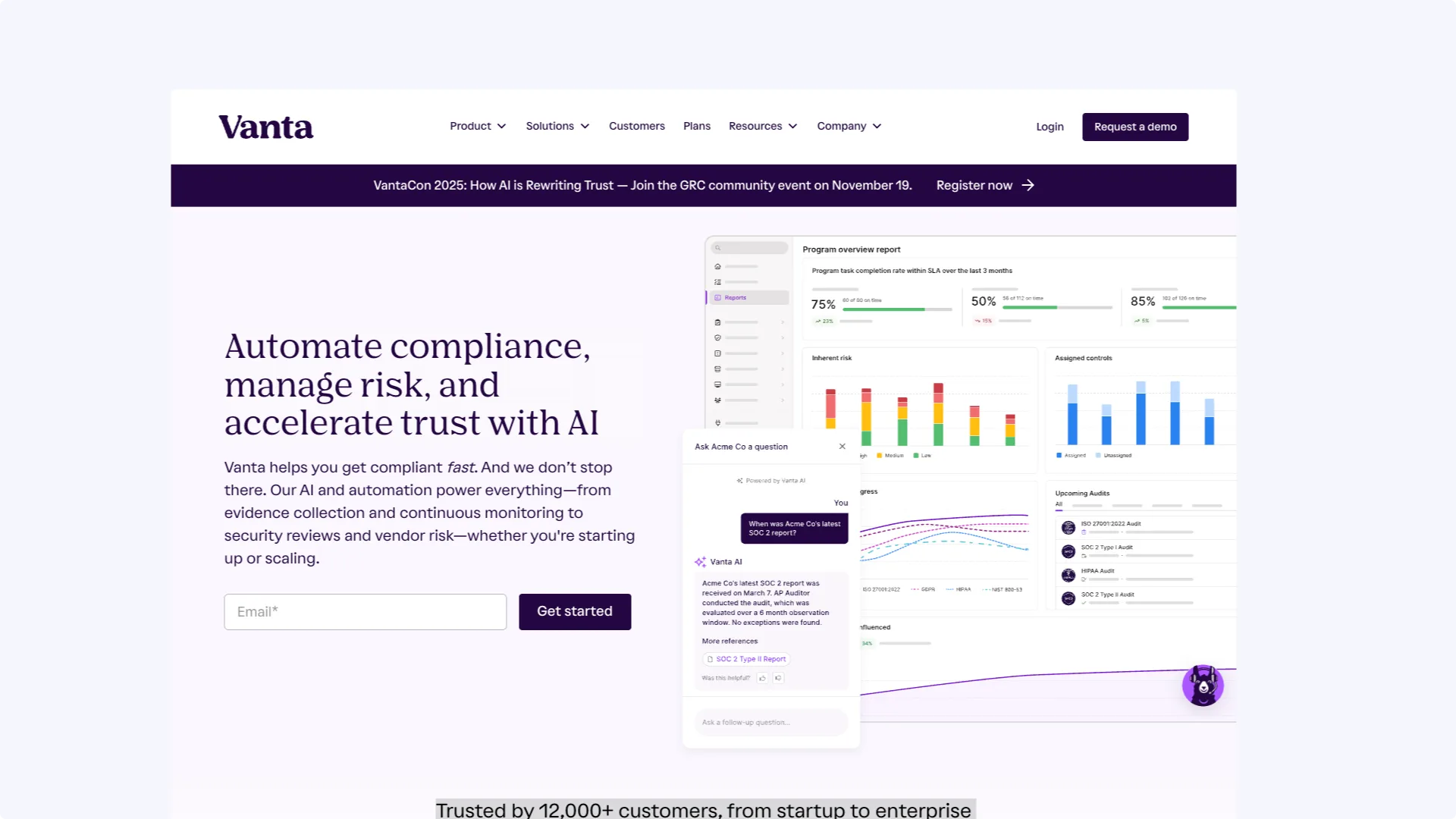
Vanta is an AI-powered trust management platform that helps businesses automate compliance and risk management required for renowned frameworks such as SOC 2, ISO 27001, HIPAA, and GDPR. Vanta emphasizes “continuous GRC,” not just point-in-time audits, but ongoing monitoring and real-time visibility into the effectiveness of controls.
Key Features
Automated Compliance
- Supports 35+ leading security frameworks, and organizations can cross-map controls across existing frameworks to automate controls monitoring and evidence collection.
- Real-time alerts notify control owners when test fails and can assist with AI-generated code snippets to suggest remediation steps for the issue.
Risk Management
- Simplifies and automates risk processes with comprehensive workflows for risk assessment, review, and approval.
- Provides a centralized risk register with a pre-built library of 100+ common risk scenarios and suggested control mappings.
- Integrated with task-tracking systems like Jira, GitHub, and Asana to assign action items in Vanta, while teams continue working where they are already working.
Streamlined Audits
- Provides a secure, centralized platform for auditors to access pre-collected, up-to-date evidence to reduce manual file transfer.
- Enables direct, real-time collaboration between the company and auditors with features to comment directly on evidence, track evidence requests, choose which data to share with auditors to protect privacy, and log, track, and resolve issues all within one tool.
Vendor Risk Management
- Automatically identifies all vendors and detects shadow IT software
- Continuously monitors the attack surface of vendor products to build a real-time view into vendor risk.
- AI to analyze documentation, pre-built security questionnaire templates to communicate with vendors, and request information.
Risk Cognizance
Overview
Risk Cognizance is an AI-powered Governance, Risk, and Compliance (GRC) cloud-based platform that specializes in serving Managed Security Service providers (MSSPs) and organizations with multiple subsidiaries. It’s architecture supports modular, configurable components, allowing organizations to choose the GRC functions they need, such as compliance, vendor risk management, policy management, and audit management.
Key features
Mult-Tenant GRC platform
- Allows MSSPs to offer GRC as SaaS under their own branding
- Ensures secure data segregation, customized workflows, and specific reporting for each client or business unit.
Policy Management
- Provides a central policy repository to maintain a single up-to-date source for all internal policies, automates policy lifecycle management, and distributes policies to relevant employees or groups to ensure targeted communication.
- Manages policy versions and schedules automated reminders for policy owners for review and attestation.
Compliance Automation
- Supports a wide range of standards, SOC 2, GDPR, HIPAA, and ISO 27001, with controls cross-mapping capabilities.
- Continuously monitors controls, tracks compliance deadlines, and generates real-time alerts for compliance issues or regulatory changes.
- Leverages AI for automating evidence collection, risk scoring, and audit trail generation.
Enterprise Risk Management
- Dynamic risk assessment with automated scoring based on impact and likelihood, replacing periodic reviews with continuous monitoring.
- Features a comprehensive risk register to log, track, and manage all identified risks, along with assignments and tracking of mitigation tasks.
Workiva
Overview
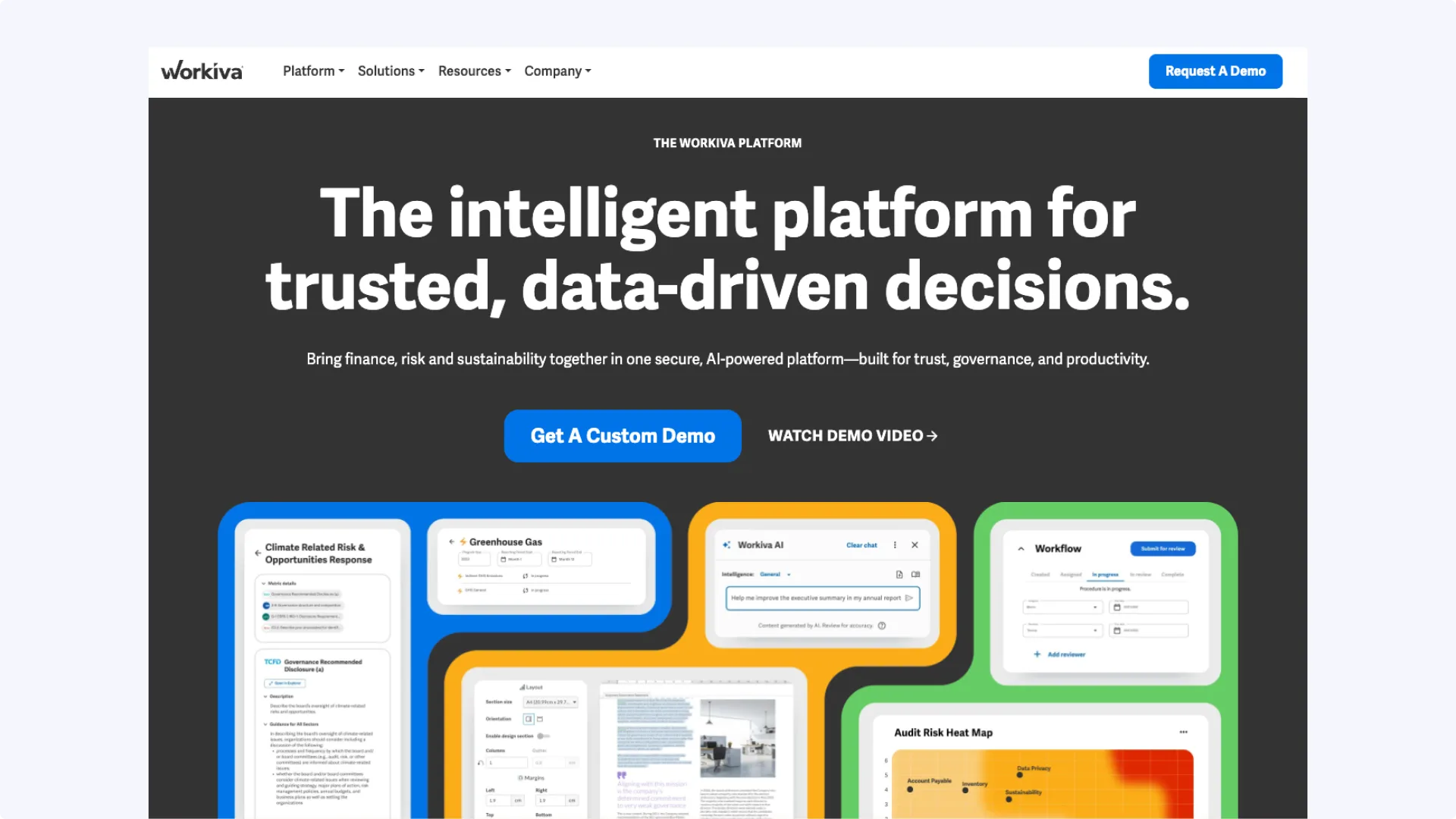
Workiva provides a unified, AI-powered platform for GRC that integrates key processes with financial reporting and ESG management. The platform is designed to connect data and processes, risk assessment and compliance controls, audit, and sustainability into one single source of truth for stronger assurance, faster collaboration, and confidential decision-making.
Key features
Workiva AI
- Automates time-intensive tasks like generating control rationalization reports, drafting process narratives, documenting key processes, and defining steps for control testing.
- AI functions operate within the secure Workiva platform; customers’ prompts or data are not used to train public models.
Unified Reporting
- Workiva platform centralizes financial, non-financial, and GRC data to create a single source of truth for reporting purposes.
- Data linking ensures that when a change is made to the source data, all linked instances across documents, spreadsheets, and presentations are automatically updated.
Data Management
- Enables managing both structured and unstructured data from various sources, using APIs and pre-built connectors to pull data from different source systems, e.g., SAP, Workday, spreadsheets, into a unified platform.
- Provides a clear audit trail with full data transformation versioning, allowing users to track who did what and when.
Intelligent Productivity
- Advanced workflows allow users to automate repetitive tasks like evidence requests, status updates, and generate alerts for reviewers.
- Offers a tailored home page with domain-specific widgets to give users an actionable view of their personal workload.
Corporater
Overview
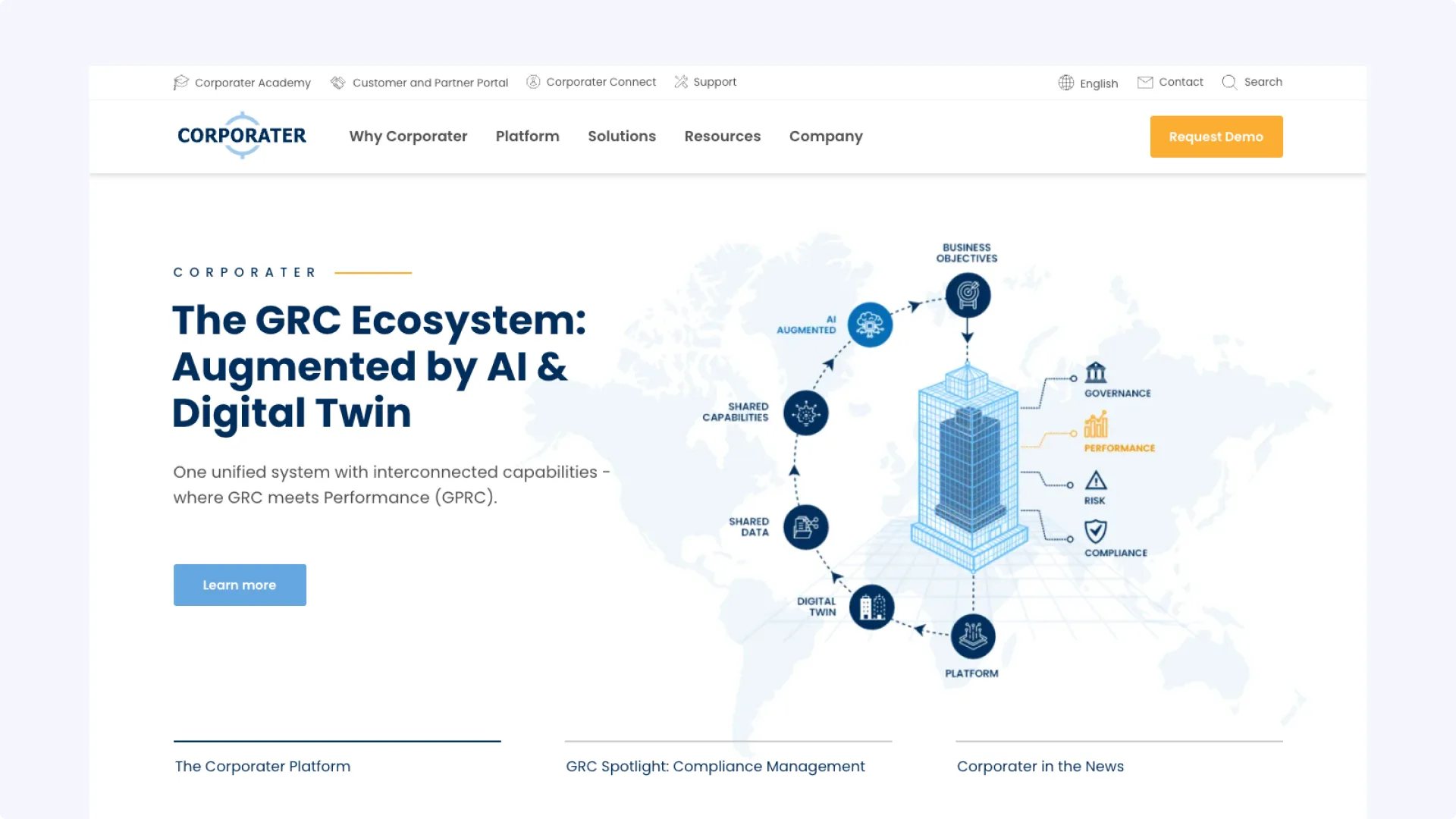
Corporater is a business-integrated GRC solution that expands to GPRC, Governance, Performance, Risk, and Compliance, governing, managing, and assuring performance for organizations using a single centralized system. With Corporate, organizations can create a digital twin to digitalize and automate business operations, manage GRC integrated with performance and strategy, and connect people, processes, and data to operate efficiently across all enterprise functions.
Key features
Risk Management
- Provides an integrated view of risk with proactive assessment, monitoring, and reporting capabilities for emerging risks, threats, and opportunities.
- Streamlines risk management with automation of workflows, notifications, and powerful risk reports in a variety of formats.
Integrated Governance Framework
- Enforces policies, monitors internal controls, and establishes clear lines of accountability,
- Customizable dashboards and data analytics provide real-time performance and risk insights to stakeholders, improving strategic decision-making.
Compliance Management
- Enables organizations to track and manage multiple regulatory frameworks such as GDPR, DORA, and ISO 27001.
- Centralizes console to create, distribute, acknowledge, and version control for all internal corporate policies.
- Offers a system for reporting, tracking, and investigations for all compliance-related incidents and breaches.
DigitalXForce
Overview
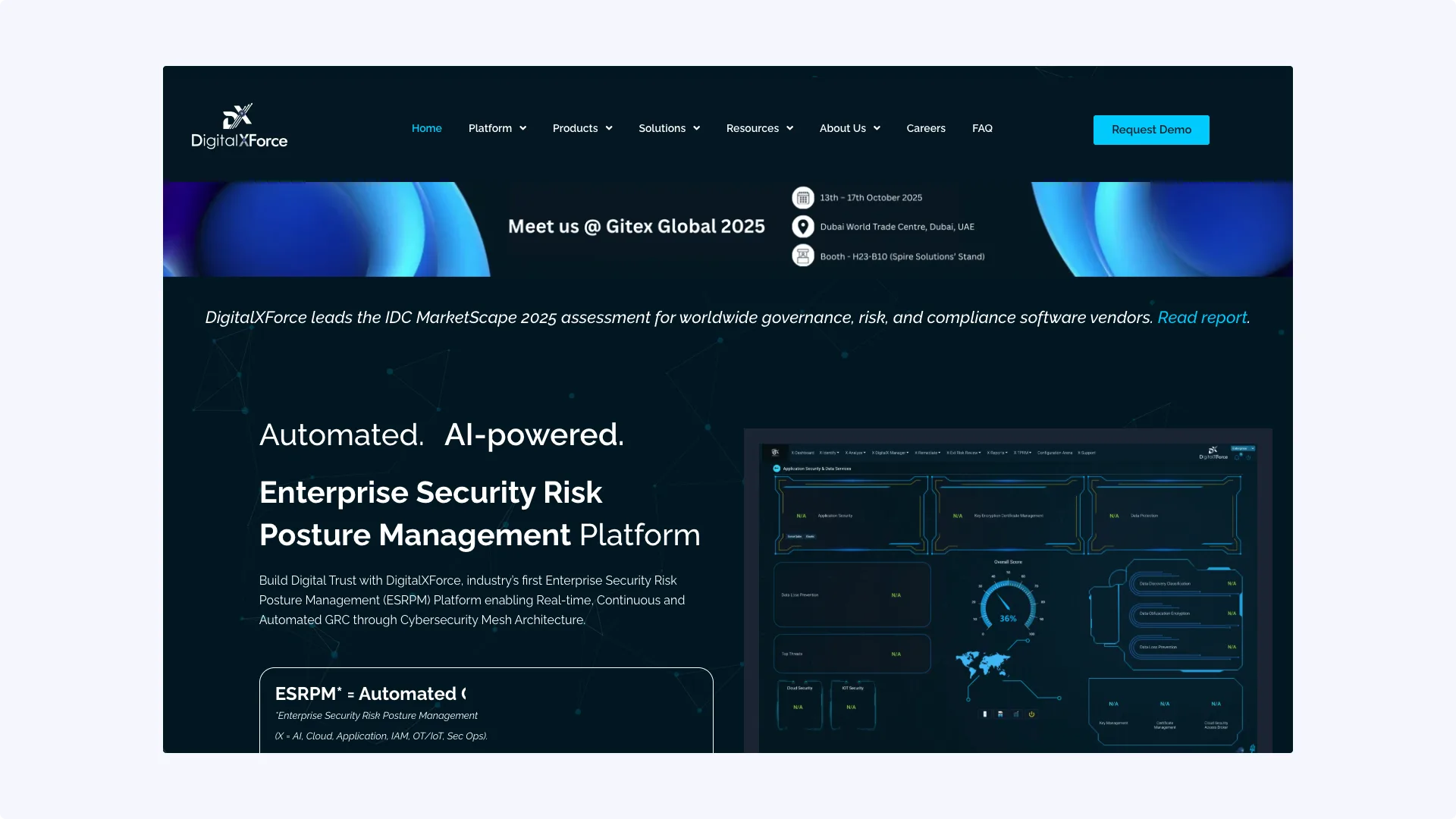
DigitalXForce is a SaaS platform offering an Enterprise Security Risk Posture Management (ESRPM) solution with a next-generation approach to GRC. DigitalXForce unifies cybersecurity, risk, and compliance management in a single platform, focusing on real-time, continuous, and automated GRC achieved through Cybersecurity Mesh Architecture (CSMA)
Key features
AI Governance and Risk Management
- Provides structured policy management with approval workflows, maintains detailed information on policies and regulatory objects.
- Centralized risk portal registers risk events, monitors open issues, and automates response procedures.
- Audit automation helps organizations plan, execute, and report on audit engagements, continuous compliance monitoring identifies gaps, and creates targeted roadmaps for resolving non-compliance issues.
Risk Operation Center
- A command center that provides a continuous, data-driven, and AI-powered dashboard for 360-degree security visibility across the entire attack surface.
- X-ROC continuously validates controls, identifies non-compliance, and auto-generates audit-ready evidence, enabling accurate compliance across all supported frameworks and standards.
Automated Third-party Risk Management
- Automates the collection of evidence and security documentation from third parties.
- Integrates third-party data into the overall enterprise risk strategy.
- For each vendor, risk assessment and trust scores are assigned based on security posture and compliance status.
StandardFusion
Overview
StandardFusion is an integrated GRC ecosystem that unifies governance, risk, compliance, audit, vendor risk, incident management and business continuity into one platform.
Key features
All-in-one GRC platform
- All GRC activities, including risk, compliance, audit, and policy management, are managed from one unified location.
- Reduces complexity, duplicate work, and ensures consistency with scalable capabilities to handle increased complexity, new regulations, and business expansion.
Risk Management
- Helps organizations proactively identify, assess, treat, and monitor enterprise, operational, and third-party risk.
- Empowers users to link risks to specific controls and track the progress of mitigation efforts.
Compliance Management
- Enables organizations to map a single control to multiple regulatory frameworks, e.g., SOC 2, ISO 27001, HIPAA, to avoid duplicate effort.
- Centralizes the requests and storage of audit evidence so that teams are always prepared for internal and external audits.
Policy Management
- Streamlines and automates policy lifecycle management with policy storage, editing, and management capabilities in one dynamic platform, keeping documents accessible and up to date.
- Connects policies directly to frameworks, controls, risks, and assets for a comprehensive view of policy impact.
Ascent AutoResilience
Overview
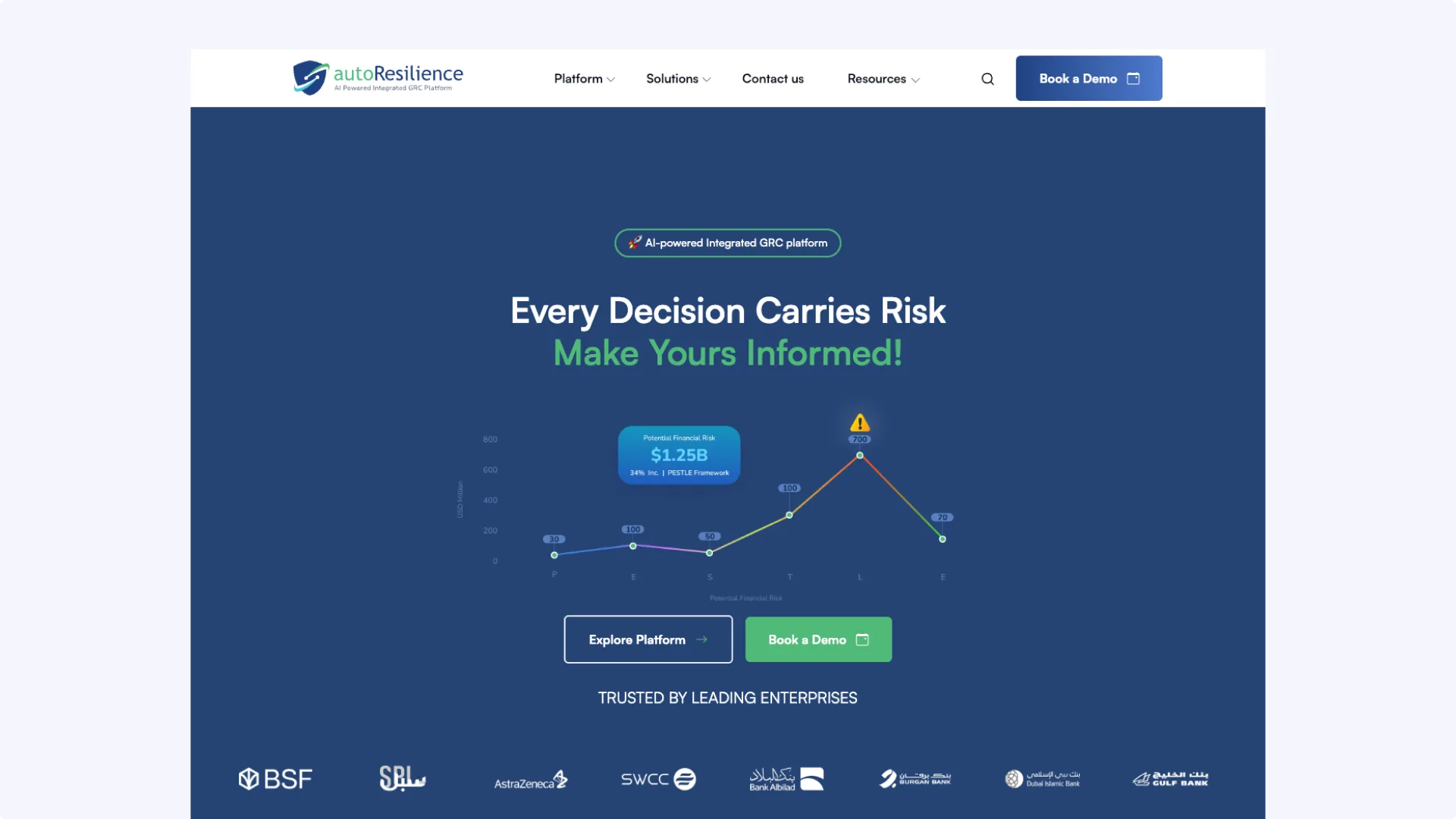
AutoResilience is a unified, AI-powered GRC platform that integrates risk visibility, automated compliance, audit, and control functions in one place. Ensure compliance with over 35 standards, including RBI, SEBI, ISO 22301, ISO 31000, GDPR, PCI DSS, HIPAA, NCEA, and DPDP.
Key Features
Audit Management
- AI workflows provide an end-to-end audit process, from evidence capture to final reporting, to ensure data accuracy and audit transparency.
- Interactive dashboards show audit progress, risk exposures, and allow status tracking of audit issues to ensure risks are mitigated promptly.
Performance & Objective Management
- Links enterprise-wide objectives to operational activities and controls to ensure GRC efforts are aligned with business performance.
- Organizations can assign ownership of each task, define targets, and track real-time performance with well-defined KPIs with complete visibility to leadership.
Internal Controls
- Allows organizations to build a centralized internal control library, mapped directly to relevant risk, regulations, and policies.
- Automates internal controls testing and monitoring, providing real-time analytics to identify control gaps or failures before they result in a loss event.
Diligent One Platform
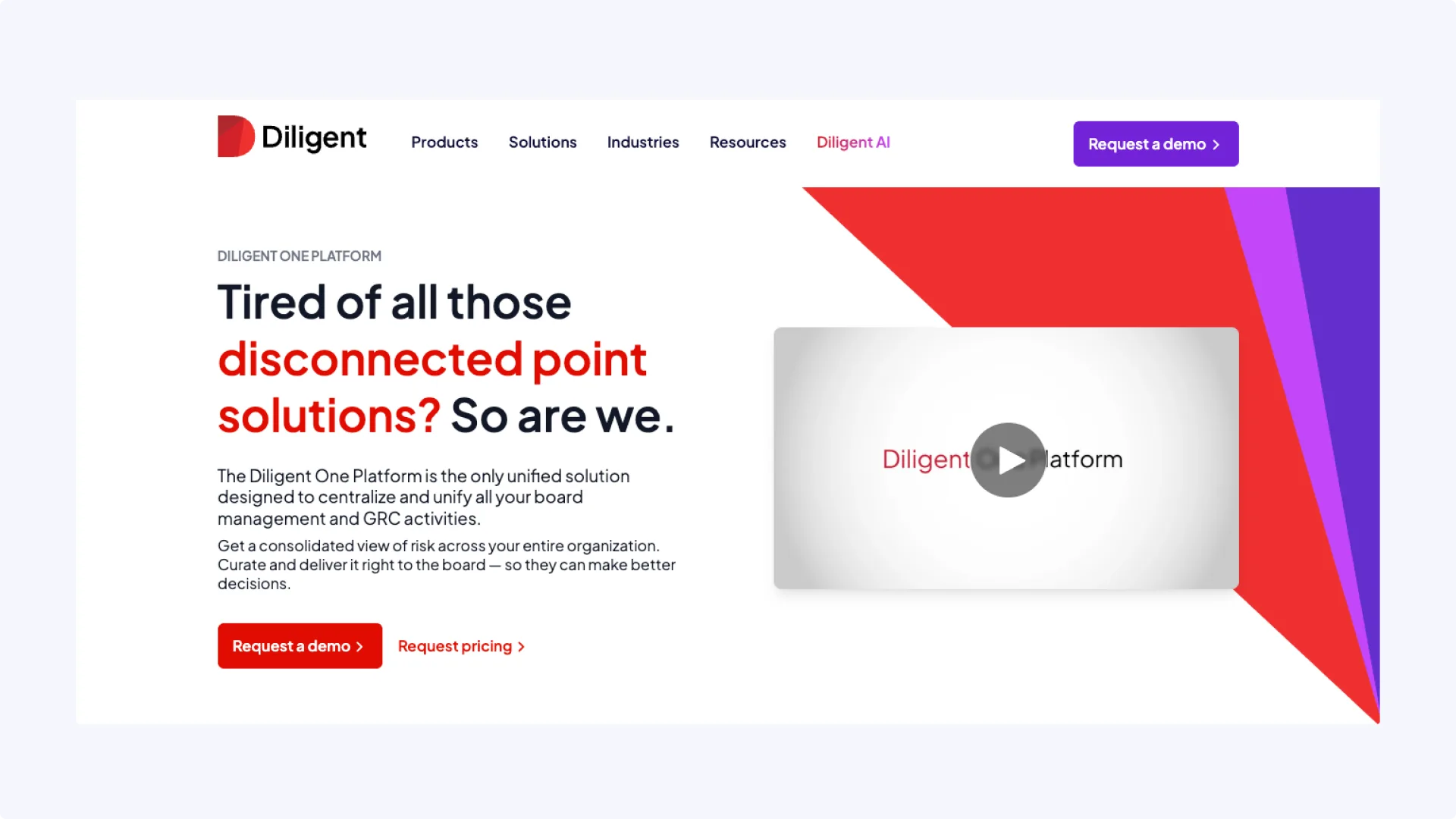
Overview
Diligent One Platform is designed to centralize and unify all GRC activities and board management. Eliminates the need for multiple vendors by providing a broad range of AI-powered GRC applications working together in a single, user-friendly interface, helping organizations to centralize Governance, Risk management, compliance, and third-party management.
Key features
AI Risk Essentials
- Simplifies risk management with actionable insights and clear visualization of Enterprise Risk Management.
- Provides an interactive risk heatmap to visualize risk severity, allowing users to identify high-priority issues and prioritize a remediation plan quickly.
Policy Manager
- Helps organizations adapt quickly to new regulations and ensures that policies stay up to date with a centralized data repository.
- Uses configurable and automated workflows to simplify policy approvals, revisions, and updates with automatic distribution of policy to the target audience.
Third Party Manager
- AI-enabled business intelligence can screen new partners against access sanctions, watchlists, and PEPs.
- Automates vendor onboarding, renewals, assessments, approvals, and offboarding with continuous monitoring to stay ahead of emerging threats.
IBM OpenPages
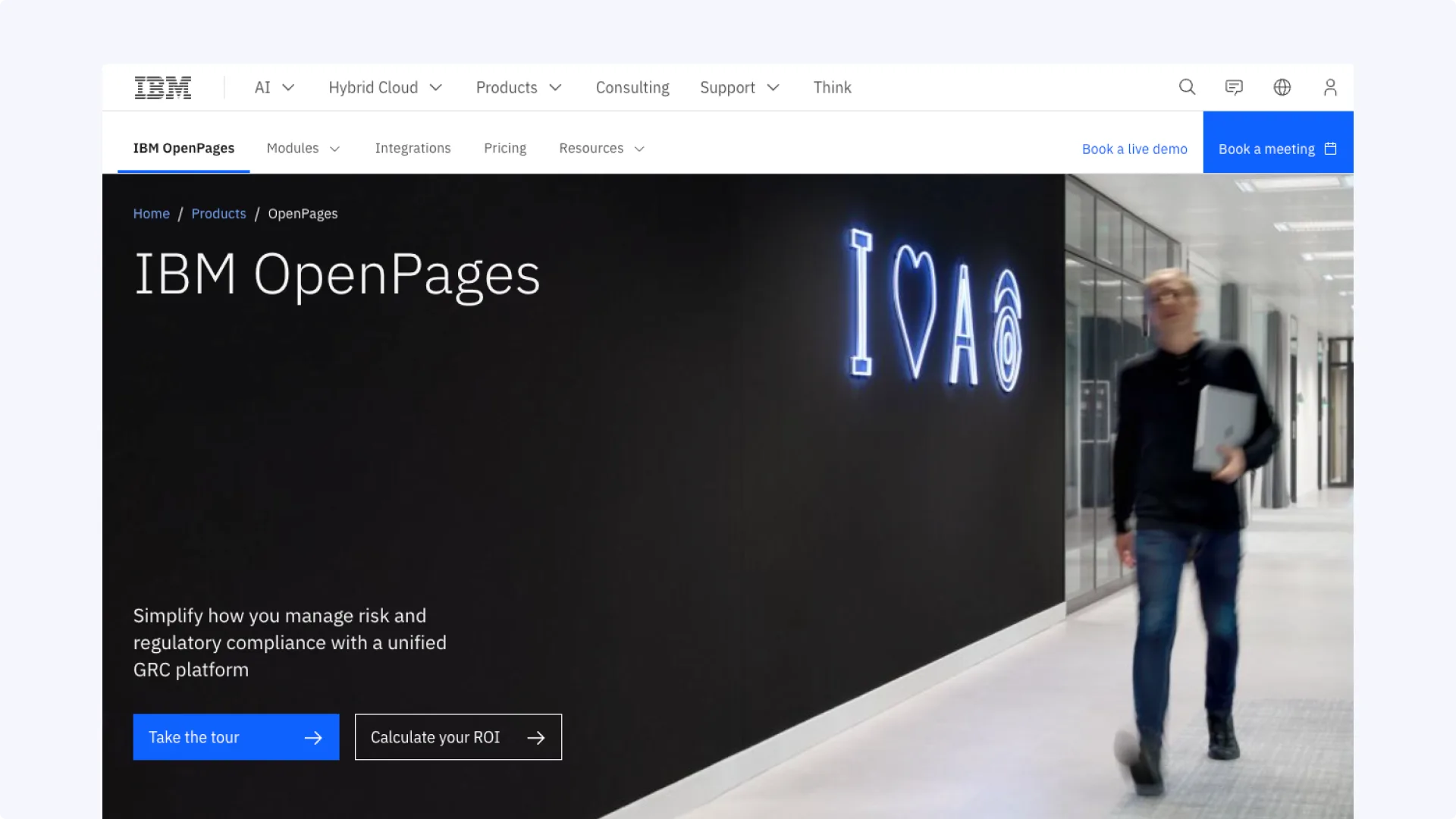
Overview
IBM OpenPages supports modular product suites and provides AI-driven, scalable Governance Risk and Compliance solutions that help organizations identify, manage, monitor, and report on risk and regulatory compliance. Solutions can be deployed with IBM Cloud PAK for Data, and it’s also available as Saas on AWS. It uses a single data model, standardized libraries, and leverages AI analytics to predict insights and provide a consistent view of risk.
Key features
Financial Controls Management
- FCM is designed to automate and provide a secure central repository to store all internal controls documentation, a logical presentation of processes, risks, and controls sharing multi-level relationships.
Regulatory Compliance Management
- Organizations can manage complex, constantly changing regulatory obligations by automatically processing large volumes of regulatory data into a single repository.
- Provides the ability to map regulatory requirements to internal risk data by connecting it to key risks, controls, and policies.
Operational Risk Management
- Centralizes all operational risks data, including Risk Control Self Assessments (RCSA), Key Risk Indicators (KRIs), and Loss Event Data into a single platform.
- Tracks loss incidents and near misses, determines root cause, and performs trend analysis to prevent recurrence.
Onspring
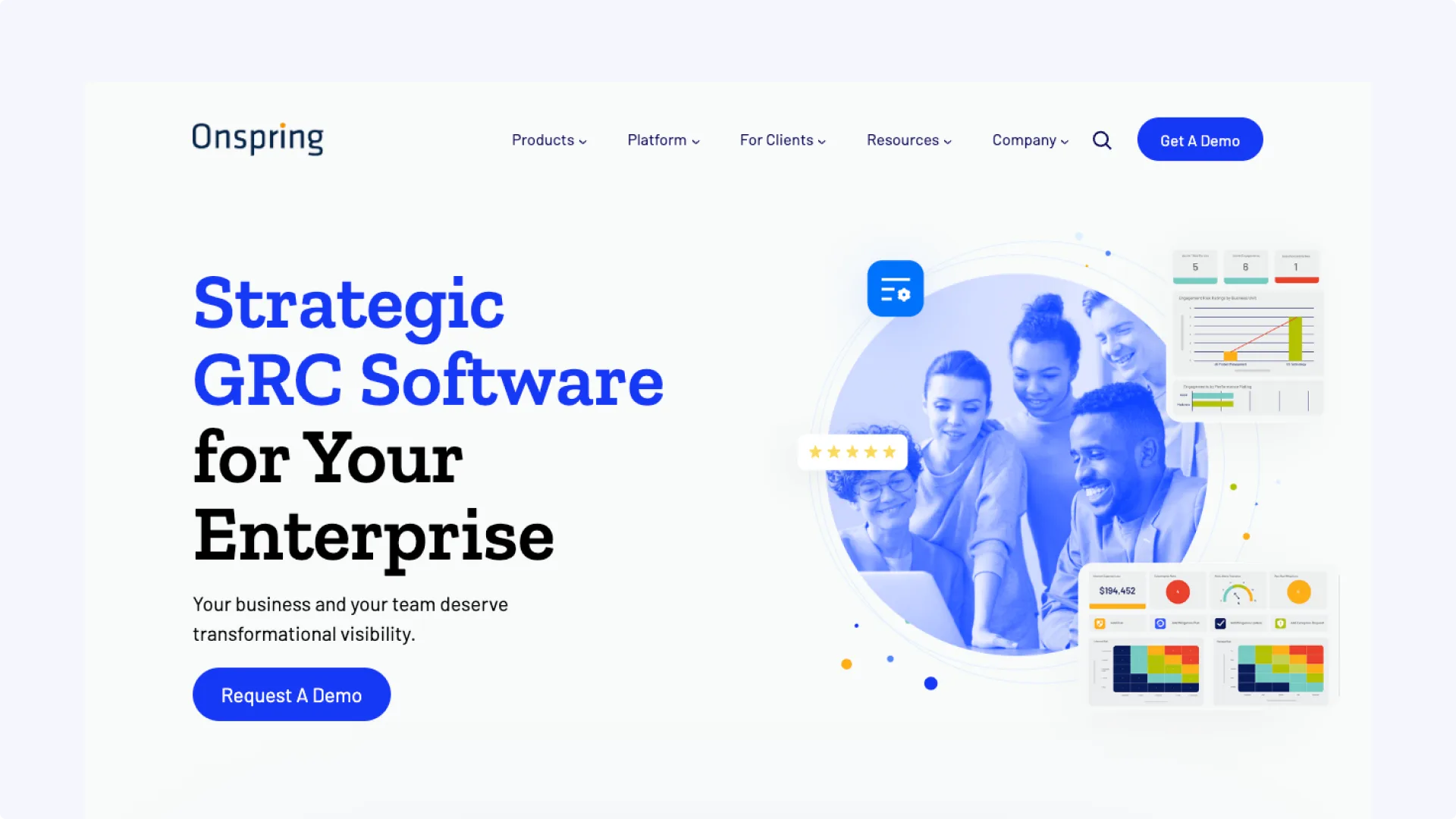
Overview
Onspring is a cloud-based GRC platform that connects and monitors all business-critical functions, processes, and information. Its Low-Code/No-Code capabilities empower business users to configure workflows, reports, surveys, and integration processes without heavy IT involvement.
Key features
Compliance management
- Facilitates faster and accurate control testing
- Provides tools to manage issues that arise from control deficiencies or non-compliance and demonstrates the effectiveness of controls to stakeholders and regulators through auditable data and reporting.
Incident Management
- A single platform for recording all incident details, integrated with all business systems to coordinate the response and ensure that key personnel are alerted and engaged via automated workflow.
Internal Audit Management
- Supports the entire audit process, from risk management and annual planning to fieldwork, evidence collection, reporting, and issue follow-up.
- Provides instant visibility into audit status, findings, and remediation progress so that leadership has a real-time view of audit activities.
Protecht ERM
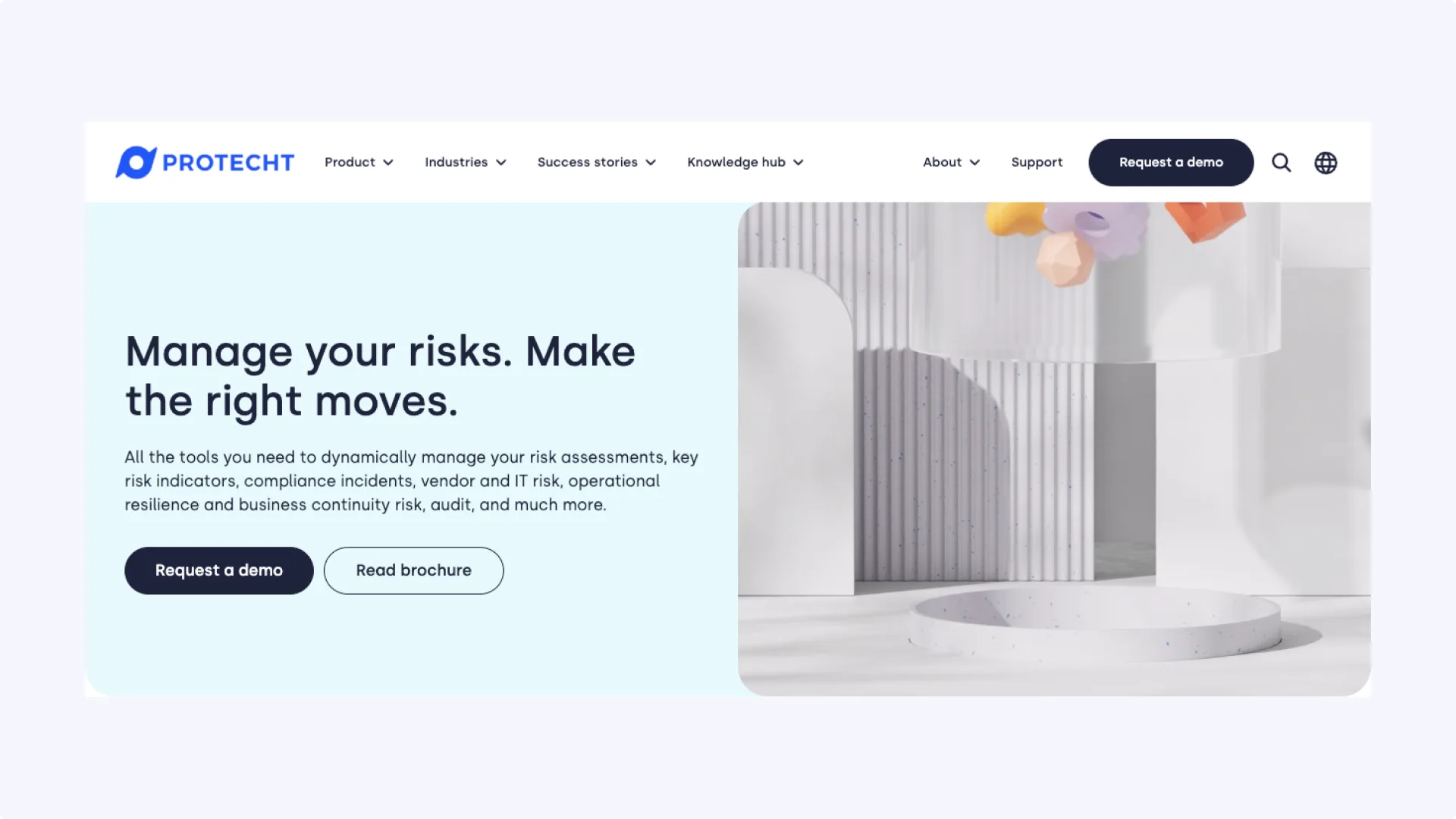
Overview
Protecht ERM is a platform designed by risk experts to manage all aspects of GRC, transitioning organizations from manual, fragmented risk, control, and compliance processes to an integrated, data-driven, and configurable system. Centralized data and analytics deliver comprehensive reports and dashboards that connect risk with controls, incidents, issues, and key risk indicators (KRIs).
Key features
Enterprise Risk Management
- Aggregates and integrates all captured risks data, i.e., assessments, KRIs, and incidents into a single platform, providing real-time insights for strategic decisions.
- Risks are linked to controls, incidents, and continuous monitoring keeps track of risk-treatment and control effectiveness.
Third-Party Vendor Managements
- Enables organizations to manage third-party risk throughout the entire relationship, including onboarding, continuous assessments, issue resolution, and offboarding.
Controls Management
- A single repository of all control definitions, ownership, mapping with risks, policies, and regulatory requirements demonstrates visibility and avoids redundancy in controls.
- Control deficiencies and failures are tracked by linking them to a central issue management process for timely remediation and follow-up.
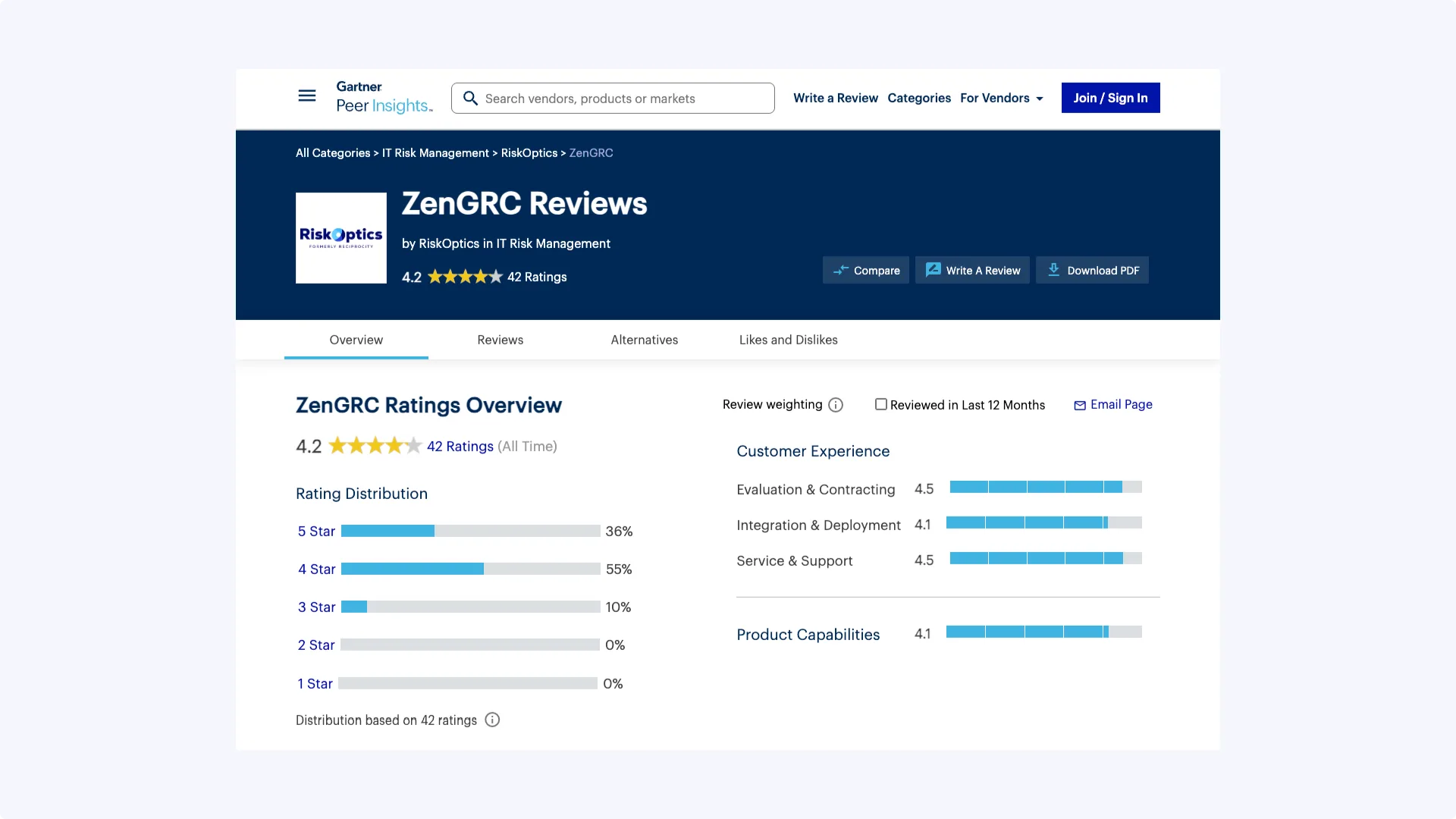
ZenGRC
Overview
ZenGRC is a cloud-based GRC solution to simplify and streamline the governance, risk, and compliance platform. Organizations can securely store and allow access to all risk and compliance data in a single location, eliminating the need to navigate multiple tools.
Key features
- Artificial intelligence assists and accelerates the evaluation of control design and operating effectiveness by analyzing control definitions, evidence, documentation and suggests areas of improvement.
- Acts as a secure, access-controlled portal where an organization can share its security posture and compliance documentation with authorized internal and external parties.
- Supports the simultaneous management of multiple compliance frameworks, i.e.,. SOC 2, HIPAA, COBIT, ISO 27001. The platform allows users to reuse controls and evidence across different frameworks through a centralized library, minimizing duplication of effort.
Reviewed GRC Tools (with Ratings and Reviewer Comments from Gartner Peer Insights)
Date: 30-09-2025
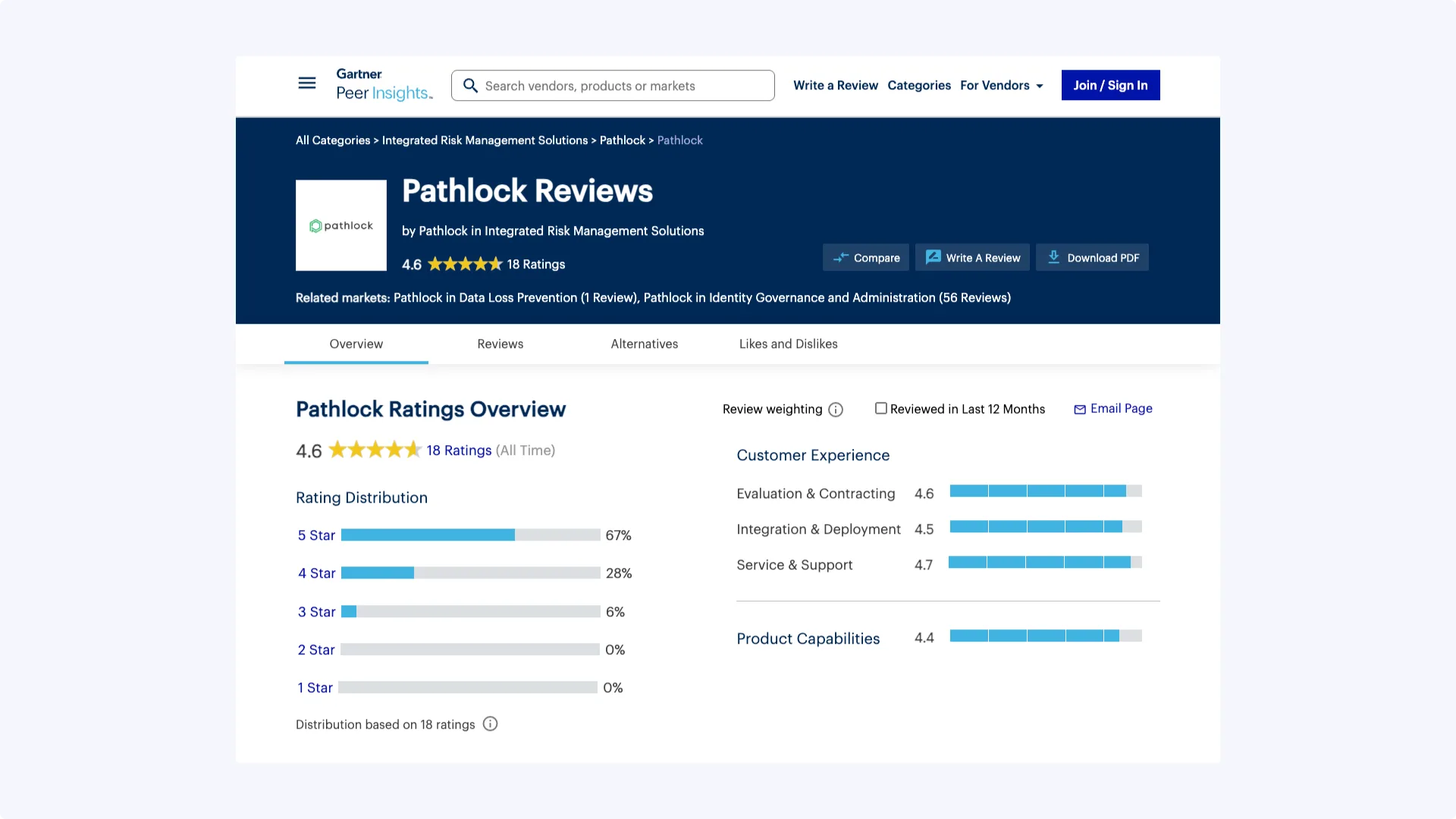
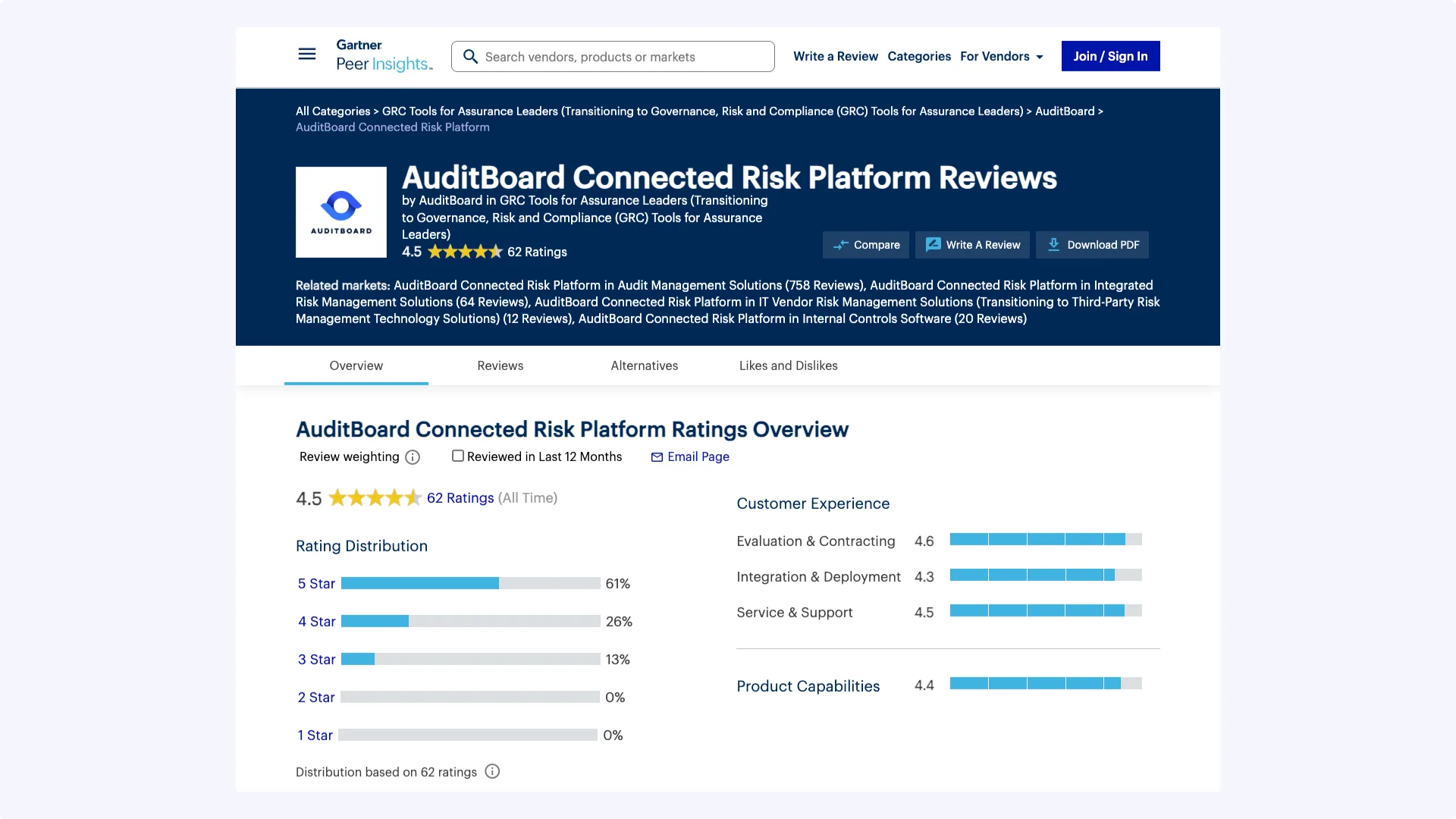
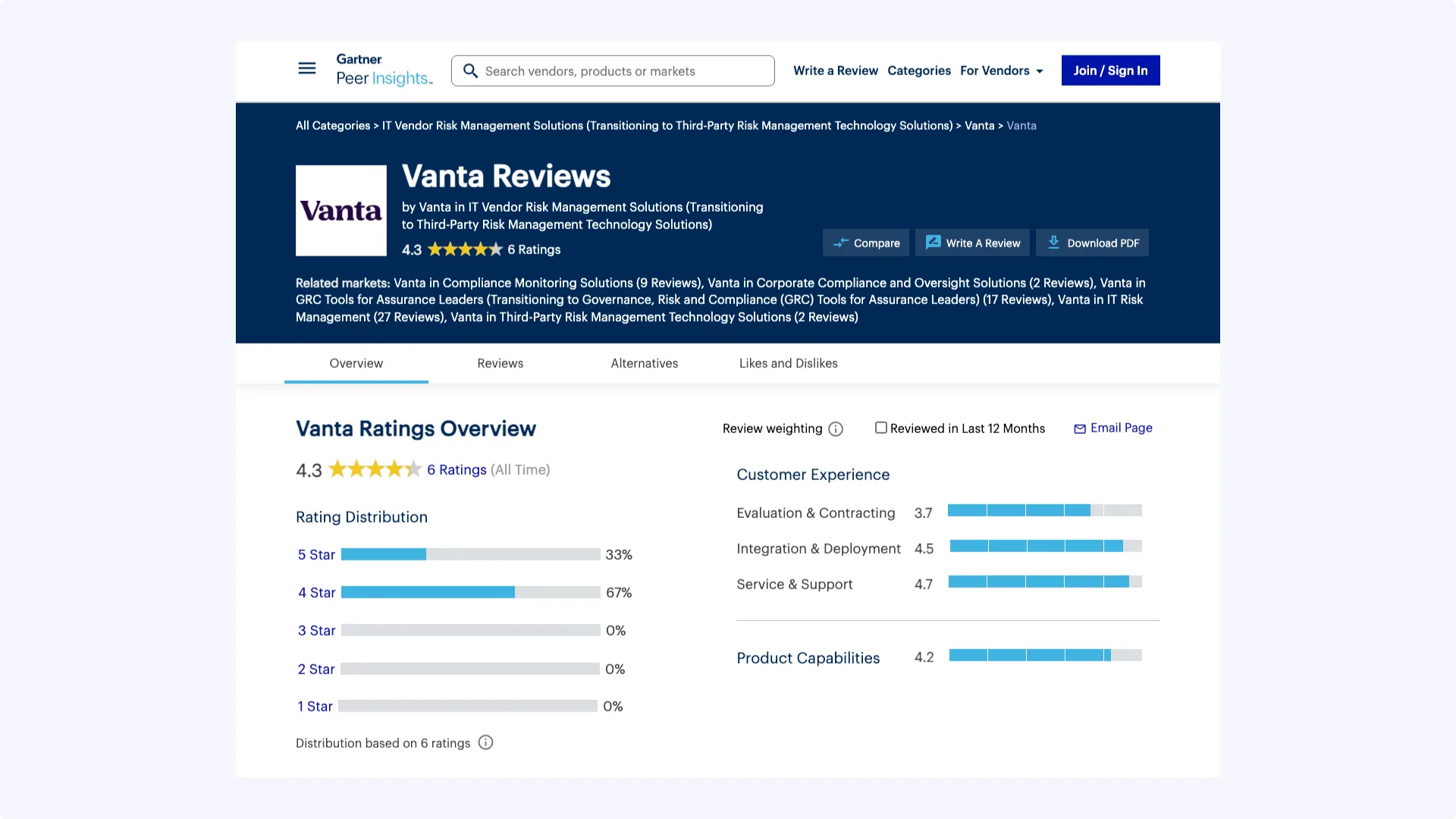
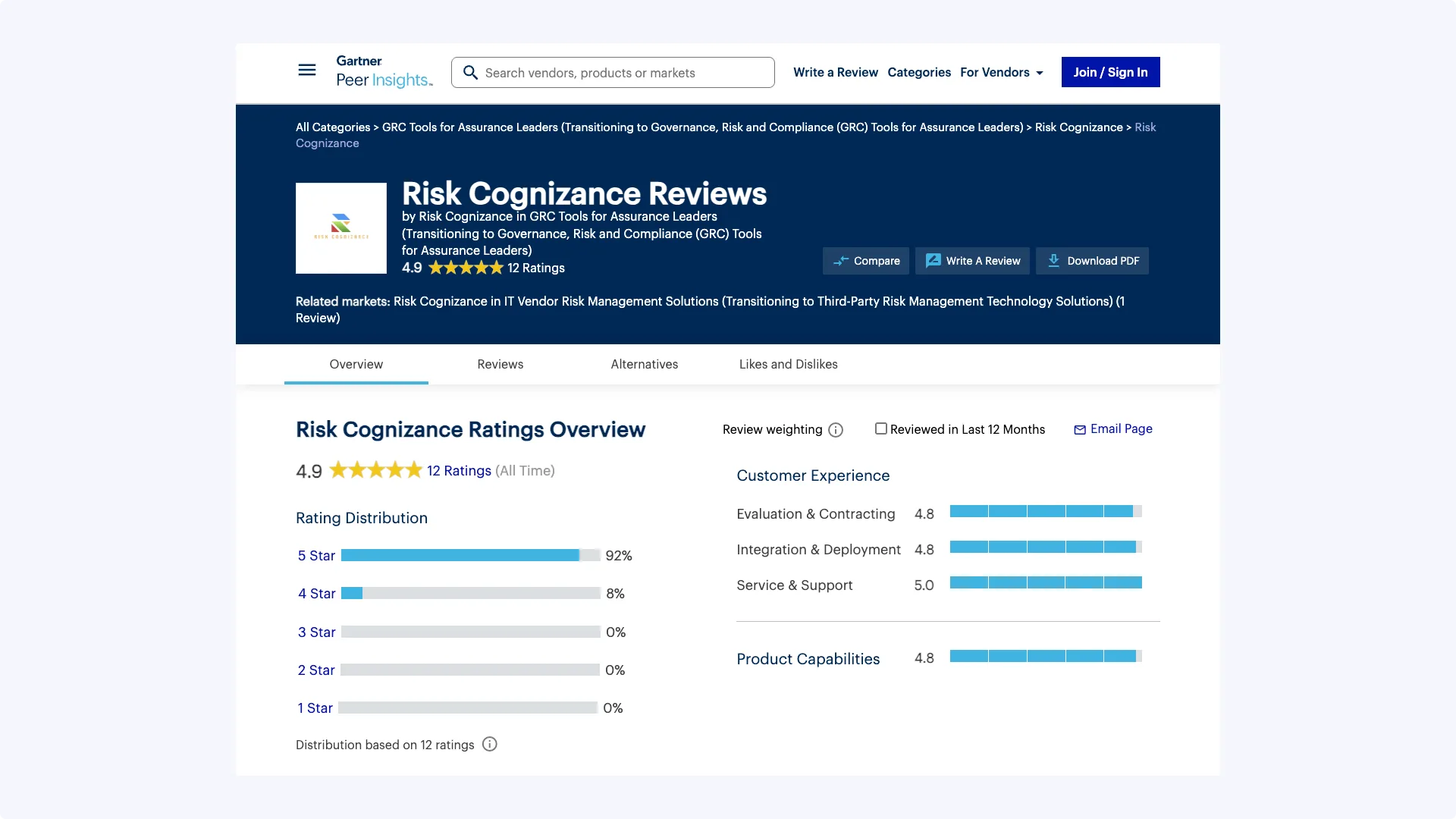
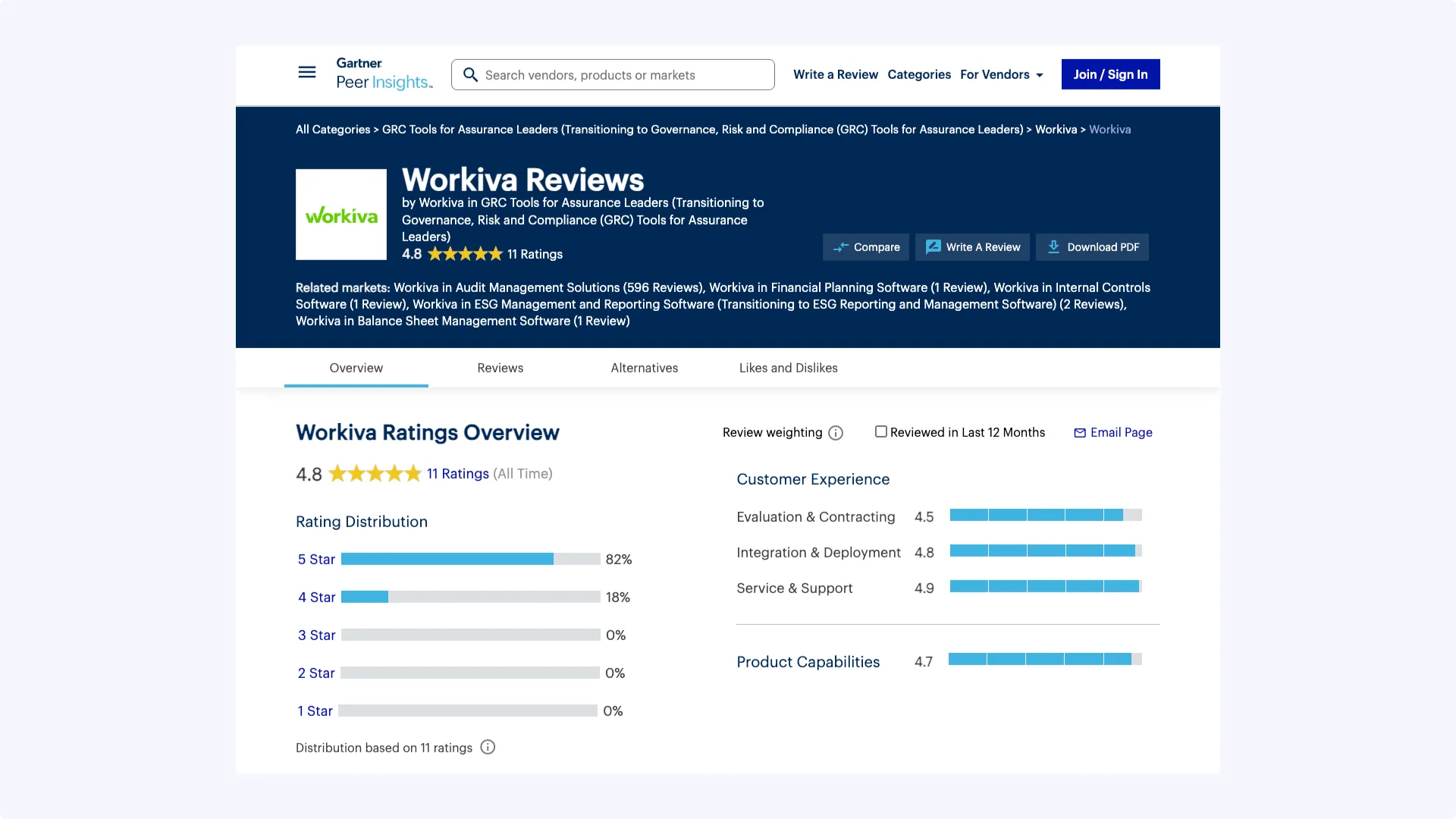
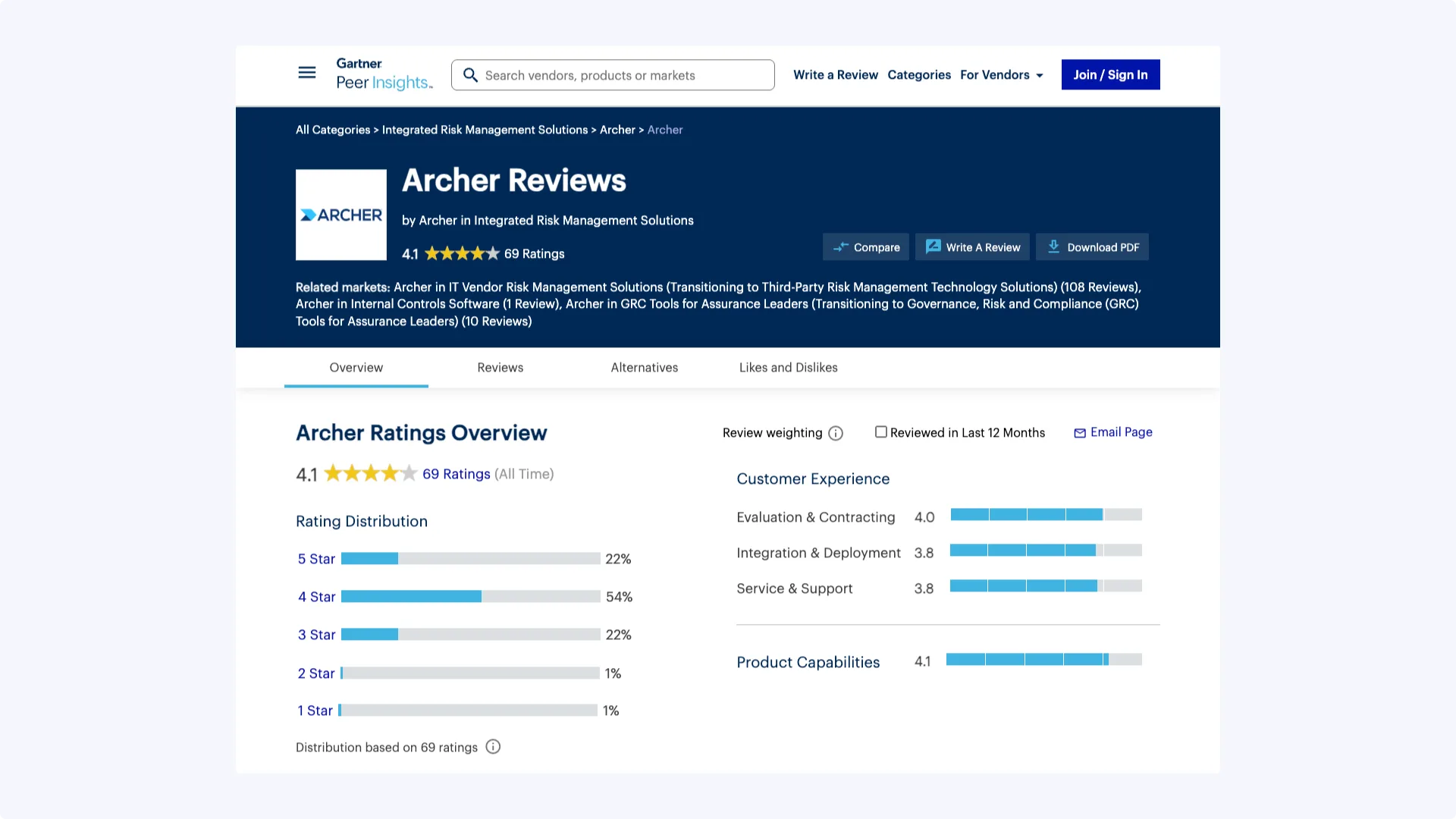
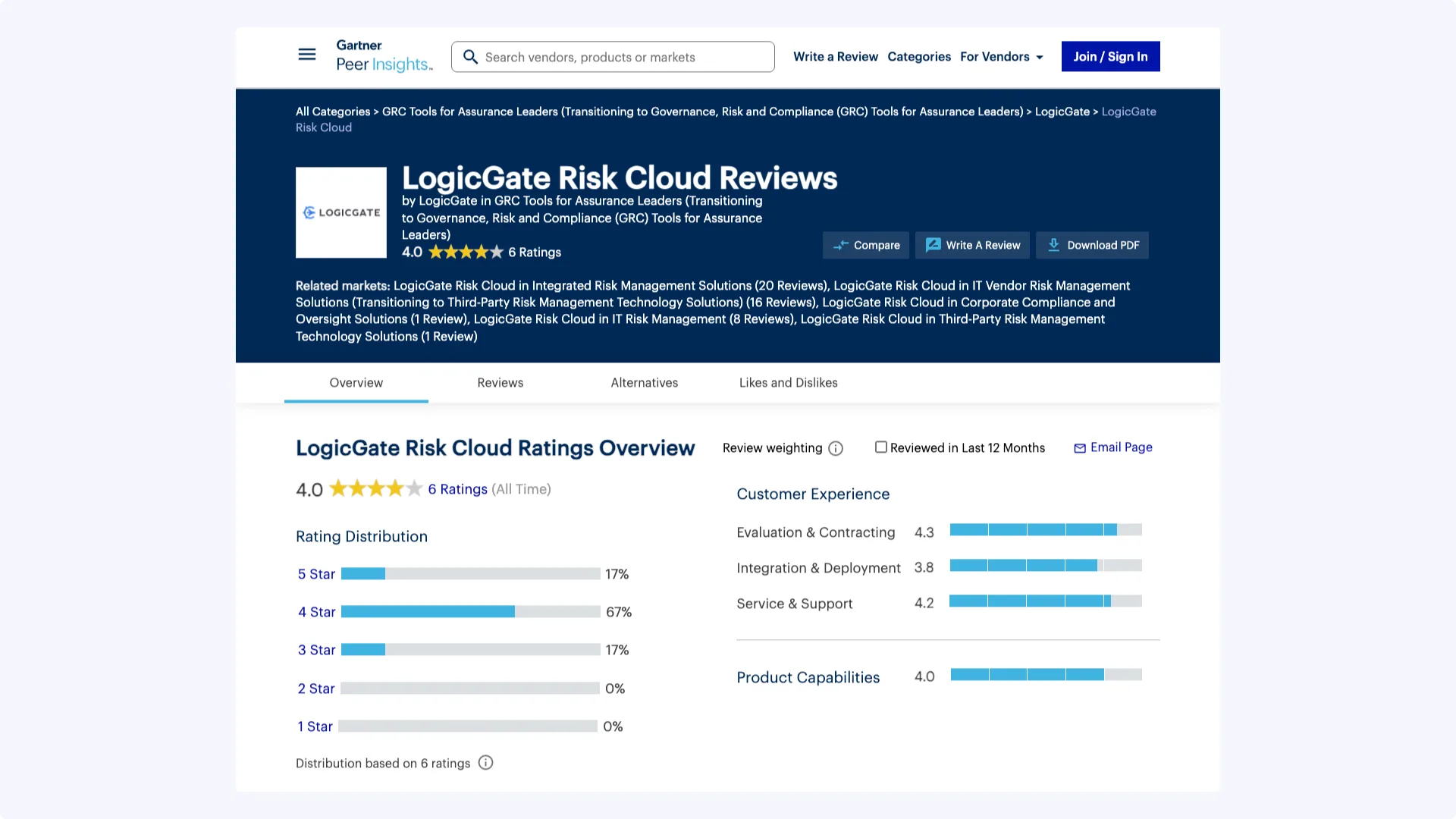
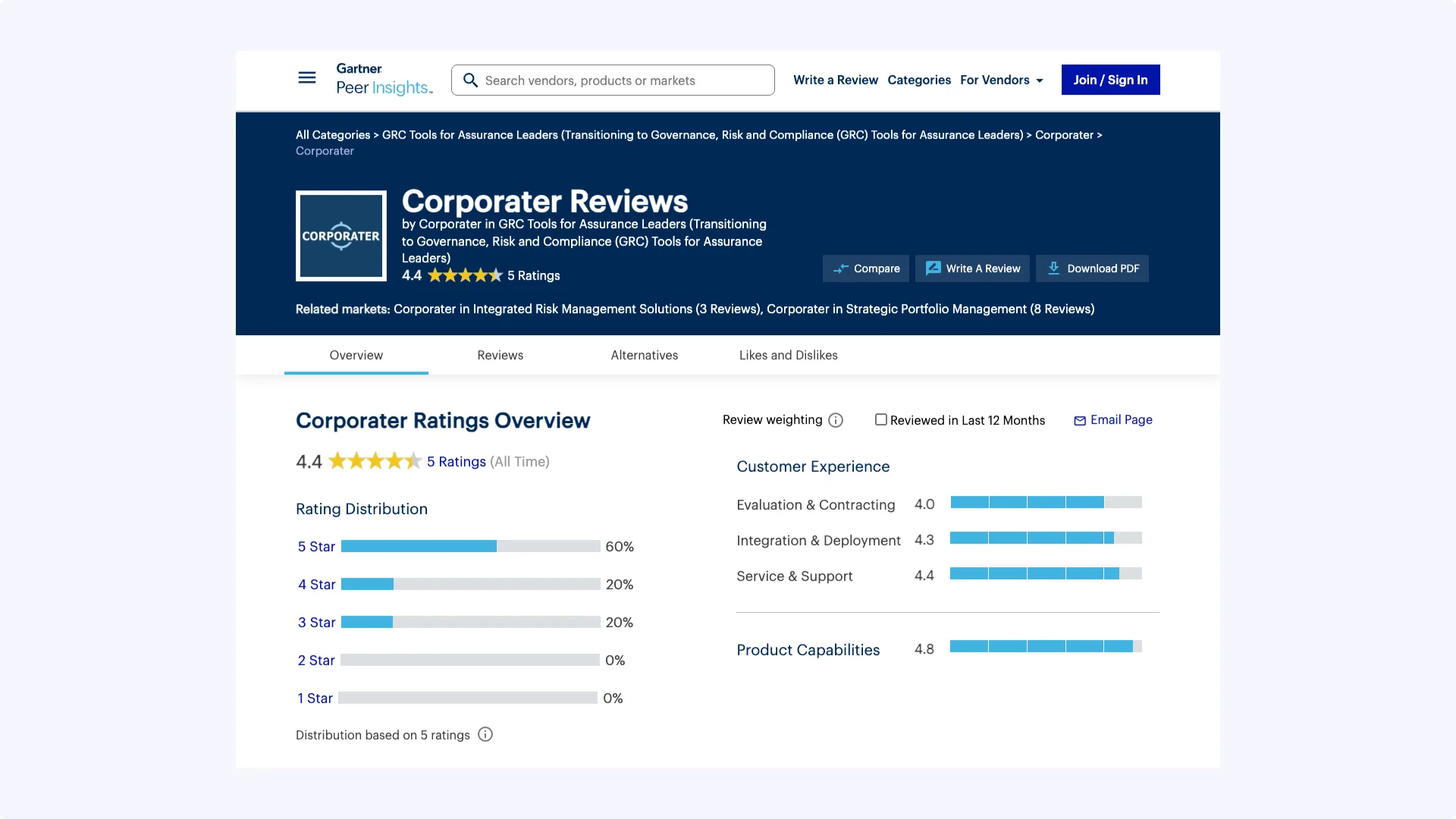
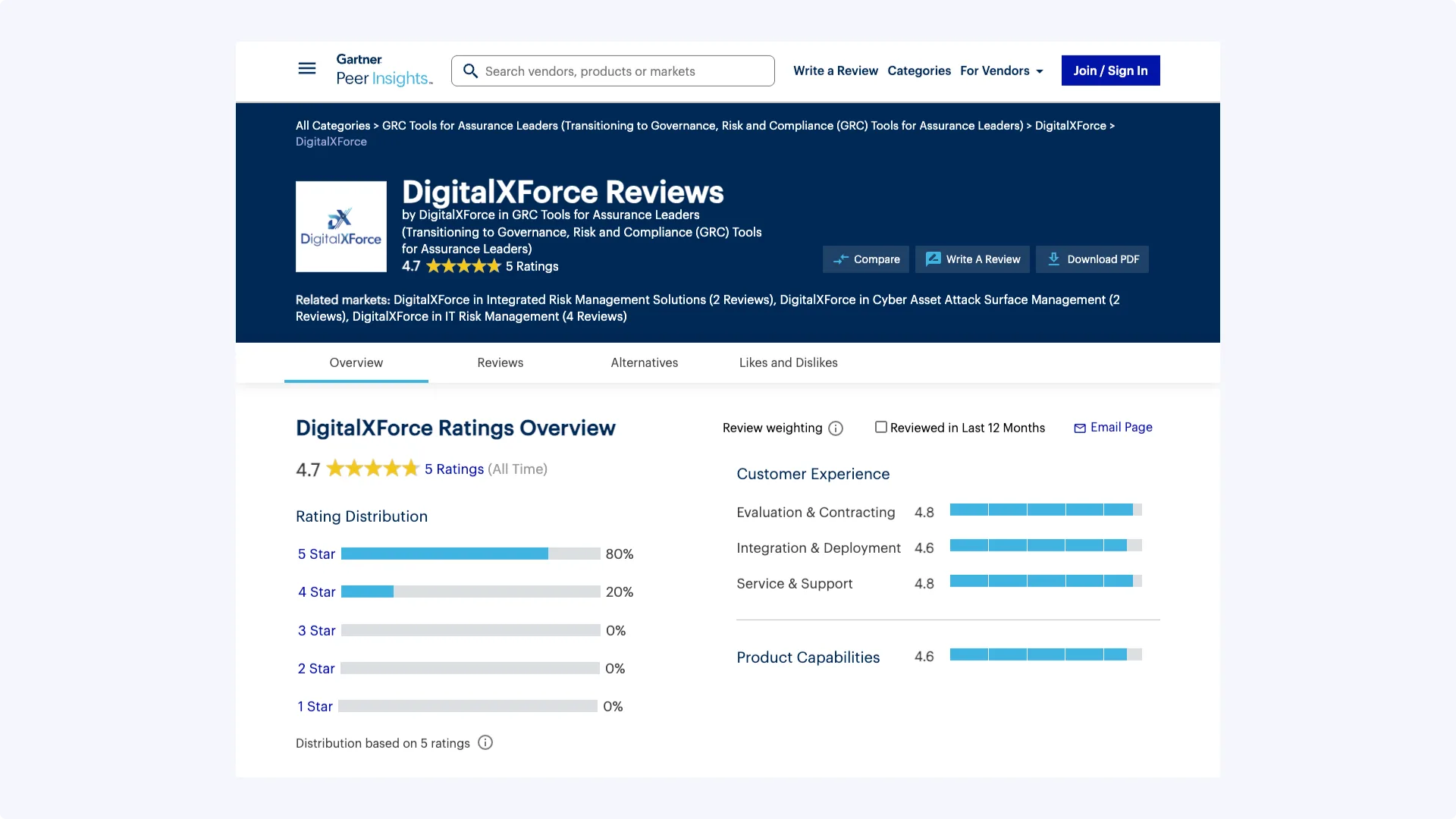
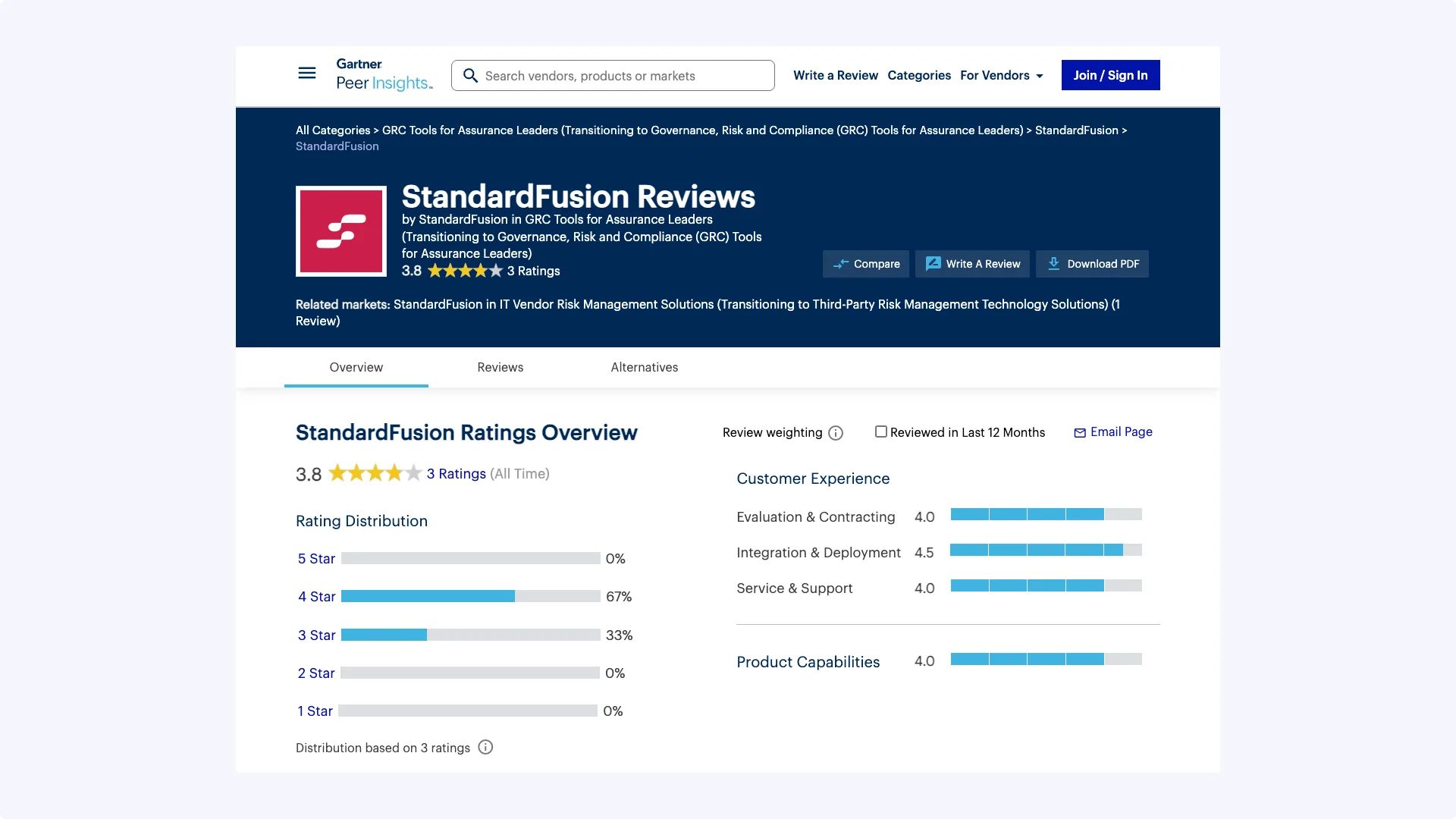
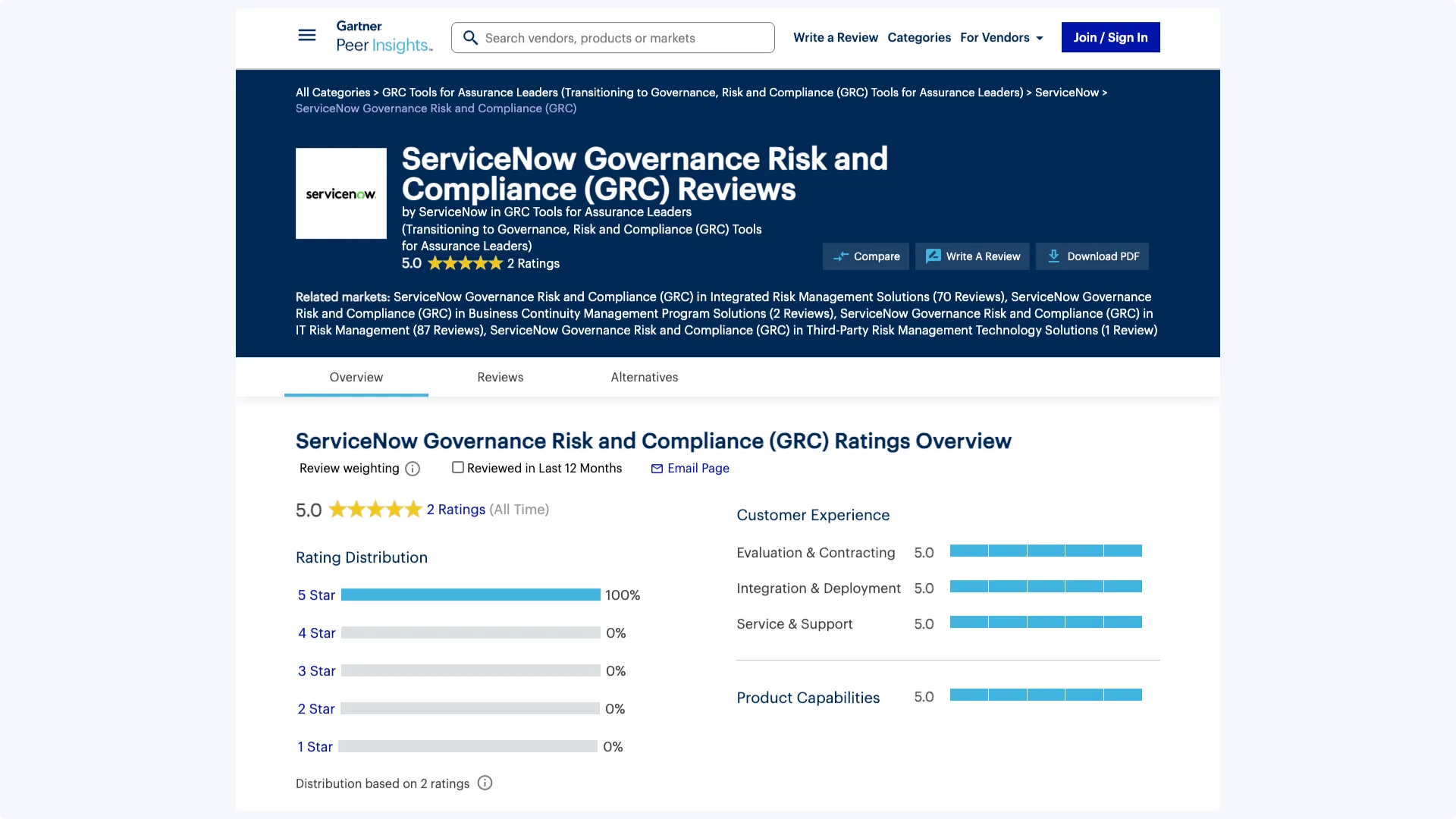
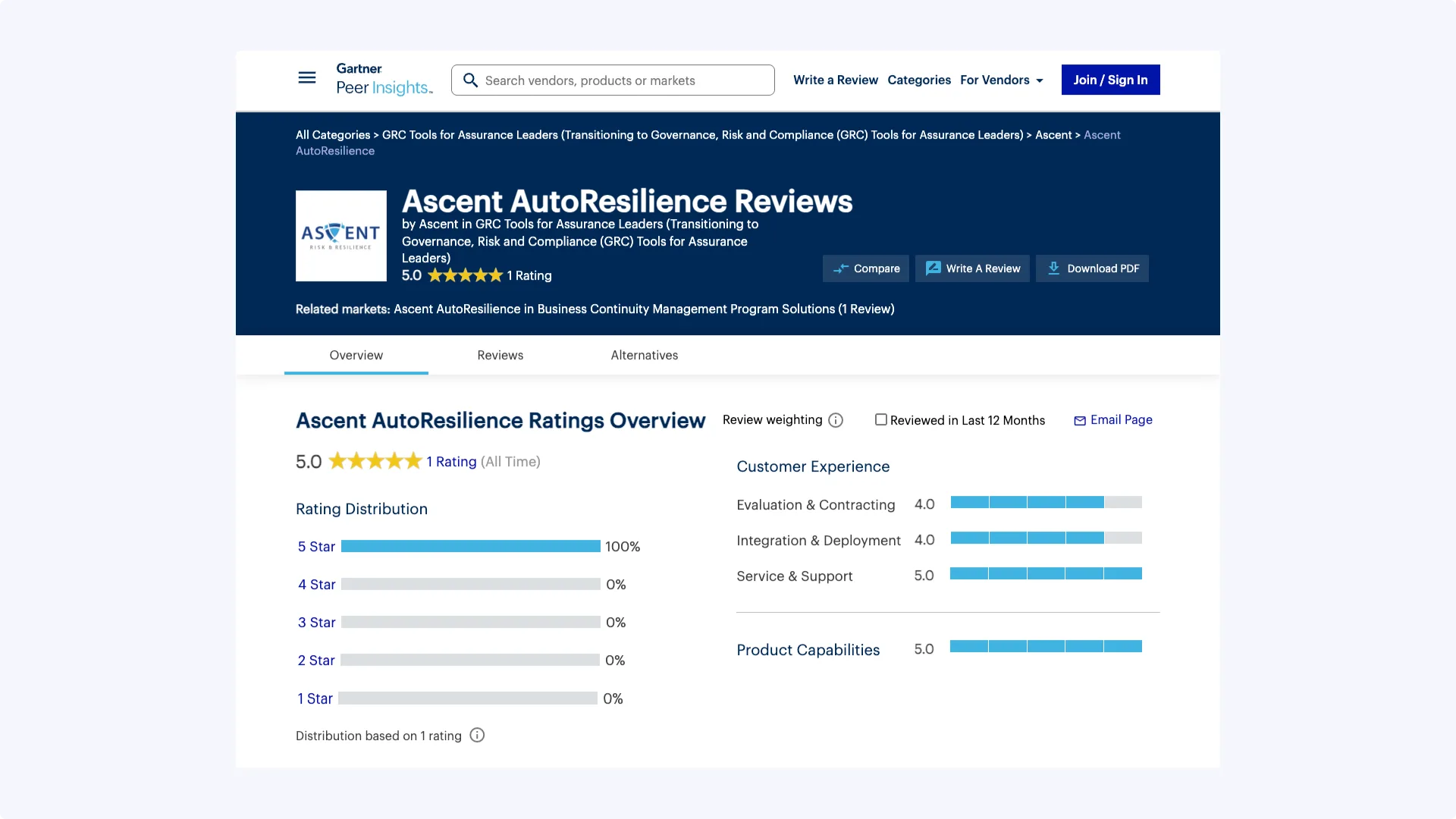
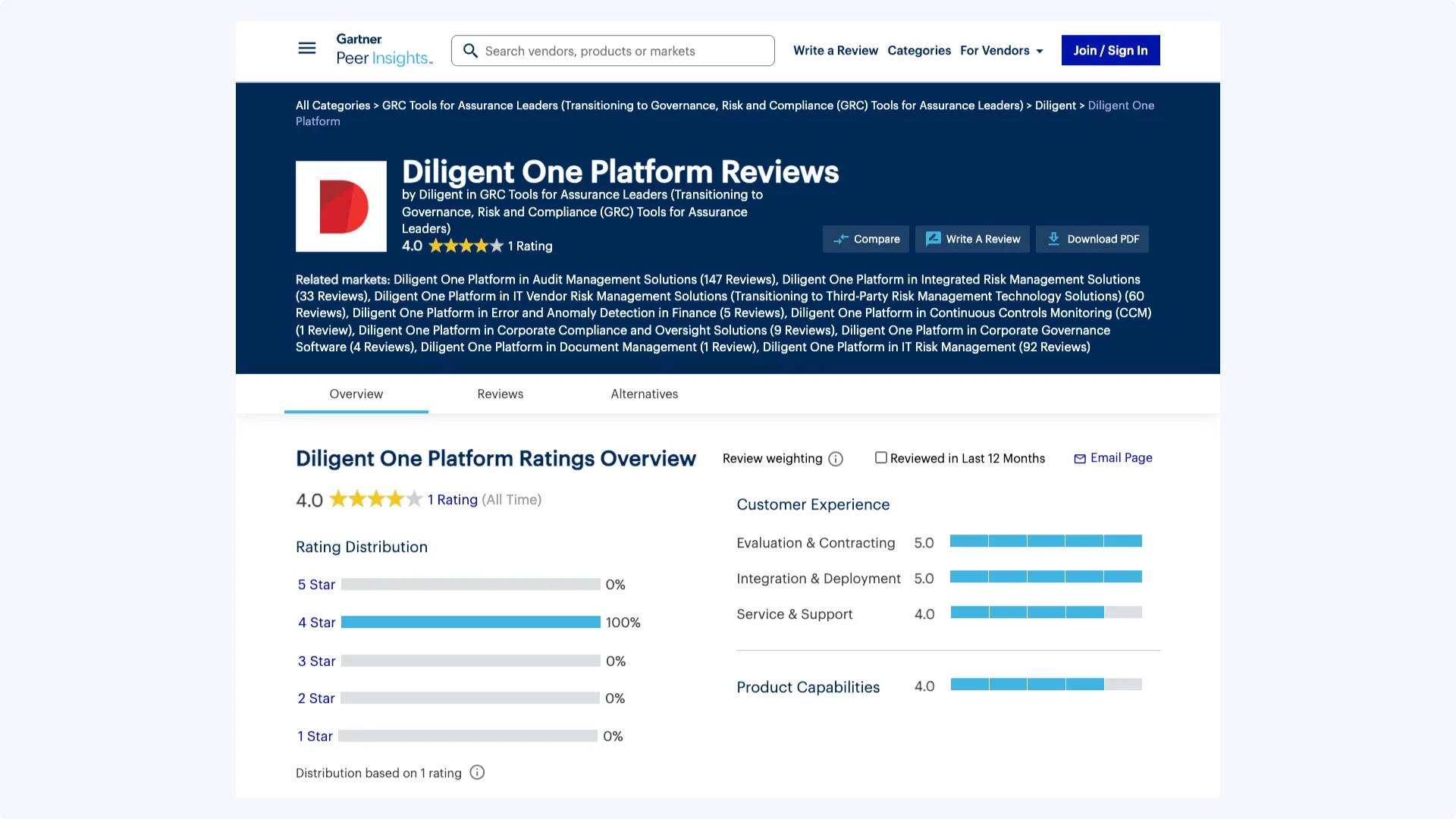
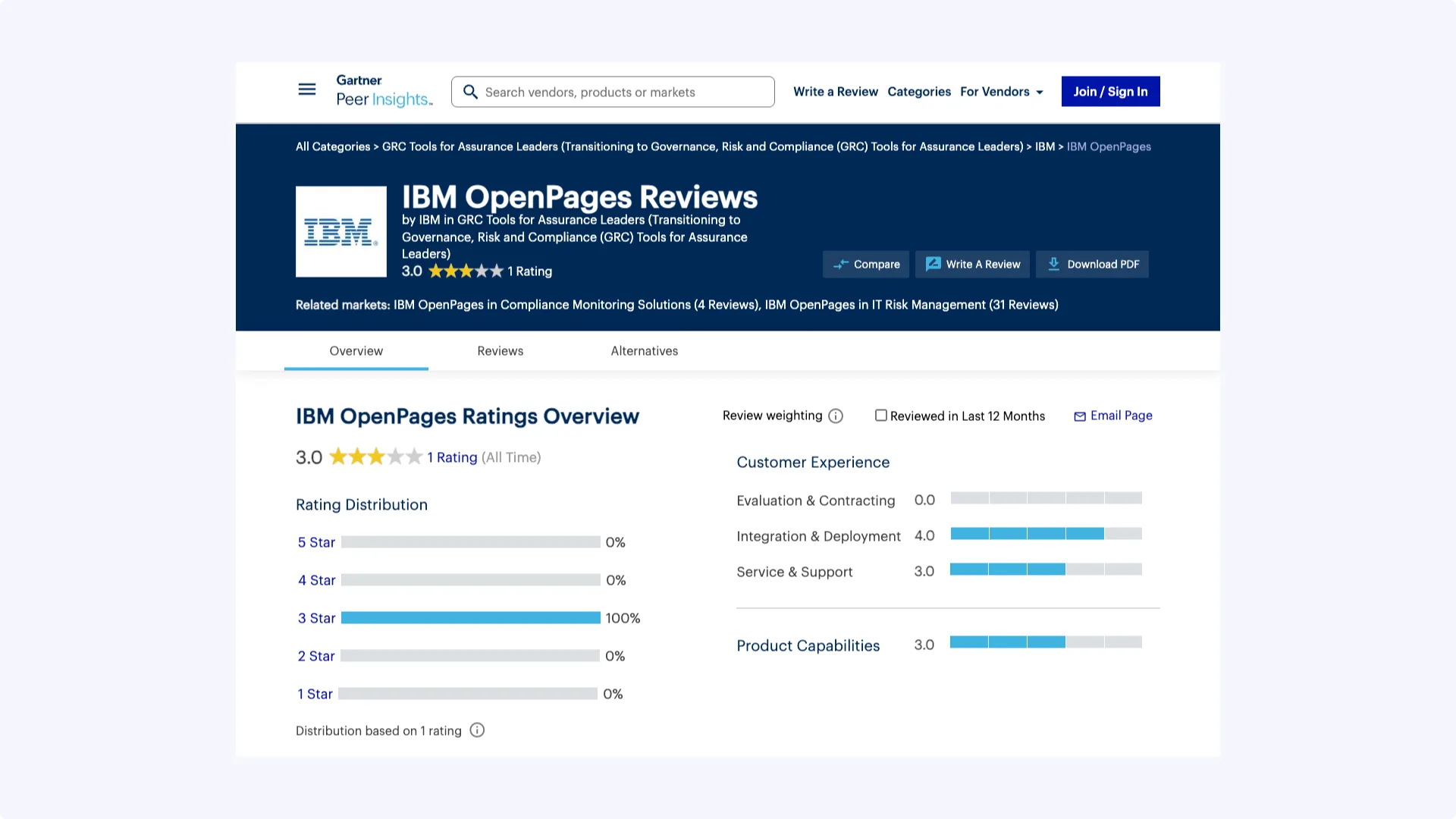
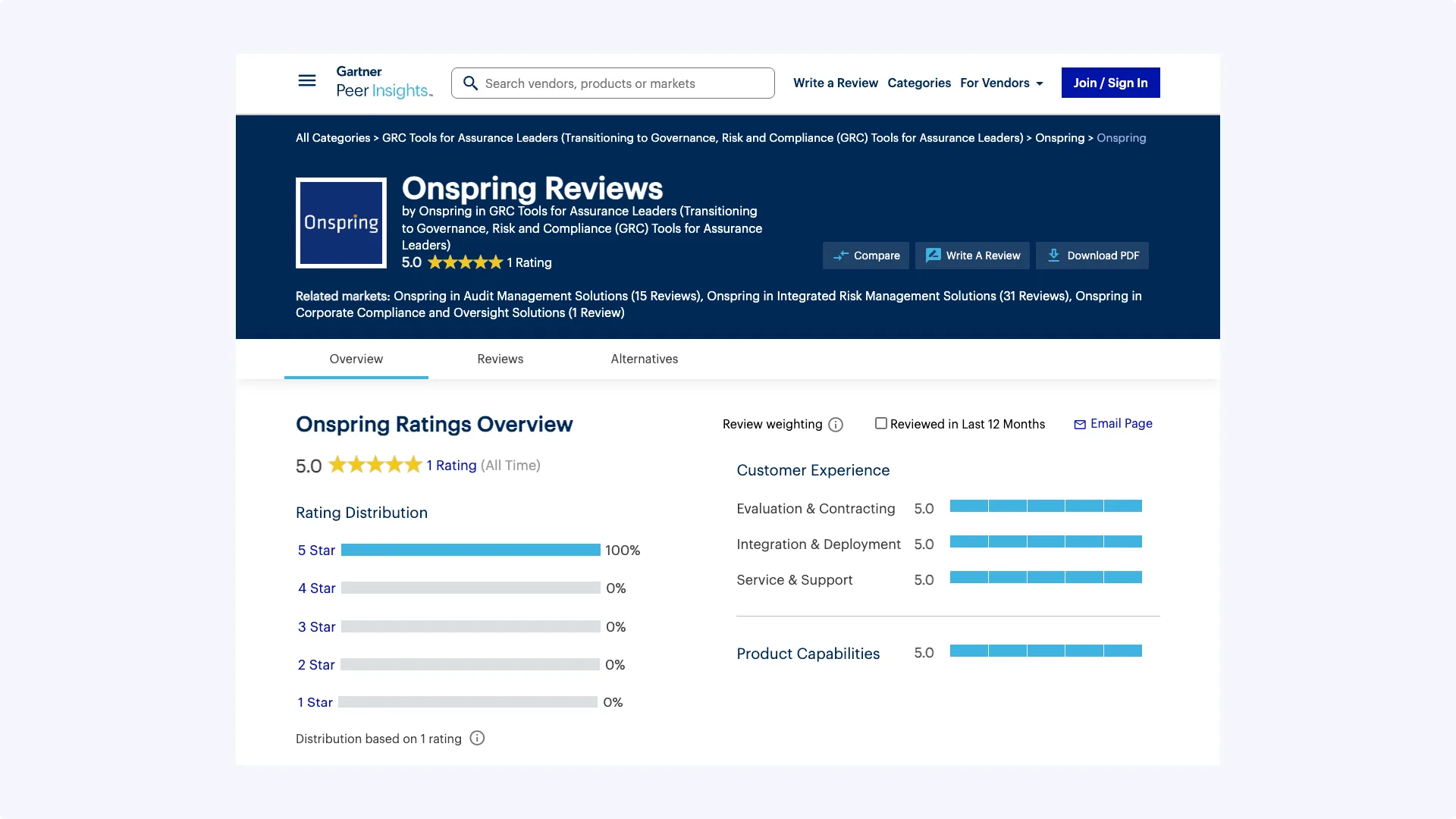
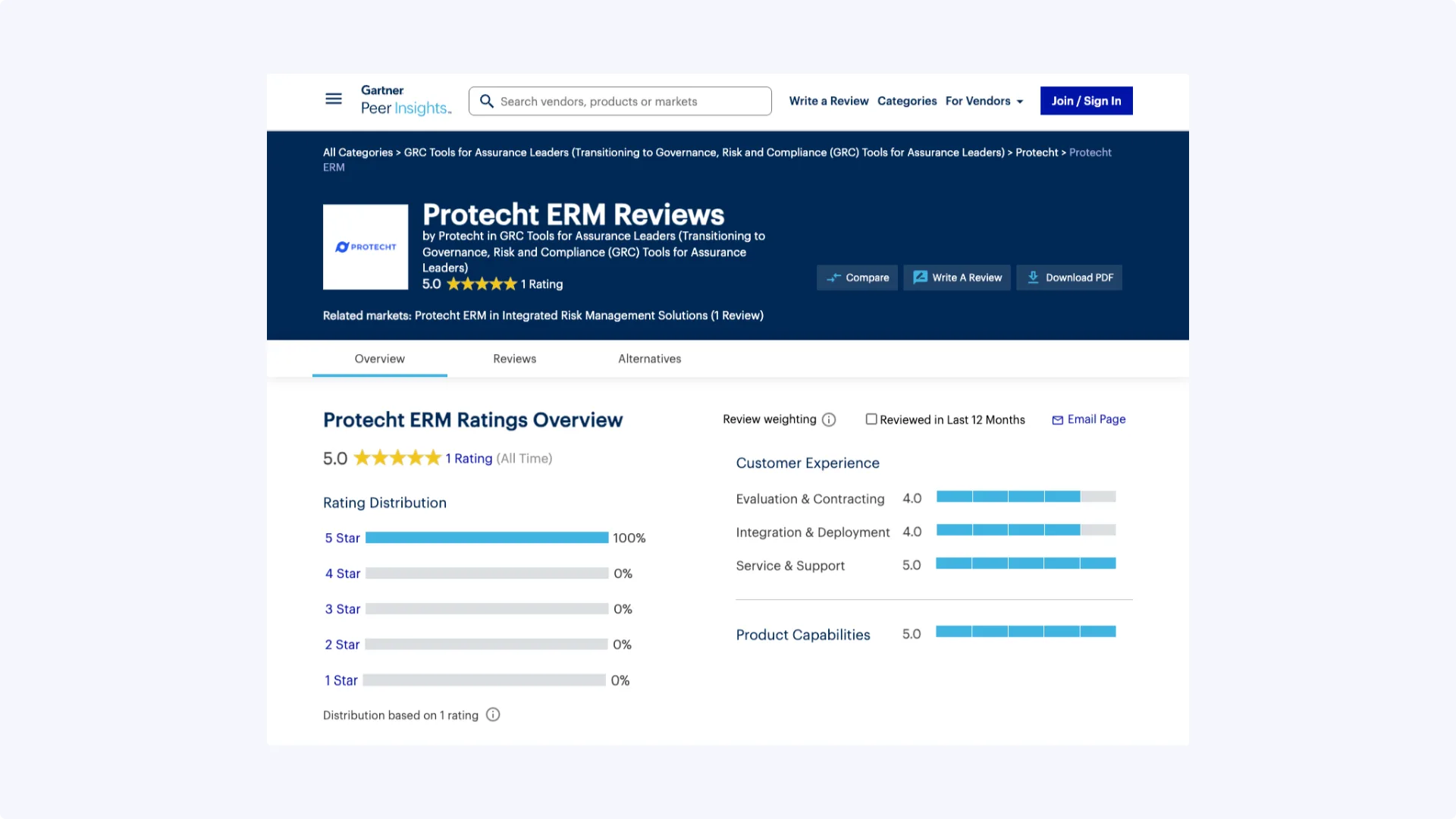
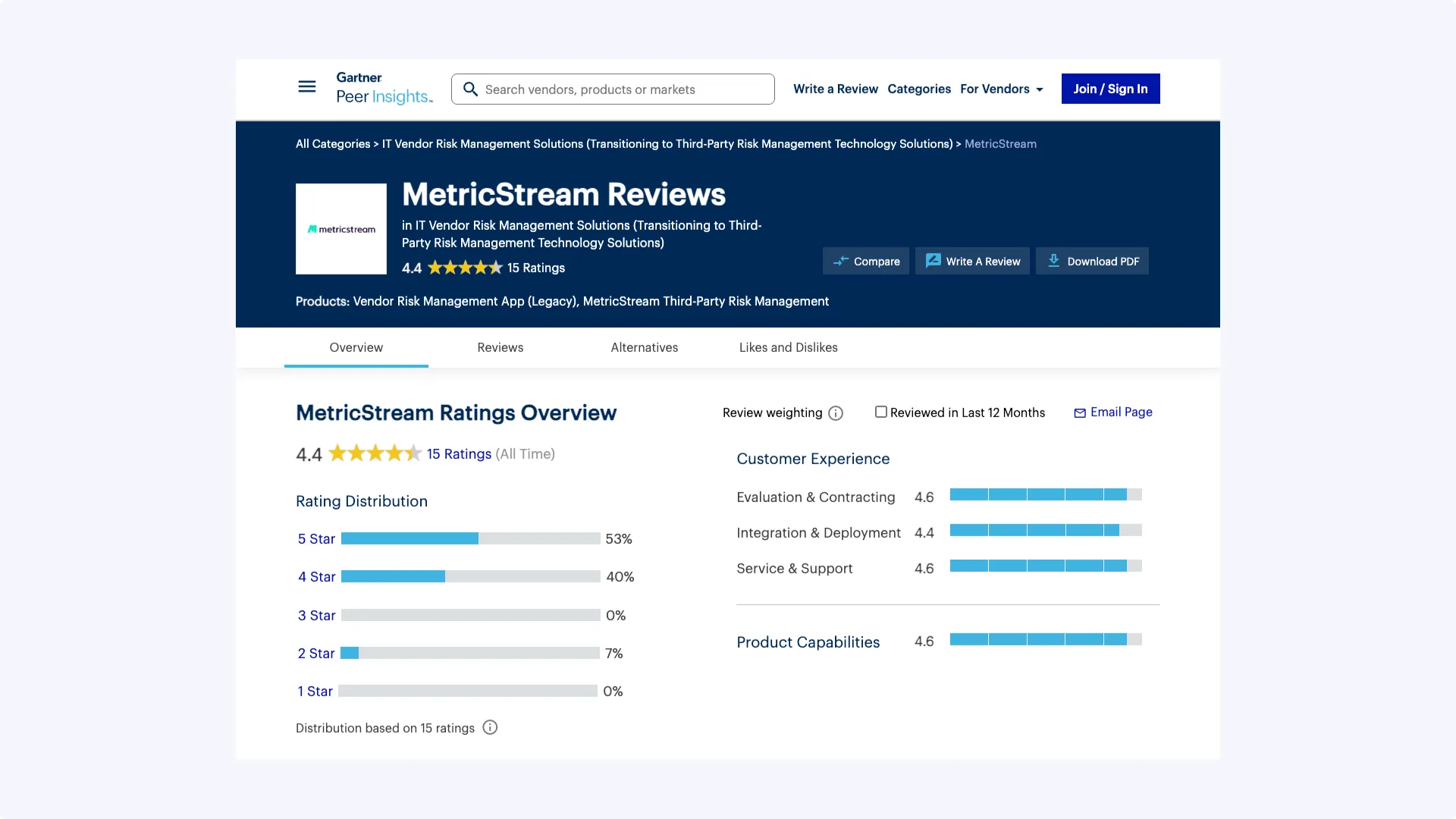
- ZenGRC (4.2/42 Ratings)
How to Choose the Best GRC Tools
GRC tools have become essential for modern organizations. The right tools boost the efficiency of governance processes, manage risks proactively, and maintain consistent regulatory compliance. With numerous solutions available in the market, selecting the right GRC tool requires careful evaluation of multiple factors.
The following are the key aspects to consider for enterprise GRC tools selection:
- Functionality: Not every organization requires all the GRC capabilities. All-in-one platforms reduce integration burden and provide a single source of truth, bundled with multiple modules, and are suitable for enterprises that want a centralized governance system. Whereas specialized tools focus on a particular GRC domain, such as compliance management, risk management, or audit management, they provide advanced features for a specific area or framework. Specialized tools are suitable for organizations with an existing GRC program that want to focus on a particular challenge using more advanced capabilities. A unified GRC platform must include features such as risk assessment and management, policy and documentation management, compliance management, audit management, advanced automation, continuous monitoring capabilities, and comprehensive reporting.
- Integration: GRC tools do not operate in isolation; they need to connect with the existing technology ecosystem for access management, data exchange, and security incident management. Integration with identity and access management (IAM) systems is crucial for user provisioning and access control. Organizations already using an ERP system such as SAP, Oracle, or Microsoft Dynamics, GRC tool integration enables automated control testing, financial data validation, and regulatory compliance. Compatibility with ITSM systems such as ServiceNow and Jira, via connectors or API, allows for automated incident management, change management workflows, and IT risk tracking.
- Configurability: Every organization has unique GRC requirements based on its industry, size, and regulatory framework. Usually, off-the-shelf solutions rarely fulfill all of the requirements. The GRC solution must provide flexible workflows for approval flows, remediation tasks, and scheduled reviews. It should also offer custom fields and an extendable schema to add new attributes to assets, risks, or third parties for mapping taxonomy. Different stakeholders require different data views; dashboards should be highly customizable with role-based access capabilities, drag-and-drop widgets support, and real-time alert functionality.
- Intuitive interfaces: Intuitive and easy-to-use interface allows users to quickly find information and complete tasks with minimal training, saving time on user onboarding. Standardized menus, navigation patterns with consistent layout across all modules, minimize the learning curve and prevent confusion. GRC success depends on the cooperation of non-GRC specialists as well. An easy-to-use tool encourages frontline engagement by simplifying tasks like control evidence submissions, incident reporting, and policy attestation.
- Pricing: GRC tools pricing spans a wide range, from simple, lower-cost SaaS solutions suitable for small to mid-size businesses to expensive, highly customizable enterprise platforms. The most common price model is a per-user license. The per-module licensing model allows organizations to only pay for the functionality they need. Cloud-based GRC solutions usually offer licensing in the form of a subscription fee, saving initial implementation costs and vendor-managed maintenance, upgrades, and infrastructure. On-premises deployment of the GRC solution requires a larger upfront software license fee, and the organization needs to manage its own servers, security, and maintenance.
Benefits of Implementing a GRC Tool
Implementing a GRC platform delivers more than compliance efficiency. It drives strategic resilience and informed decision-making across the enterprise by consolidating governance. Through risk and compliance processes, organizations gain a single source of truth that enhances cross-functional collaboration and reduces the fragmentation of critical data. Decision-makers can assess enterprise risk posture in real time, align it with business objectives, and make proactive, data-backed decisions that strengthen both operational and financial performance.
GRC automation improved business agility by enabling organizations to respond faster to emerging risks, regulatory changes, or audit findings. Predictive analytics and automated alerts allow leadership to anticipate challenges before they impact business continuity, turning compliance into a competitive advantage. By connecting risk intelligence with strategic planning, companies can reallocate resources efficiently, reduce costs associated with non-compliance, and maintain stakeholder trust through consistent governance practices.
A modern GRC solution also fosters a risk-aware culture, embedding accountability at every level of the organization. Transparent workflows, ownership tracking, and continuous reporting promote clear communication and shared responsibility between departments. This not only strengthens internal controls but also builds confidence among regulators, partners, and customers, demonstrating a mature, well-governed organization. GRC tools empower enterprises to move from reactive compliance to proactive governance. They deliver scalability, reduce audit fatigue, and ensure that risk compliance and security are seamlessly aligned with strategic goals, creating a foundation for sustainable growth, resilience, and operational excellence.
Common Challenges in GRC Tool Implementation
Resistance to change
Implementing a GRC tool is a strategic investment to streamline operations, gain visibility into risk, and ensure regulatory compliance. However, employees may be reluctant to adopt new tools, preferring familiar processes such as spreadsheets, emails, or legacy systems. This resistance often stems from fear of disruption, lack of clarity, loss of autonomy, or additional workload. It may result in low adoption rates, incomplete data entry, and reliance on parallel processes, which undermine the overall implementation of the GRC tool.
Organizations should establish a structured plan with visible leadership support and clear communication on the benefits of the GRC tool, such as efficiency, automated workflows, reduced workloads, and compliance with regulatory requirements. Provide role-based and practical training, along with a reward system, to ensure all users are comfortable and proficient with new procedures and responsibilities. Rather than forcing implementation at once, plan a phased approach that begins with a pilot program and gradually expands by resolving issues and incorporating feedback from specialized groups.
Integration challenges
GRC tools must integrate seamlessly with existing ERP systems, ITSM platforms, and data repositories, fitting well into existing workflows and reporting structures. Incompatible data formats, legacy systems without APIs or connector support can create technical barriers, data silos with duplicate efforts, and procedural inefficiencies.
Organizations must conduct a thorough system compatibility and requirement analysis to document all integration points, data flows, and dependencies before buying and implementing GRC tools. Use standardized APIs and middleware for integration with phased pilot programs after testing extensively in lab environments to avoid service disruption in critical operations.
Resource Constraints
GRC tool implementation requires substantial investment that includes licensing, customization, integration, training, and ongoing maintenance. Limited budgets, a lack of skilled resources, or a shortage of GRC specialized team members can slow down tool adoption across different departments and affect the effectiveness of new procedures.
Organizations must carefully analyze and build realistic business use cases that account for all the implementation phases and ongoing costs. An adequate budget must be allocated from the start, covering software cost, integration, training, and staff hiring. Focus first on high-risk, high-impact areas before expanding to overall compliance and governance functions, leverage third-party consultant expertise to fill temporary skill gaps, and train permanent employees to manage GRC activities.
Complexity of Regulations
Organizations face overlapping and complex regulations from various authorities, each with different requirements from multiple frameworks such as GDPR, CCPA, SOX, and HIPAA. Regulatory requirements are often ambiguous, requiring interpretation, and they keep changing with new legislation and emerging threats or events. Keeping the GRC tool configuration and the underlying compliance processes up to date is a continuous challenge. Failure to adapt to changes may lead to non-compliance and severe penalties.
Design the GRC framework and tool configuration with flexibility and scalability in mind to accommodate future regulatory changes. Build a regulatory requirement library for multiple frameworks, and continuously engage legal, compliance, and industry specialists to interpret requirements accurately. Continuously monitor regulatory changes and update GRC workflows, policies, and reporting tools templates accordingly.
Conclusion
The implementation of a governance risk and compliance tool is not just a technological upgrade. It’s a strategic move to streamline compliance processes and risk management, build a resilient business that can adapt to evolving challenges. Static compliance checklists are outdated. Business models and regulatory compliance frameworks are continuously changing. Modern GRC solutions must adapt to these dynamic challenges to accommodate new risk vectors and provide multi-framework support to monitor, measure, and manage risks in real-time.
From sophisticated cyberattacks to shifting privacy laws and frameworks expanding their reach globally, organizations are facing a constantly changing risk landscape. GRC compliance software must be able to respond to present risks such as supply chain vulnerabilities, insider threats, and AI-related risks, which are emerging as critical concerns nowadays. Governance risk and compliance software must provide real-time threat intelligence, automated compliance monitoring, and proactive risk identification to keep up with the modern-day threat-accelerated environment. Reactive risk management is not sufficient. GRC platforms must effectively respond to present risks and possess analytical abilities, such as AI and machine learning, to predict future risks.
The GRC tools examined throughout this analysis offer diverse strengths. Pathlock tools are suited for organizations of all sizes, whether a startup navigating regulatory requirements for the first time or a global enterprise managing complex compliance frameworks. Pathlock has positioned itself as a trusted partner in the GRC ecosystem, particularly for its focus on application-level access governance, continuous controls monitoring, and cybersecurity application controls across ERP and enterprise applications.