
Access the 2026 Gartner Market Guide for Identity Governance and Administration (IGA)
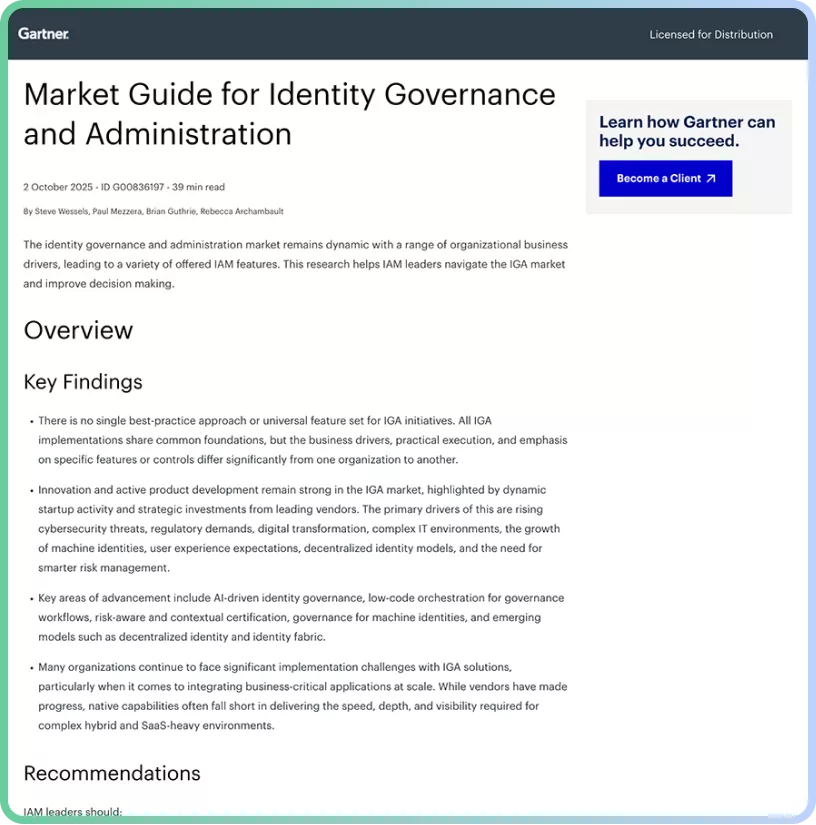
IGA in 2026, a Gartner® Report: Check out the findings
The report states: “Gartner defines identity governance and administration (IGA) as solutions that oversee the identity life cycle, facilitate access provisioning, and manage access rights across on-premises and cloud environments for workforces and workloads” While we believe this definition has not changed much over the years, the operating environment around it has transformed dramatically.
AI is changing the scale and operating model of identity governance. With rapid AI adoption, organizations need to manage not only employee access but also a rapidly expanding population of service accounts, workloads, bots, integrations, and AI agents. Many of these identities can execute business processes at machine speed with little or no direct human involvement.
According to Gartner, “In 2026, the growing complexity and scale of AI is driving cybersecurity leaders to rethink identity governance strategies.”
The pressure comes from more than identity volume. Each new identity can introduce permissions, policy decisions, and activity that must be traced to a legitimate business purpose. The scope of identity governance and administration is therefore expanding: security teams need to know who or what has access, whether that access is appropriate, how it is being used, and whether the organization can prove that its controls worked.
Gartner explains: “In 2026, IGA is evolving from legacy, quarterly cycles of manual access reviews to an autonomous, continuous, and outcome-driven process that encompasses both access certification and provisioning. Enterprises must now manage an exponentially increased number of identities, including workforce users and workloads, while defending against sophisticated cyberattacks that exploit misconfigurations, orphaned privileged accounts, and weak credentials. These challenges are further intensified by regulatory pressures and the need for seamless integration with other cybersecurity disciplines, such as privileged access management (PAM).”
Against this backdrop, in our opinion the Market Guide report’s key findings identify three conditions that can hold IGA programs back as the market evolves. Together, they show where organizations need to focus as identity governance and administration moves toward a more automated, unified, and continuous operating model. Notably, the Gartner Market Guide highlights market shifts that we believe have long aligned with Pathlock’s strategy.
Finding #1: AI-Driven Automation Must Preserve Accountability
Gartner: Failure to implement AI-driven automation results in persistent manual processes, which are prone to human error and inefficiency. AI-driven automation has fundamentally transformed IGA, reducing manual intervention by offering AI-assisted options to close the skills gap, minimizing privilege creep, and enhancing continuous audit readiness. The adoption of cloud-native IGA solutions further amplifies these benefits, offering scalability, cost efficiency, and rapid integration.
Pathlock’s Perspective: Automation Needs an Accountable Owner
AI can help IGA programs analyze access data, build workflows, and recommend remediation for potential violations, saving time on manual reviews and boosting efficiency. However, automation needs clear accountability. A recommendation to retain or revoke access should be tied to policy, risk, and evidence. A service account or AI agent may perform the work, but a business owner must remain accountable for its purpose, permissions, and execution. Ownership gives the organization a person who can approve access, take responsibility for exceptions, and confirm that the identity is still required.
Pathlock Nexus allows organizations to realize the benefits of AI-driven identity governance while preserving accountability:
- Identity establishes who or what is allowed to act.
- Governance determines whether the access and resulting activity are appropriate.
- Assurance provides evidence that governance operated effectively.
AI can accelerate work across these layers while operating within defined policies, controlled data access, approval controls, and a complete audit trail.
Finding #2: Identity Fabric Alone Doesn’t Solve Application-Level Risk
Gartner: Siloed identity systems lead to fragmentation, increasing the risk of overprivileged accounts and operational inefficiencies. By adopting an identity fabric, organizations establish a unified architecture that empowers security teams with end-to-end privilege control, improved operational efficiency, and enhanced visibility. This integrated approach enables comprehensive monitoring, essential for zero-trust initiatives, and mitigates risks across the enterprise.
Pathlock’s Perspective: Correlation Isn’t the Same as Governance
While a unified identity fabric can reduce fragmentation, correlating accounts and entitlements addresses only part of the governance problem. Organizations also need to understand the work those entitlements enable inside critical applications.
This is especially important when managing risk, governance, and compliance (GRC) processes in ERP and other business-critical applications running finance, procurement, human resources, supply chain, and other key business functions. A permission that appears acceptable on its own may become risky when combined with another permission or used as part of a sensitive sequence of transactions.
Segregation of Duties (SoD) controls are designed to prevent one identity from holding enough access to complete a high-risk business process without independent oversight. In AI-enabled environments, however, SoD conflicts can span user access, AI agents, and other non-human identities, allowing individually permitted actions to be combined in ways that circumvent existing controls.
Pathlock Nexus addresses this with a transaction-first approach to Application Access Governance that starts with a business event, such as creating a vendor or releasing a payment, and traces the event back through the permission, technical role, business role, and identity that enabled it. Policy can then be applied to the full chain rather than to an isolated entitlement. As a result, Pathlock’s governance fabric connects identity governance, application controls, and assurance across these processes. It also supports end-to-end visibility where a process spans several applications. That broader view helps security teams evaluate access holistically.
Finding #3: Manual Compliance Creates Audit and Visibility Gaps
Gartner: Manual compliance processes are time-consuming and error-prone, leading to gaps in audit trails and misalignment with regulatory requirements. Organizations lack comprehensive visibility into their identity landscape, leaving shadow identities, orphaned accounts, and dormant credentials unmonitored. This creates blind spots that attackers can exploit, increasing the risk of credential misuse and privilege escalation.
Pathlock’s Perspective: Evidence Should Be Continuous, Not Reconstructed
Manual compliance processes force teams to assemble evidence after the fact, often from multiple tools. This slows audits and increases the risk of oversight.
Continuous Controls Monitoring reduces these gaps by collecting and connecting evidence as access decisions and high-risk actions occur. Each event can be linked to the identity, policy, approval, and audit trail behind it, giving security and compliance teams more current visibility.
Pathlock Nexus extends this model into critical business applications by connecting entitlements with actual usage and transactions. Teams can identify unused or excessive access, validate Segregation of Duties and sensitive-access policies, and focus reviews on exceptions that carry real business risk.
Gartner recommendations for security and risk leaders
- Prioritize the adoption of AI-enabled IGA platforms to proactively manage identity risks, streamline compliance, and support scalable operations. This strategic investment will not only strengthen security posture by minimizing vulnerabilities such as orphaned accounts and privilege creep but also ensure audit readiness and regulatory compliance.
- Accelerate your organizational integration strategy to focus on a unified identity fabric to achieve zero-trust security objectives. This strategy will reduce operational complexity, lower technical debt, and provide holistic visibility into all IAM activities, thereby strengthening risk mitigation and enabling faster detection and response to privileged account threats.
- Invest in advanced IGA platforms that offer automated, regulation-specific reporting and continuous risk assessment capabilities, aligned to compliance mandates. This approach will ensure sustained audit readiness, enable rapid adaptation to regulatory changes, and provide a defensible compliance posture, reducing the risk of penalties and reputational damage in an increasingly complex regulatory environment.
Practical Guidance for IGA Modernization From Pathlock
These steps map directly to how Pathlock customers operationalize IGA modernization across real-world identity governance use cases:
- Create an inventory of workforce identities, workloads, service accounts, bots, integrations, and AI agents, and assign an accountable owner to each non-human identity.
- Connect identity sources with the applications where these entities obtain access and perform business activity.
- Use AI-assisted workflows to reduce repetitive administration while preserving auditability.
- Add entitlement-level usage and transaction context to the access certification process.
- Evaluate least privilege from both directions: validate access against policy and validate roles against the work users and machines actually perform.
- Bring IGA, PAM, application controls, and continuous assurance into a coordinated governance model rather than operating them as separate compliance exercises.
We feel the 2026 Gartner Market Guide describes an IGA market moving toward autonomous, continuous, and outcome-driven governance. Achieving that outcome requires more than processing access decisions faster. Organizations need to connect identities and permissions with application activity, business processes, and control evidence.
Pathlock Nexus is built around that connection. By bringing identity, governance, and assurance together for ERP and other business-critical applications, Pathlock helps organizations govern human and non-human identities, apply business context to access decisions, and continuously verify how access is used.
| Get the full 2026 Gartner® Market Guide for Identity Governance and Administration This article covers three of the report’s key findings. Read the complete report for the full Gartner analysis and recommendations for security and risk leaders. → Download the 2026 Gartner® Market Guide for IGA → See how Pathlock Nexus governs AI-era identity |
Read the full 2026 Gartner® Market Guide for Identity Governance and Administration to explore the market findings and recommendations in detail.
Source and Gartner Disclaimer
Source: Gartner, Market Guide for Identity Governance and Administration, Rebecca Archambault, Brian Guthrie, Paul Mezzera, Steve Wessels, 28 August 2026.
Gartner is a trademark of Gartner, Inc., and/or its affiliates.
Gartner does not endorse any company, vendor, product or service depicted in its publications, and does not advise technology users to select only those vendors with the highest ratings or other designation. Gartner publications consist of the opinions of Gartner’s business and technology insights organization and should not be construed as statements of fact. Gartner disclaims all warranties, expressed or implied, with respect to this publication, including any warranties of merchantability or fitness for a particular purpose.