
Risk is inevitable. It lurks in every decision like a shadow at high noon; invisible to the eye, yet always present. Uncertainties like rapid market shifts, cyber threats, regulatory changes, and natural disasters are more common than we might think. Yet risk does not have to be destructive. Organizations that take a proactive stance can spot warning signs early, adapt their strategies, steer through uncertainty, and turn potential threats into opportunities for growth and innovation.
Defining Enterprise Risk Management (ERM)
To navigate uncertainty, instinct is not enough. Organizations need a well-designed framework to understand and manage risk. That is where Enterprise Risk Management (ERM) comes in.
ERM is a systematic approach that enables organizations to identify, assess, manage, and monitor risks across all departments and functions. It is not a single process or a checklist. It is a mindset and a way of thinking that guides everyone in the organization in making decisions while considering the associated risks and opportunities.
Organizations can reap measurable benefits by implementing ERM. Studies show that an effective ERM program can reduce the frequency of risk events by as much as 63% and lower operational losses by up to 35%. These numbers represent fewer disruptions, stronger performance, and informed decision-making.
The Role of ERM Tools: Breathing Life into ERM
ERM tools, also known as risk mitigation software, turn risk management theory into practice. They provide the structure, processes, workflows, and analytics that empower organizations to manage risks. More importantly, they turn scattered data into meaningful insights, helping teams respond quickly and smartly to challenges.
ERM tools are essential to a company’s risk strategy. They collect and analyze risk data from across the organization to deliver insights and predict potential risks. This helps in proactive decision-making and enables businesses to stay resilient in a volatile world.
Key Features of Effective Enterprise Risk Mitigation Tools
Here are some key features of effective ERM tools.
Risk Identification and Assessment Capabilities
The first step to managing risk is knowing what you have to deal with. ERM tools make this easier by providing a centralized risk repository, where organizations can record every potential threat and issue in one place. These tools come with a simple, intuitive interface, so that even first-line employees can quickly report observations, incidents, and early warning signals.
Once captured, risk teams can analyze this data using built-in features like risk questionnaires, heat maps, and automated risk correlation. This streamlines communication between departments and gives leadership a holistic view of the organization’s risk posture.
Scenario Analysis and Risk Quantification
Risk management is about preparing for what might happen next. ERM tools allow organizations to simulate “what-if” scenarios, which sketch a picture of how unexpected situations can impact operations and how to prepare for them. By testing these scenarios, companies can identify control gaps, refine response strategies, and allocate resources based on priority.
Advanced ERM platforms support quantitative modelling, such as Monte Carlo simulations, to systematically analyze uncertainty. These simulations transform broad estimates into probability distributions that show the likelihood of different outcomes and potential risk exposure. This enables decision-makers to make wiser investment choices and chalk out potential recovery paths before a crisis occurs.
Automated Reporting and Analytics
Gone are the days when teams manually compiled risk reports from spreadsheets. Today’s ERM tools automate this process. They can turn risk data into interactive dashboards that are easy to interpret and share across teams. Users can create custom reports on demand, track performance metrics in real time, and visualize trends through graphics. Many platforms now include AI-powered analytics, which enhance the accuracy of risk assessment and identify patterns or correlations in massive datasets that might otherwise go unnoticed. This automation saves time while strengthening the organization’s ability to detect risks early and act swiftly.
Integration with Strategic Planning Processes
ERM tools help to integrate risk management into business strategy. They provide dashboards, analytics, and reports with risk data and its correlation to business strategy. Leaders can visualize how specific risks can affect key business objectives, from revenue targets to supply chain performance.
Top Enterprise Risk Mitigation Tools in the Market
This section examines some leading ERM platforms that help organizations identify, assess, and mitigate risks. Each tool has distinct capabilities in risk assessment, compliance management, and vendor risk monitoring.
Pathlock Cloud
Pathlock Cloud is a comprehensive risk-management platform. It is a best fit for large organizations that operate across multiple applications and business systems. It provides real-time visibility into access, role, and application risks, quantifies exposures financially, automates control monitoring and remediation, and supports continuous compliance. Organizations can use Pathlock modules for identity governance, access analysis, and control monitoring to proactively manage risk.
Key Features of Pathlock Cloud
- Pathlock Cloud provides fine-grained access and identity governance across 100+ enterprise systems. It monitors user access, lifecycle changes, privileged accounts, and role/permission sprawl across ERP, CRM, and cloud applications.
- It features Dynamic Access Control and Dynamic Authorizations, which grant or restrict access in real-time with attribute-driven authorizations (such as time, device, location-based masking).
- Pathlock automates user access reviews and certification campaigns, user provisioning, and Joiner-Mover-Leaver (JML) processes with policy-based workflows. This helps organizations in managing user provisioning and de-provisioning.
- It provides Elevated Access Management (EAM), also known as “Firefighter” access, that grants time-bound, temporary privileged access for emergency scenarios and third-party contractors. The system maintains audit trails of all activities performed under elevated access and automates workflows with approval processes.
- It offers a library of pre-built controls, rulesets, and workflow templates. Organizations can customize these to meet industry-specific regulatory requirements.
- It offers risk quantification and scoring that delivers risk scores based on real-time behavior, analyzes conflicts in segregation-of-duties (SoD), and translates process risks into measurable financial exposure.
- It includes AI-powered User and Entity Behavior Analytics (UEBA) that analyzes user and entity behavior across business applications to detect anomalous activities and threats. It can also integrate with SIEM solutions to send alerts.
- Pathlock offers exception-based transaction monitoring that provides real-time visibility into user behavior around data access and usage. It can identify actual violations and notify business owners when exceptions occur.
- It includes continuous controls monitoring (CCM) that automates the sampling, testing, and monitoring of process controls and configuration changes. This helps organizations detect control failures, master data changes, and compliance drift. As a next step, the platform can also quantify financial exposure from violations and provide proactive remediation.
- Pathlock provides dynamic reporting and dashboards with executive-level insights, real-time visualizations, customizable reports, and audit-ready documentation.
- It integrates seamlessly with major cloud marketplaces and identity providers (like Microsoft Entra ID).
Following are demo of core features for Pathlock Cloud’s Enterprise Risk Mitigation.
User Access Review and Certifications
In demo below, you’ll see how Pathlock Cloud simplifies User Access Reviews (UAR) to streamline audit processes across critical applications.

Pathlock User Access Review and Certifications Demo
Learn how to:
- Launch user access certification campaigns
- Track risk scores in real time
- Perform access reviews via Excel uploads for non-integrated apps
- Drill into user, role, and access details Handle delegations, reassignments, and audit logs
- Pathlock Cloud helps you ensure proper access controls without waiting on integrations across SAP, Oracle, or other business systems,
Access Risk Analysis
Pathlock utilizes out-of-the-box, customizable rulesets to detect role conflicts, manage segregation of duties (SoD) across various business applications, and prioritize high-risk users and roles.

Pathlock Cloud Access Risk Analysis Demo
See the demo below for Pathlock’s Cloud’s User Access Analysis, we explore how Pathlock helps you with:
- Build customized dashboards to visualize risk effectively
- Leverage out-of-the-box content for rapid deployment and faster ROI
- Maintain a centralized view of risk across all applications
- Apply flexible risk mitigation approaches tailored to your needs
- Generate comprehensive audit reports with ease
Compliant Provisioning
Pathlock uses automated Joiner-Mover-Leaver (JML) processes for fine-grained user risk analysis before provisioning access.

Pathlock Cloud Compliant Provisioning Demo
In this demo, you’ll see how Pathlock:
- Simplifies access requests through an intuitive self-service portal
- Performs proactive risk analysis before granting privileges
- Supports flexible access changes with intelligent role recommendations
- Provides real-time tracking of requests and approvals for full transparency
- Orchestrates mitigation workflows to ensure secure, compliant provisioning
Elevated Access Management
Pathlock tracks and monitors privileged user sessions, automating elevated management through an automated workflow.

Pathlock Elevated Access Management Demo
In the demo, you’ll see how to:
- Request temporary elevated access as needed
- Approve or deny access with full context and clear risk indicators
- Automatically revoke privileges immediately when the session ends
- Monitor every action through detailed audit logs and change histories
- Maintain compliance with granular, session-level activity tracking
MetricStream
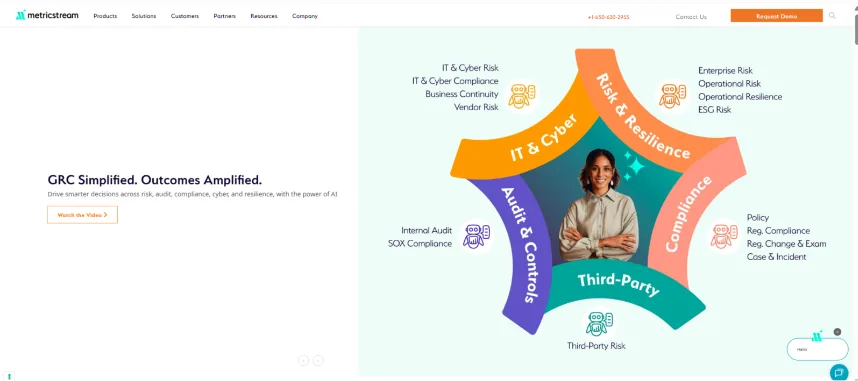
The MetricStream ERM solution provides a single platform that integrates many aspects of risk management. It is best suited for organizations that want to streamline risk processes, gain real-time insights into the risks they face, and optimize business performance with informed decision-making.
Key Features
- It offers a federated and centralized risk repository for cross-organization collaboration. You can define business objectives, processes, products, assets, risks, and controls, and establish relationships among them. This ensures consistency and transparency.
- It includes advanced risk assessment and analysis tools. Audit teams can schedule and perform regular risk assessments and multi-dimensional assessments weighted across objective, product, process, hierarchy, etc.
- It provides control designs and assessments that align with industry standards. Organizations can define controls based on frameworks like COSO / COBIT, design control test plans, utilise questionnaires/surveys, and more.
- It enables monitoring of key metrics. You can track KRIs (Key Risk Indicators), KCIs (Key Control Indicators), and KPIs (Key Performance Indicators), set thresholds, and send notifications in case an incident occurs.
- It incorporates AI/ML technology to enhance risk and compliance operations, with capabilities for issue management, classification, and tracking remediation efforts. MetricStream’s AI roadmap includes generative AI for GRC content creation and automated risk assessment.
- It offers a 360° view of risk and trends via executive dashboards, graphical charts, and reports that deliver real-time insights.
- It features design-and-configure tools and APIs that enable extensibility and integration with third-party systems.
UpGuard
UpGuard offers a modern, all-in-one solution designed to monitor, assess, and reduce third-party risks. Whether you are onboarding a new supplier or tracking the performance of an existing contractor, UpGuard helps to streamline workflows and turn risk signals into smart decisions.
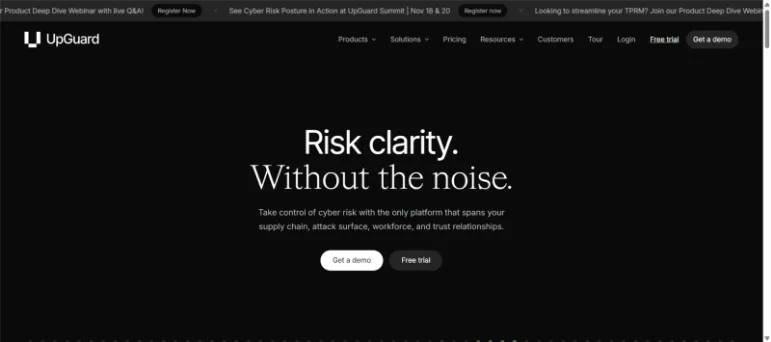
Key Features
- It provides automated attack-surface scanning and security rating, covering network security, email security, brand & reputation, website security, etc.
- It has AI-powered security questionnaires and autofill workflows to speed up vendor due diligence.
- It provides continuous monitoring so that emerging risks are detected between scheduled reviews.
- It offers automated workflows to assign, track, and verify remediation actions with vendors. This bridges the gap between identifying and fixing risks.
- Organizations can adjust certain aspects of weighting or scoring criteria to match internal policies and risk thresholds.
- It offers a centralized dashboard for vendor risk profiling, evidence gathering, remediation tracking, and reporting.
- It includes a reporting library and customized insights for different stakeholder levels, plus managed-service options for outsourcing risk-related operations.
- It helps map vendor controls against major frameworks, such as ISO 27001, SOC 2, NIST, and GDPR.
- It integrates with major workflow and ticketing systems (like ServiceNow, Jira, Slack), which allows risk data to flow smoothly into other systems.
Diligent
The Diligent ERM solution is built to align leadership with the full spectrum of risks confronting the organization. It helps turn risk into actionable insights, enables data-driven decisions, and cultivates a comprehensive understanding of risk.
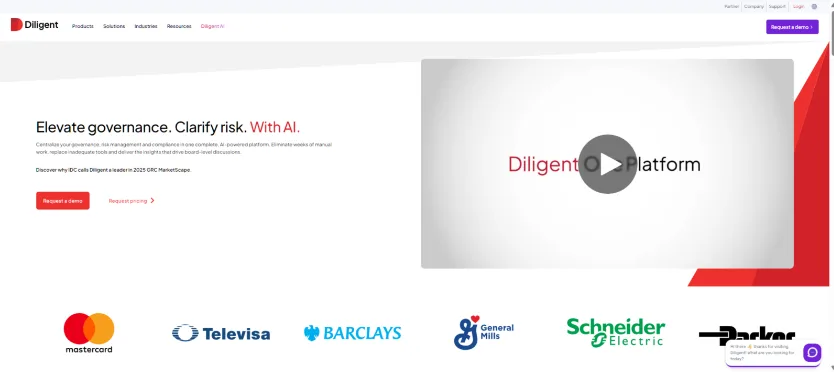
Key Features
- It centralizes risk data for a unified risk viewpoint across teams, fostering collaboration and providing real-time visibility into top risks, trends, and risk appetite.
- It leverages automated risk monitoring with advanced analytics and AI-powered capabilities to identify patterns, detect anomalies, and provide early warning of potential risks.
- It offers automated risk assessments with configurable scoring and evaluation criteria. The platform can schedule recurring assessments, automatically distribute questionnaires to stakeholders, and compile results in real-time for faster decision-making.
- It provides interactive risk heatmaps, risk-appetite frameworks, and workflows that align risk exposure with business objectives.
- It includes reporting capabilities that can connect risk programs with governance for the board and the executives.
- It also supports regulatory compliance. With built-in frameworks, controls, and workflows, organizations can ensure that their controls and processes align with industry standards and regulations.
ServiceNowGRC
The ServiceNow platform simplifies complex risk assessments and boosts the organization’s decision-making capacity. It centralizes data communication by facilitating teams to share risk data through chat, web portals, and mobile apps. Overall, it optimizes risk management and strengthens operations.
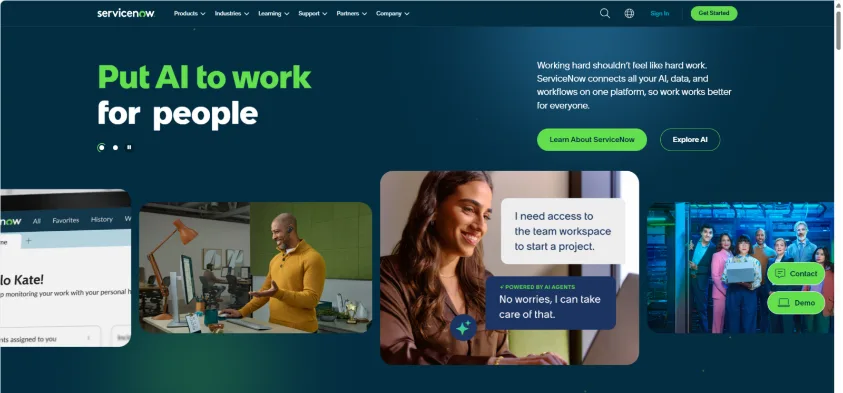
Key Features
- It provides a single platform for identifying, assessing, responding to, and continuously monitoring enterprise and IT risks.
- It offers flexible self-assessment design and scheduling based on maturity levels, supports both qualitative and quantitative risk scoring, and maintains control accuracy as the organization grows. Workflows connect risk owners and response teams, with access available through portals and mobile apps.
- It enables innovative issue management powered by AI and machine learning. Automated risk assignment, grouping, and remediation suggestions reduce manual workload and improve response time.
- It includes a comprehensive risk statement library that standardizes ratings and reporting through a common risk taxonomy. This promotes consistency across the organization.
- It uses interactive dashboards and advanced analytics to give executives visibility into high-impact risks and the organiation’s risk posture.
- It is built as part of the broader ServiceNow family, connecting business, security, and IT into a shared data model.
OneTrust
The OneTrust platform specializes in compliance and vendor risk management, data privacy regulations, and third-party relationships. It has earned its reputation as a robust cloud-based GRC platform that offers customizable functionalities for your risk management needs.
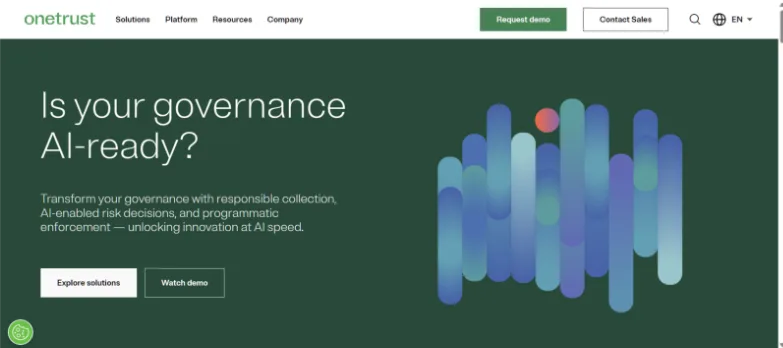
Key Features
- It offers an integrated GRC and security module. Using it, organizations can efficiently scale their risk and security functions and align risk assessment with mitigation efforts.
- It connects data, privacy, and risk teams in one system, enabling organizations to stay ahead of regulatory change.
- It includes a third-party risk management application that enables organizations to manage risks associated with third-party relationships. Features include a centralized vendor inventory, automated vendor assessments, continuous monitoring of third-party performance, and built-in workflows and controls.
- It supports several risk, privacy, and security frameworks (including ISO 27001, NIST), and automates their implementation. For example, OneTrust provides 50+ pre-built frameworks, automates evidence gathering, and helps align risk/security policies and controls with industry standards.
- It links risk monitoring with incident response workflows. For example, OneTrust’s incident and breach response module enables organizations to manage incidents centrally, automate notifications, and use regulatory intelligence in risk workflows.
LogicGate
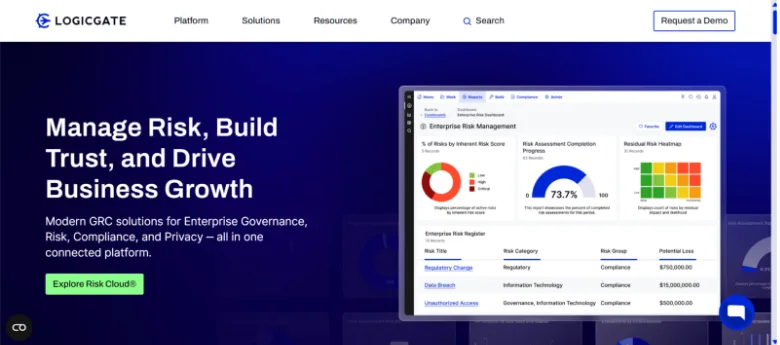
The LogicGate ERM solution is a highly adaptable, modern ERM platform built with a focus on flexibility, ease of customization, and optimized ERM processes. It is best suited for organizations that want to streamline their ERM processes without dealing with complex technical requirements.
Key Features
- It includes quick start features like pre-configured risk scoring and built-in guidance for assessing inherent and residual risk ratings. With these features, risk assessments tend to be more accurate.
- It provides a centralized platform to document and track risks, with templates for risk controls and policies. This helps organizations align risk management with industry standards and regulations.
- It is built on a no-code graph database that enables dynamic connections between risks, controls, business units, and process owners.
- Its advanced risk quantification (for instance, Monte Carlo simulations) provides financial context to risk decisions. This gives leadership a good understanding of risk impacts in tangible financial terms.
- It automates workflows, provides real-time risk insights, and streamlines compliance.
SecurityScorecard
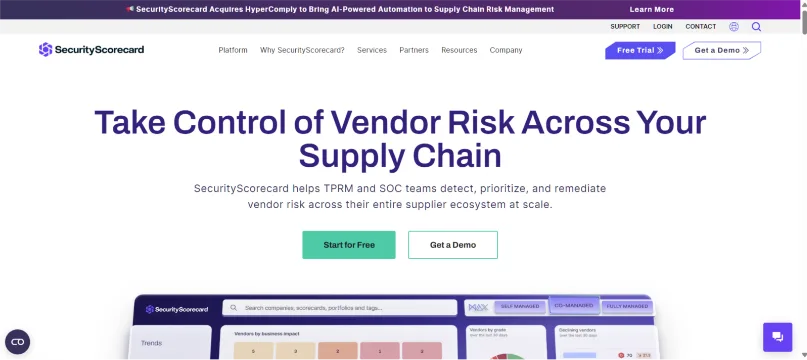
SecurityScorecard is a cybersecurity-ratings and vendor intelligence platform that provides organizations with insight into the external security posture of their third-party vendors and internal assets. It aggregates data from multiple sources to generate vendor security ratings. It also offers dashboards and reporting tools for monitoring risk, prioritizing remediation tasks, and providing executive-level visibility.
Key Features
- It generates vendor and enterprise security ratings based on factors like DNS, SSL, endpoint security, and patching cadence.
- It provides external attack-surface monitoring, including detection of vulnerabilities, open ports, exposed assets, and credential leaks.
- It enables direct collaboration between vendors and assessors. Vendors can view their scores, dispute findings, and submit remediation evidence within the platform.
- It provides the potential outcome of remediation efforts and board-level summary reporting to guide vendor risk actions.
- It includes API and integration support for feeding scores and risk data into other systems (SIEM, GRC, vendor-risk workflows).
- It aligns assessments with frameworks such as NIST, ISO 27001, GDPR, and SOC 2. This enables organizations to map vendor risks to compliance requirements.
Bitsight
Bitsight’s external-facing risk platform provides security ratings, compliance tracking, and attack surface monitoring, giving organizations visibility into third-party and internal cyber risk. It empowers teams to assess vendor exposure, track performance over time, and get executive-level insights for decision-making.
Key Features
- It automatically identifies risks by tracking compliance gaps against frameworks such as NIS 2 and SOC 2.
- It provides security ratings that assess third-party (and internal) entities for breach likelihood and ransomware risk, with industry peer benchmarking to validate performance against similar companies.
- It has built-in workflow support for a full third-party risk management lifecycle, from onboarding through continuous oversight and executive reporting.
- It monitors exposure across cloud, geography, subsidiaries, and remote workforce via external attack surface management.
- It enables process automation and integration with GRC and vendor-risk systems, such as ServiceNow, Archer, and ProcessUnity.
- It tracks changes in vendor security ratings and automatically alerts users to new vulnerabilities or incidents.
Prevalent
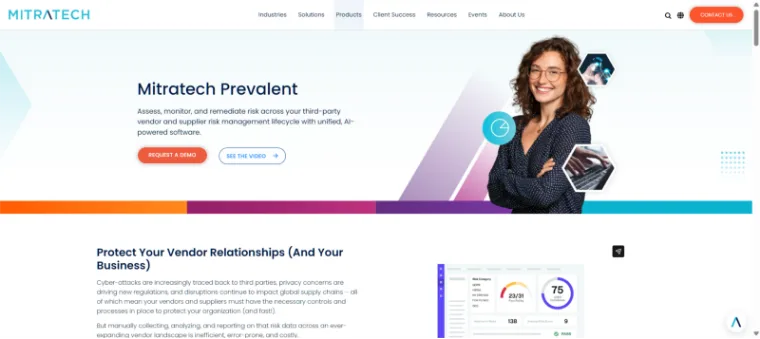
The Prevalent platform supports the full vendor lifecycle, from onboarding through offboarding. It provides AI-assisted automated assessments, continuous monitoring, threat intelligence feeds, and remediation workflows. These features give visibility and control over vendor-related risks.
Key Features
- It provides automated vendor risk assessments with an extensive library of templates and AI-enabled auto-population from uploaded data.
- It offers continuous monitoring of third-party risks, including cyber, business, reputational, ESG, and financial exposures.
- It has vendor lifecycle management workflows that cover onboarding, contract management, off-boarding, and remediation tracking.
- It offers real-time analytics, executive reporting, and dashboards that support decision-making.
- It includes integration and automation capabilities, such as workflows tied to vendor assessments, questionnaires, and issue remediation.
- It supports the mapping of vendor assessments and controls applicable to regulatory and industry frameworks, like ISO 27001, NIST, GDPR, and SOC 2.
Panorays
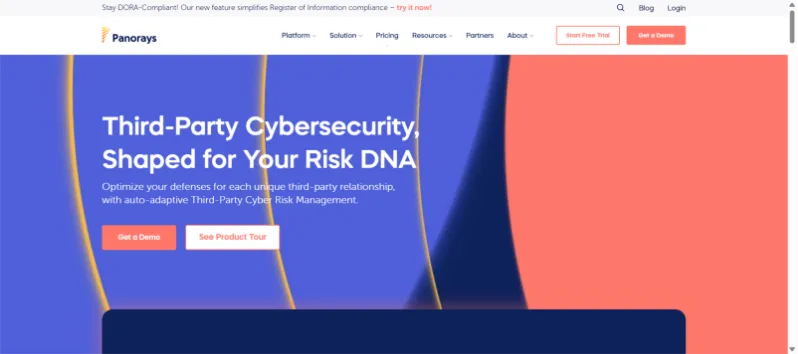
Panorays focuses on providing clarity and efficiency across the third-party lifecycle. It offers a unified security rating system combined with automated questionnaire workflows. Its strength lies in its streamlined assessments and clear reporting.
Key Features
- It provides security ratings that consolidate external scan data and vendor assessments into a vendor-risk score.
- It offers automated questionnaire workflows with pre-built templates and customizable questions for vendor assessments.
- It includes external attack-surface monitoring and vendor risk detection to expose third-party weaknesses and hidden dependencies.
- It includes vendor lifecycle management, including onboarding, continuous evaluation, and off-boarding workflows.
- Integrations and APIs enable organizations to connect it with platforms like ServiceNow and RSA Archer.
- It supports compliance mapping to standards such as GDPR, ISO 27001, and NIST.
RiskRecon
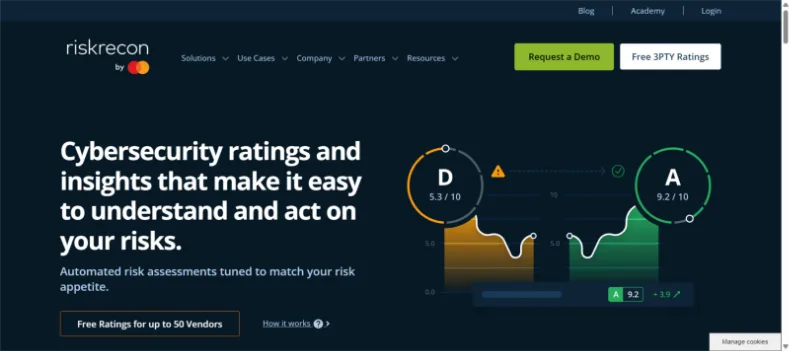
RiskRecon (now part of Mastercard Incorporated) specializes in external security monitoring and asset attribution. Its main strength lies in identifying and prioritizing third-party cyber risks through external attack surface analytics.
Key Features
- It provides external attack surface monitoring and asset attribution, giving detailed visibility into vendor infrastructure, cloud assets, and exposures.
- It continuously scans vendors’ public-facing systems and sends alerts when new vulnerabilities or exposures appear.
- It offers a security-rating service that assigns grades or scores to third parties. This is useful in sorting the vendors and assets that need attention.
- It prioritizes vulnerabilities by asset value, so that organizations can take care of critical assets or systems first.
- It offers API and integration support for exporting scan findings and connecting to GRC/ticketing systems.
- It helps visualize fourth-party risks (i.e., vendor’s vendors).
ProcessUnity (formerly CyberGRX)
ProcessUnity streamlines the full vendor risk lifecycle through configurable workflows, continuous monitoring of vendor exposures, and integration capabilities. It combines questionnaire exchange, vendor scoring, and automated assessments to furnish a clearer, more timely view of third-party risk.
Key Features
- Its vendor risk assessment exchange feature lets companies share already completed security questionnaires. This speeds up vendor reviews and risk checks.
- It provides continuous monitoring of vendor risk exposures through real-time threat intelligence and vulnerability tracking.
- It features a bi-directional API and integration with ticketing, SOC, and GRC systems to automate TPRM data flows.
- It enables dynamic risk scoring and risk management through configurable frameworks. This lets organizations adjust vendor risk profiles based on business context.
- It provides user-friendly dashboards and analytics for risk reporting, vendor segmentation, and high-impact vendor relationships.
- It includes built-in frameworks that map vendor assessments to regulations and standards, such as ISO 27001, GDPR, NIST, and SOC 2.
Vanta
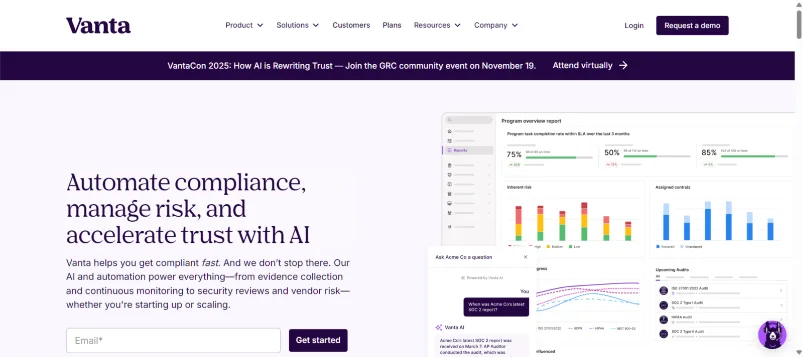
Vanta is a trust management and compliance automation platform that enables organizations to streamline vendor and internal compliance workflows. Although its external attack-surface monitoring is limited compared to some complete TPRM tools, Vanta is suitable for organizations that want to simplify compliance and vendor onboarding.
Key Features
- It automates compliance workflows across 35+ frameworks (such as SOC 2, ISO 27001, GDPR) and consolidates vendor compliance into a unified dashboard.
- It offers AI-driven evidence collection and questionnaire automation for vendor assessments and compliance tasks.
- It provides vendor discovery capabilities that can uncover and onboard third and fourth-party relationships.
- It includes API and integrations with dozens of third-party services to pull data automatically.
Drata
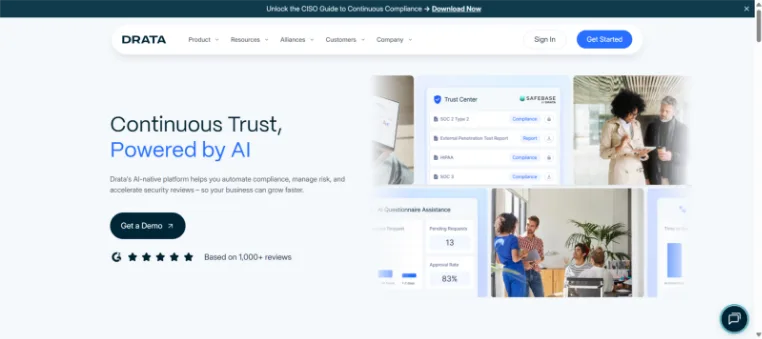
Drata brings together internal and vendor risk into a single platform, providing organizations with a holistic view of both. It emphasizes real-time visibility, automation, and AI to manage vendor assessments, risk tracking, and compliance workflows.
Key Features
- It automates vendor directory and onboarding (bulk upload, SSO integration) to simplify vendor management.
- It provides an automated vendor impact assessment that evaluates a vendor’s data access, environment access, and operational impact to suggest risk levels.
- It includes a centralized risk register that links vendor risks to internal control workflows. This helps teams track issues and the progress of remediation.
- It automates evidence collection and audit readiness by gathering proof for controls and supporting compliance with standards (such as SOC 2).
- It automatically monitors changes in vendor security posture and compliance status. It alerts users if a vendor’s risk level increases or a control fails.
- It also provides configurable dashboards and reporting tools that give stakeholders a clear view of vendor risk status, remediation progress, and overall risk posture.
Black Kite
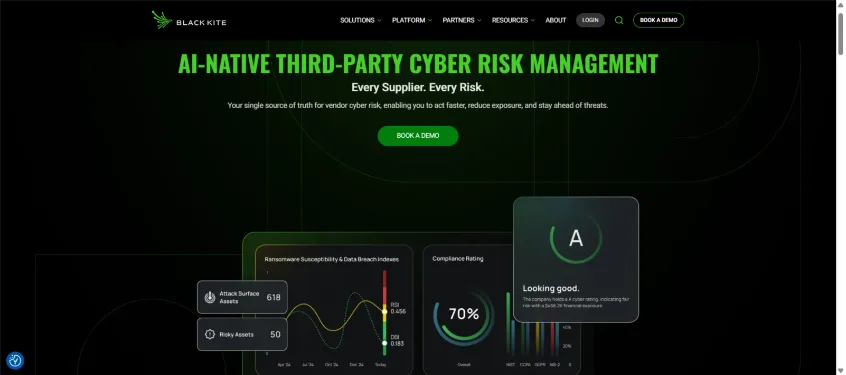
Black Kite is a third-party risk intelligence platform. Organizations can use it to monitor and understand risks across their vendor networks. It provides clear visibility into external threats using non-intrusive scans, financial impact analysis, and standardized risk scoring (Open FAIR). The platform identifies issues such as ransomware exposure and dark web activity, helping businesses spot problems early and take action.
Key Features
- It can assess vendor footprints through OSINT sources such as domains, subdomains, and certificates. This provides an external risk and attack-surface analysis to identify exposures.
- It provides quantified risk scoring using letter-grade systems and financial impact modeling frameworks like Open FAIR to rank vendor risk.
- It offers third-party and Nth-party visibility. This allows organizations to monitor direct vendors and their supply-chain relationships.
- It includes remediation workflows that let users assign risk tasks, track remediation progress, and engage with vendors from within the platform.
- It integrates with frameworks like NIST and ISO 27001, making audit reporting and compliance easier.
- It offers API and integration capabilities to connect with GRC, vendor-risk, and other enterprise systems for data sharing and workflows.
Whistic
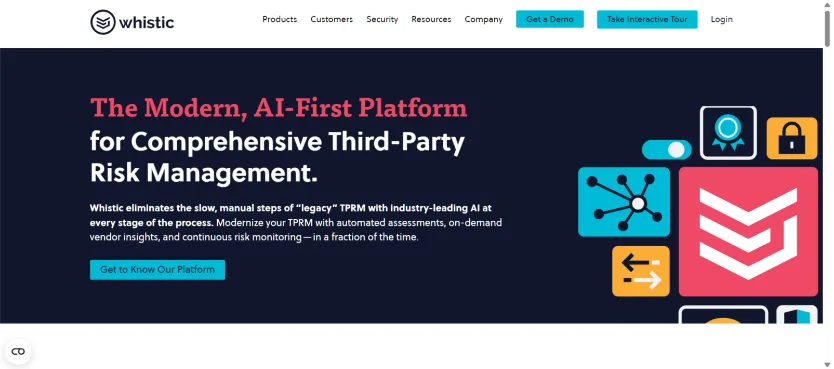
The Whistic platform focuses on vendor assessments, trust-center sharing, and AI-powered automation. It helps organizations to assess vendors quickly and share confidence with stakeholders more smoothly.
Key Features
- It provides continuous monitoring of vendor risk with updated insights.
- It has a vendor-exchange marketplace that provides pre-completed assessments and the reuse of questionnaires among companies.
- It includes a ‘Trust Center’ where companies can publish and share their security posture and related documents with vendors and partners.
- It offers AI-enabled tools (such as Assessment Copilot) to summarise audit reports, auto-fill responses, and speed up review cycles.
- It includes workflows that facilitate teams to collaborate on third-party risks.
Criteria for Evaluating ERM Tools
To select an ERM tool for your organization, do not just look at the feature lists. Consider your organization’s goals, structure, and maturity level; then choose a solution that aligns with your specific needs. In general, the best ERM tools are those that identify and track risks, enable better decision-making, improve workflows, and deliver measurable business value. Here are some perimeters to help you determine whether an ERM solution is effective.
Ease of Use
An effective ERM tool should be intuitive and easy to navigate. It should have a clean, user-friendly interface that encourages employees to use it rather than get lost in its complexities. When users find it easy to enter, access, and act on risk data, it drives higher adoption across the organization. This improves data accuracy and consistency, leading to better insights and faster response to risks.
Return on Investment (ROI)
While cost is an important consideration, the real value of an ERM tool lies in its long-term return. Organizations should consider benefits such as reduced financial losses from risk events, lower insurance premiums, enhanced operational efficiency, and stronger compliance posture. For some industries, ROI also includes avoiding regulatory penalties and improving investor confidence. All these factors contribute to a tool’s overall worth.
Functionality
Choose an ERM platform that aligns with your organization’s specific risk management needs and maturity. You should look for capabilities such as configurable risk assessments, centralized risk registers, incident tracking, and real-time reporting. It would be nicer to have a tool that offers flexibility (such as allowing customization without complex coding), so that you can scale it as your business grows and new risks emerge.
Integration Capabilities
ERM tools must not operate as standalone entities. They should be able to integrate with existing enterprise systems, such as ERP platforms, project management tools, and data analytics software, so that information flows freely and can be correlated for deeper insights. This also enhances visibility, reduces duplication of effort, and supports informed decision-making.
Benefits of Using an ERM Tool
ERM tools bring numerous benefits to an organization. They not only simplify risk management processes but also enhance visibility, insight, and resilience.
Improved Risk Visibility and Understanding
ERM tools bring clarity to the entangled web of organizational risks. By consolidating data across departments, they reveal hidden threats and even uncover opportunities that might otherwise go unnoticed. This helps leaders anticipate challenges and respond proactively, rather than being caught off guard.
Enhanced Decision-Making and Resource Allocation
When accurate, real-time data fuels decisions, they become stronger. ERM tools translate raw risk information into insights that can be mapped to business objectives. This level of clarity enables leaders to allocate resources wisely and prioritize high-impact areas.
Strengthened Resilience Against Uncertainties
A robust ERM platform can serve as an organization’s defense system against potential disruptions. Monitoring risks in real time and spotting early warning signs enables organizations to adapt when circumstances change. This nurtures a culture of preparedness that equips businesses to withstand uncertainty and thrive through it.
Regulatory Compliance and Governance Support
Organizations find it challenging to stay compliant with evolving regulations. ERM tools include provisions for embedding governance frameworks, automating controls, and generating audit-ready reporting. Organizations can leverage them to meet compliance requirements, which are imperative for establishing credibility and building stakeholder trust. It also paves the way for smoother operations and growth.
Addressing Common Challenges in ERM Implementation
Implementing an ERM program is not a straightforward journey. Organizations encounter numerous obstacles along the way. Overcoming these challenges is essential for successful implementation, seamless integration into business activities, and optimized performance.
Resistance to Change
Introducing ERM can disrupt established routines within an organization, as it requires new workflows, processes, and technologies. Employees hesitate to adopt unfamiliar tools and are initially unappreciative of their value. Overcoming this resistance starts with effective change management. Engage stakeholders early, train employees on the new system, and maintain open communication. When people see how ERM supports their goals, adoption becomes smoother.
Data Quality and Integrity
ERM systems rely on accurate, up-to-date data for well-founded risk assessments and insights. However, many organizations still work with messy data, such as incomplete or outdated records, inconsistent formats, and fragmented information stored in silos. To address these issues, organizations must establish robust governance practices, including defining ownership, standardizing inputs, and implementing validation checks. High-quality data leads to more precise risk analysis and better decision-making.
Siloed Thinking
One major hurdle to effective risk management is a narrow, departmental view of risk. When teams operate in isolation, they fail to visualize how local risks can affect the organization as a whole. To overcome this mindset, organizations should promote cross-functional collaboration by establishing risk committees with representatives from multiple departments and introducing information-sharing protocols. This helps teams to comprehend risks from a broader perspective.
Inefficient Risk Assessment Processes
Organizations should assess risks regularly and update their risk profiles to reflect emerging threats and shifting priorities. However, inconsistent and infrequent risk assessments can undermine your ERM framework. To avoid this, you must develop systematic, objective assessment methodologies that account for factors such as likelihood, impact, velocity, and interconnectivity.
Insufficient Reporting and Communication
Even the most advanced ERM system is only as effective as its communication. Stakeholders need timely, relevant information to make informed decisions. To ensure risk owners and executives are on the same page, organizations need robust reporting procedures supported by visual dashboards, scorecards, and concise summaries.
Gauging the Success of ERM Implementation
Organizations should regularly evaluate the outcomes of their ERM programs using measurable indicators and feedback, such as those discussed below.
Key Performance Indicators (KPIs)
KPIs provide tangible proof of how well an ERM program is performing. Metrics such as risk mitigation rates, incident response times, and compliance levels can help the organization measure the progress and effectiveness of its ERM initiatives and identify areas for improvement. They also highlight the ERM system’s value in reducing risk exposure and achieving operational stability.
Stakeholder Satisfaction
Stakeholder feedback is another way to gauge the success of your ERM program. When executives, department heads, and employees feel confident in how risks are identified, communicated, and addressed, the program is on track. You can use surveys, interviews, and feedback forms to measure satisfaction levels.
Adaptability
One strong indicator of a successful ERM framework is its ability to prepare an organization to adjust quickly to change and withstand uncertainty. You should monitor how well the company adapts to new risks, regulations, and market disruptions. If it can effectively pivot strategies, reallocate resources, and recover from unexpected challenges, consider it a sign of mature risk management.
Financial Performance Improvement
Ultimately, a well-executed ERM program should yield measurable financial gains. Organizations should be able to minimize losses through effective risk mitigation, reduce insurance premiums, and improve decision-making. Over time, this translates into greater profitability, operational efficiency, and investor confidence. These are clear signs that the ERM investment is paying off.
Trends Shaping the Future of ERM (2026 and Beyond)
Businesses evolve, and so does ERM. New technologies, emerging risks, and a drive for agility are transforming how organizations identify, assess, and respond to threats. The latest trends in ERM focus on prediction, adaptation, and innovation.
Enhanced Predictive Analytics
The next generation of ERM tools is built around predictive analytics. This means that these tools use data models and machine learning to predict potential risks and opportunities with remarkable accuracy. Instead of responding after an incident occurs, organizations can anticipate disruptions in advance. This denotes a shift from reactive risk management to proactive, data-driven mitigation.
Adoption of Cognitive, Cloud, and Other Innovative Technology
Modern ERM solutions now include artificial intelligence (AI) and Internet of Things (IoT) capabilities, cloud support, and third-party integrations. These are changing the way organizations manage risk. AI and IoT technologies provide real-time data and actionable insights. They also detect anomalies and predict trends as they develop. At the same time, cloud-based ERM platforms are becoming a core part of digital transformation, offering flexibility, scalability, and seamless integration with external systems. Together, these technologies create an intelligent and connected risk management framework.
Greater Emphasis on Interconnectedness of Risks
Risks do not exist in isolation. They are intertwined across departments, geographies, and industries. From cyber threats and geopolitical instability to environmental, social, and governance (ESG) risks, ERM programs are broadening their scope to include these risks. Advanced tools help organizations to map relationships between risks, assess their potential ripple effects, and design response strategies to manage them.
Continuous Improvement for Resilience
Risk management is a continuous, iterative process. Organizations should look for tools that support ongoing testing and monitoring of controls, automatic evidence collection, and regular performance reviews. These capabilities provide insights into gaps and areas for improvement, which further help fine-tune strategies. The result is stronger visibility, sharper foresight, and an agile organization that stays prepared for whatever lies ahead.
Third-Party Risk Management (TPRM) as a Critical ERM Component
While business affiliates, partnerships, contractors, suppliers, and service providers are essential to an organization’s functioning, they also introduce risks. Third-Party Risk Management (TPRM) has therefore become an extension of ERM. It helps organizations identify, assess, and mitigate risks that arise beyond their direct control.
Rising Importance of TPRM
Addressing third-party risks should be a key pillar of an organization’s risk strategies. Whether it is a supplier handling sensitive data or a contractor accessing internal systems, every organization stands exposed through its extended network. For this reason, global cybersecurity policies and regulatory requirements now emphasize TPRM as a core requirement.
TPRM vs. Vendor Risk Management (VRM)
TPRM and VRM are closely related, yet they differ in scope. TPRM encompasses a wide range of external relationships, such as business affiliates, contractors, suppliers, and strategic partners. It addresses the impact of these relationships on operations, compliance, and reputation. VRM, on the other hand, focuses mainly on vendors and their cybersecurity posture, particularly around regulatory and data protection requirements. In essence, VRM is a subset of TPRM.
Scope of Third-Party Risk Management
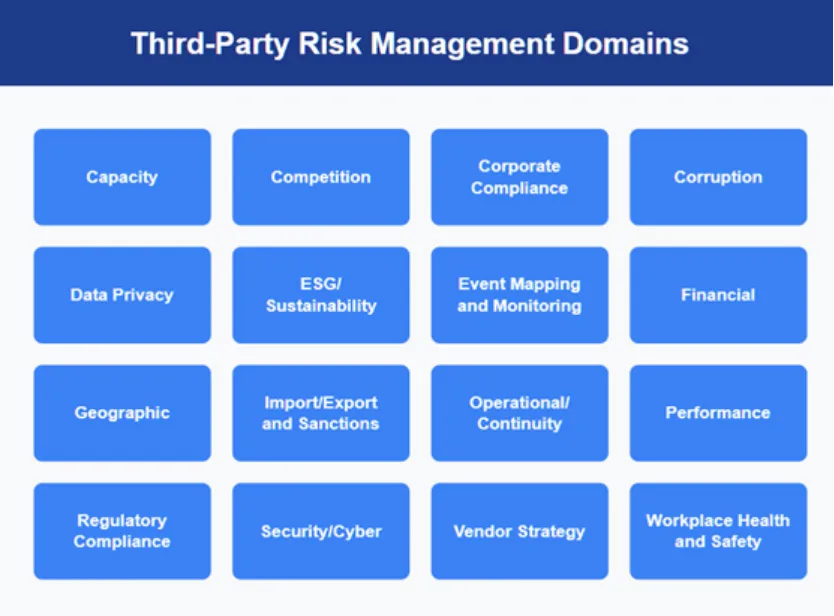
TPRM platforms vary in how comprehensively they assess risk. Some address up to 16 distinct third-party risks, from operational and financial to environmental and ethical factors. Other solutions are more industry-specific, i.e., they manage risks specific to an industry. For instance, supply chain management solutions may focus on 13 key risk factors, while IT- and legal/compliance-focused tools prioritize 10.
Features of Best TPRM Tools
The most effective TPRM platforms have the following features:
- Risk Identification: Detecting relevant third-party risks across categories such as compliance gaps, software vulnerabilities, and misaligned cyber frameworks.
- Risk Analysis: Evaluating the severity, likelihood, and remediation impact of identified risks.
- Risk Management: Workflows that cover the complete risk management lifecycle, from detection and assessment to mitigation and follow-up.
- Risk Monitoring: Continuously tracking the progress and outcome of remediation efforts, and staying alert to emerging third-party threats.
- Process Automation: Automating manual processes, like third-party risk assessments and third-party vendor questionnaires, to improve accuracy and efficiency.
Essential TPRM Software Metrics
When evaluating TPRM solutions, organizations should focus on the following:
- Ease of Use: A user-friendly TPRM platform with a straightforward, intuitive interface that simplifies onboarding and accelerates ROI.
- Customer Support: Reliable customer support that helps minimize downtime and ensures smooth operation.
- Risk Scoring Accuracy: Robust risk scoring models that reflect both inherent and residual third-party risks, allowing timely mitigation.
TPRM Software Solutions
Some leading TPRM tools in the market include UpGuard, SecurityScorecard, BitSight, OneTrust, Prevalent, Panorays, RiskRecon, ProcessUnity, Vanta, Drata, Black Kite, and Whistic. Each platform offers automation, analytics, and usability, but differs in how it handles identification, analysis, management, monitoring, and reporting. See the Top ERM Tools in the Market section for a detailed discussion of these solutions.
Building a Business Case for Investment in TPRM Software
Third-party relationships present both opportunity and risk. For organizations to adopt it, leadership must be convinced that the solution will yield measurable value, address stakeholder concerns, and alleviate pain points. To build a business case for investing in TPRM software, structure your argument around cost savings and compliance. Moreover, you should also address executive concerns, such as cost, implementation complexity, and vendor support.
Here are five steps to prepare a persuasive case for investing in TPRM software.
Analyze the Benefits of TPRM Software
To prepare a business case for investing in TPRM software, start by analyzing and listing the benefits and value it can bring to the organization. The specific benefits of TPRM software depend on the types of third-party vendors you work with and the nature of those relationships. For instance, if your main goal is to minimize third-party risk, consider features such as enhanced risk visibility and real-time monitoring. While features may vary across TPRM solutions, the following are some standard benefits they all provide:
- Enhanced Risk Visibility: Dashboards and reporting that provide a comprehensive view of vendor risk.
- Real-Time Monitoring and Alerts: Automated detection of security and compliance issues, with immediate alerts to draw attention.
- Better Compliance Management: Ensures compliance with frameworks like GRC, GDPR, and ESG. This reduces the risk of penalties and reputational harm.
- Centralized Data Management: Eliminates silos and simplifies the management of vendor data.
- Improved Efficiency: Automation saves time and resources previously spent on manually managing third-party relationships.
- Scalability: Easily accommodates more vendors and their data.
- Enhanced Decision-Making: Data analytics enable proactive actions based on informed decisions.
- Improved Vendor Performance: Supports better tracking of vendor performance and whether they adhere to SLAs.
- Flexibility and Adaptability: Empowers organizations to respond quickly to shifts in regulatory and risk landscapes.
Identify Organizational Pain Points the TPRM Software Can Solve
Every business has its own set of vulnerabilities. To strengthen your business case, link TPRM capabilities directly to those pain points, which could be:
- Manual, time-consuming, and repetitive processes, such as data collection and risk assessment. TPRM software can automate these tasks.
- Unorganized vendor data and fragmented systems. TPRM software can centralize this data, enabling consolidation and improved visibility.
- Difficulty in monitoring and assessing vendor risks in real time. TPRM software provides quick risk identification and management with continuous risk monitoring and assessment capabilities.
- Compliance and regulatory challenges. TPRM software can help ensure that third-party practices align with regulations.
- Insufficient reporting and analytics, leading to poor insights. With detailed reporting and analytics from TPRM software, organizations can gain insights into third-party risks.
- Lack of real-time, actionable insights. TPRM software provides real-time monitoring and alerts, enabling organizations to respond quickly to incidents.
This mapping of issues with solutions builds a strong case for investing in TPRM software.
Conduct a Cost-Benefit Analysis to Determine ROI
Your business case must also quantify both tangible and intangible benefits to stay credible. Perform a cost-benefit analysis to demonstrate how investment in a TPRM solution will be financially fruitful.
A cost-benefit analysis has the following phases:
- Costs: Identify and assess the cost of TPRM software, such as licensing, deployment, maintenance, and operational expenses.
- Benefits: Identify and assess the benefits of TPRM software, like risk reduction, increased efficiency, improved data security, stronger decision-making, better vendor management, and fewer compliance penalties.
- Calculate: Compare net present value (NPV) to return on investment (ROI) to assess financial feasibility. Positive indicators validate your business case.
Review Implementation Details and Ongoing Support
Every TPRM solution should be implemented through a Vendor Risk Management plan, with many providers also offering ongoing support. These factors are essential when making a business case for investment in TPRM software.
- The TPRM implementation process is different for different types of software. Developing a clear understanding of the process in advance can help you to assess feasibility, set timelines, plan resources, and manage potential disruptions during integration.
- Ongoing support and maintenance keep TPRM software effective, updated, and aligned with evolving risks, security standards, and regulations. Without them, the software can quickly become outdated.
It is important to assess the vendor’s support quality, regular updates, fixes, and technical support to ensure the TPRM software runs smoothly.
Compare TPRM Solutions on the Market
Finally, conduct a comparative evaluation of different TPRM solutions available on the market. Base your comparison on:
- Features
- Compatibility with existing systems
- Scalability
- User-friendliness
- Risk intelligence
- Vendor reputation
Examine real-world feedback and independent reviews to select a solution that meets your organization’s requirements.
Conclusion: Thriving in Uncertainty with Enterprise Risk Mitigation
Effective risk management is a continuous, iterative process that evolves as markets, technologies, and threats change. By using customized risk mitigation software that provides analytics, automation, and collaboration, businesses can adapt to new challenges and turn risks into strategic advantages. With updated, responsive ERM frameworks, organizations can achieve greater operational efficiency and identify new opportunities for growth and innovation.